
The Thin-Walled Reality
It is 2:47 AM. The city hums quietly fourteen floors below.
Your dog is a tight ball of serenity. Then a door slams three floors down.
They erupt—a sharp, piercing alarm that reverberates off the hardwood and through the paper-thin walls.
Within seconds, you are not just dealing with a barking dog apartment issue. You are dealing with the neighbor.
The rhythmic thumping on the ceiling. The passive-aggressive note slid under the door.
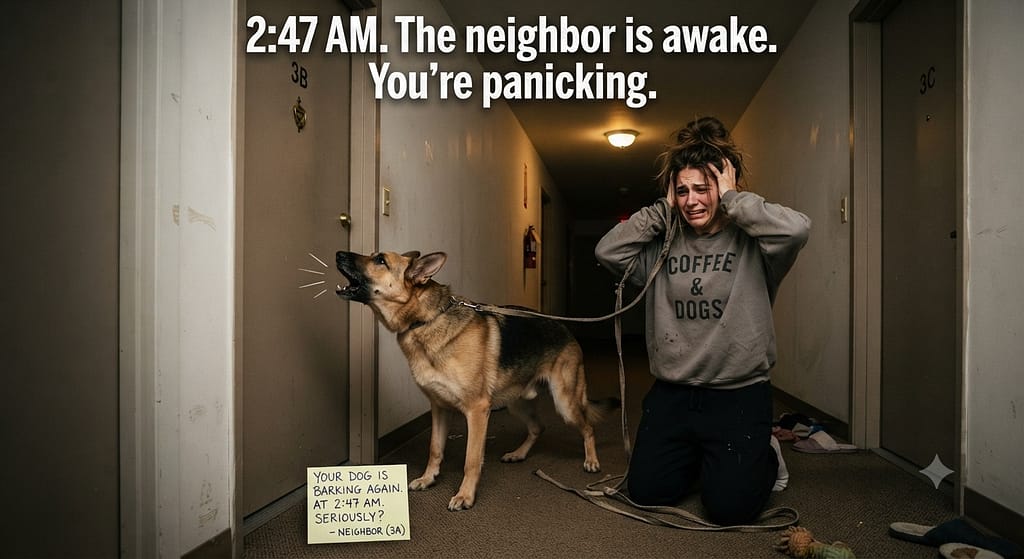
The cold knot of anxiety that makes you dread your own front door.
This is the urban canine crisis. It isn’t disobedience; it is a panic response to an unnatural acoustic environment.
In a suburban home, a dog barks at a squirrel; in a high-rise, they bark at the ghost sounds of hundreds of strangers living inches away.
This guide is your complete Barking Solution.
This guide is not about suppressing your dog’s voice.
It is about reprogramming their emotional response.
We will diagnose the root, drain the physical fuel, master the environment, and install a bulletproof “quiet” button.
Welcome to the Silence Protocol.

Section 1: The 4 D’s of Urban Silence – A Framework for Noise Management in Dogs
Before you can fix the problem, you need to understand the mechanics.
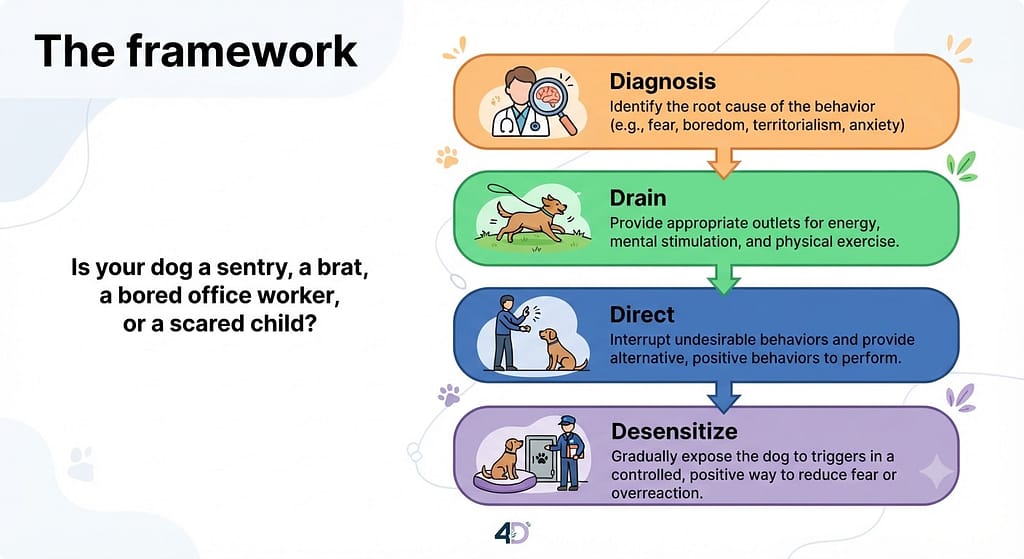
We operate on a simple diagnostic framework that isolates exactly why your dog is erupting.
We will identify barking triggers in dogs, categorize the distinct dog barking types, and establish clear dog training protocols that work within four walls.
1. Diagnosis (The “Why”)
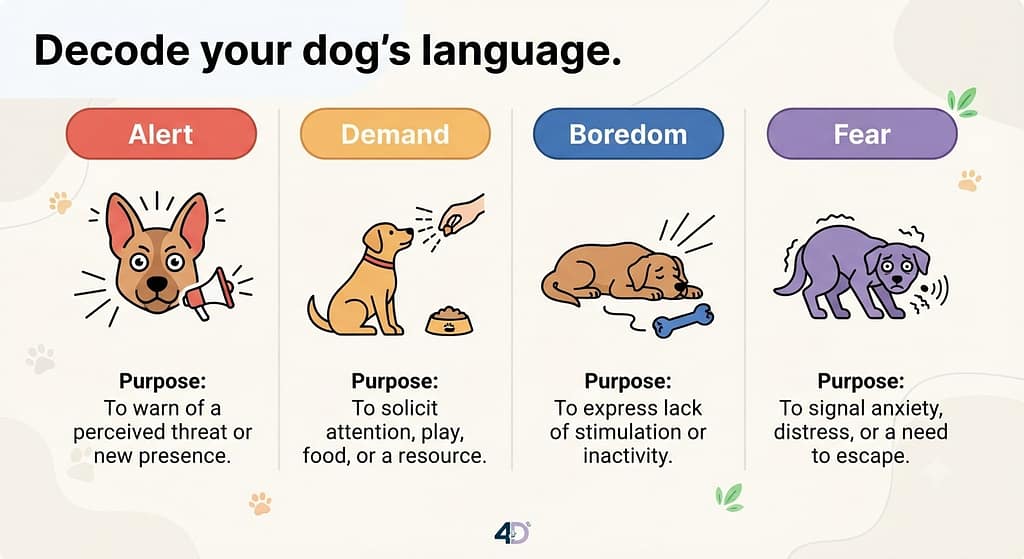
Is your dog a sentry, a brat, a bored office worker, or a scared child?
The trigger determines the cure.
- The Alert: “Intruder detected!” (Sharp, staccato bursts).
- The Demand: “Give me that cheese now!” (Repetitive, whiny, directed at you).
- The Boredom: “I am so under-stimulated I might combust.” (Monotonous, droning, lasts for hours).
- The Fear: “That garbage truck is going to eat me!” (Frantic, high-pitched, coupled with trembling).
For leash reactivity management, see our leash reactivity guide for busy sidewalks
2. Drain (The “Fuel”)
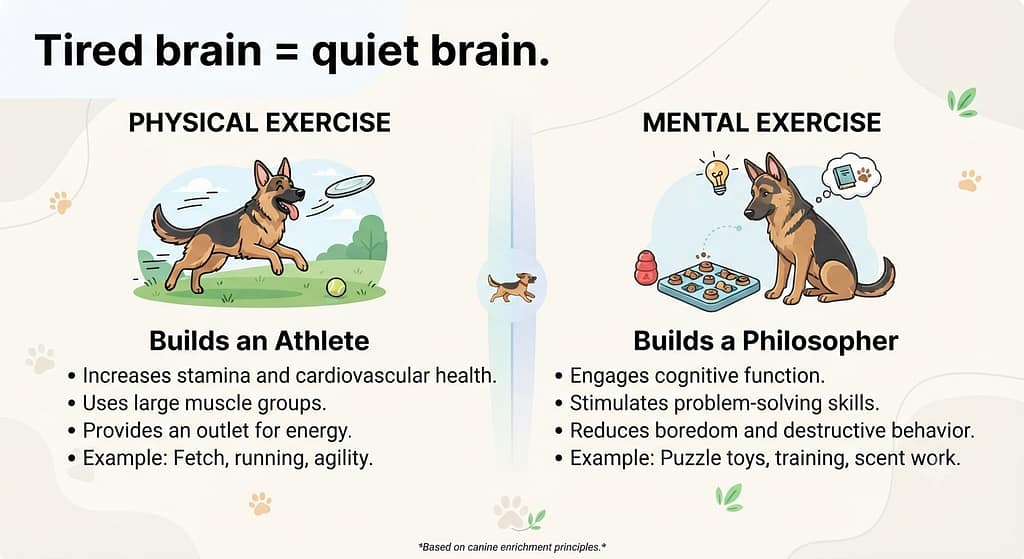
You cannot reason with a pent-up animal. A physically energetic dog has a hair-trigger nervous system.
We must drain the tank through mental exhaustion before we even attempt to teach silence.
3. Direct (The “Cue”)
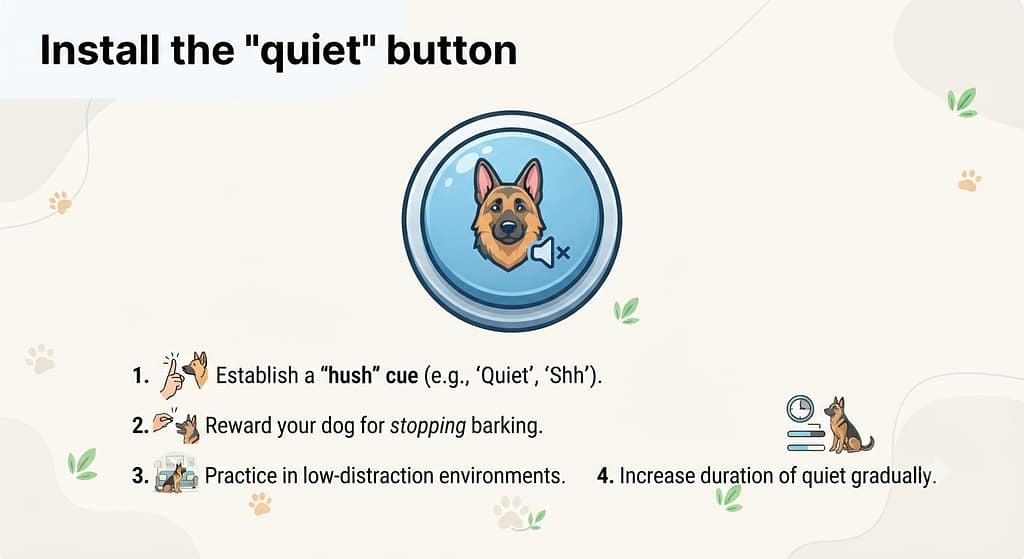
This is installing the “Quiet” command. It replaces the reflex to bark with the reflex to check in with you.
4. Desensitize (The “Rewrite”)
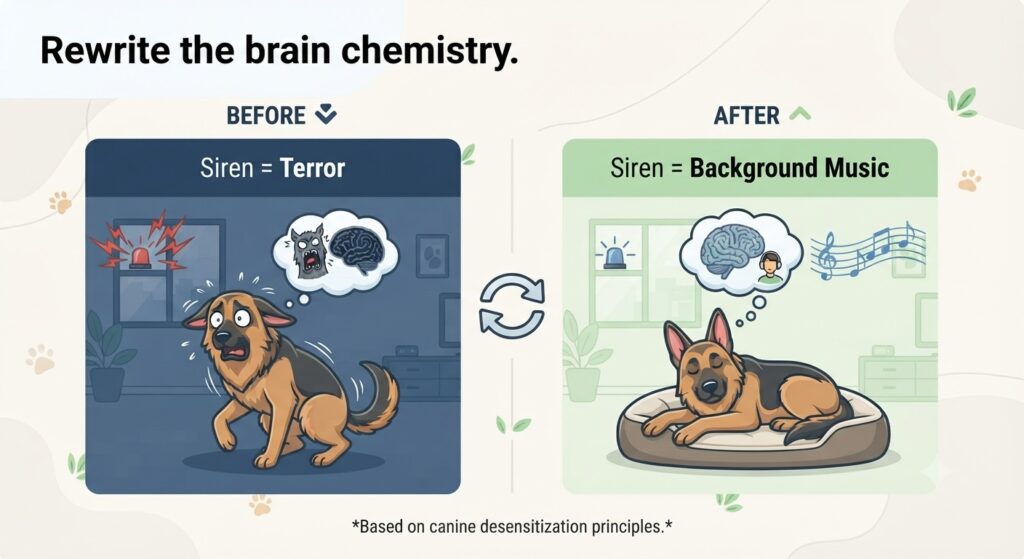
This is the long game. We fundamentally alter the dog’s brain chemistry regarding urban noise. The siren goes from “terror” to “background music.”
Section 2: The Diagnosis – Reading the Alarm Bell (Dog Barking Types & Triggers)
You cannot fix a leak if you don’t know where the pipe is bursting. Let’s decode your dog’s specific language, particularly when dealing with a dog barking in an apartment complex scenario where every sound echoes.
The “Neighborhood Watch” Bark (Alert)
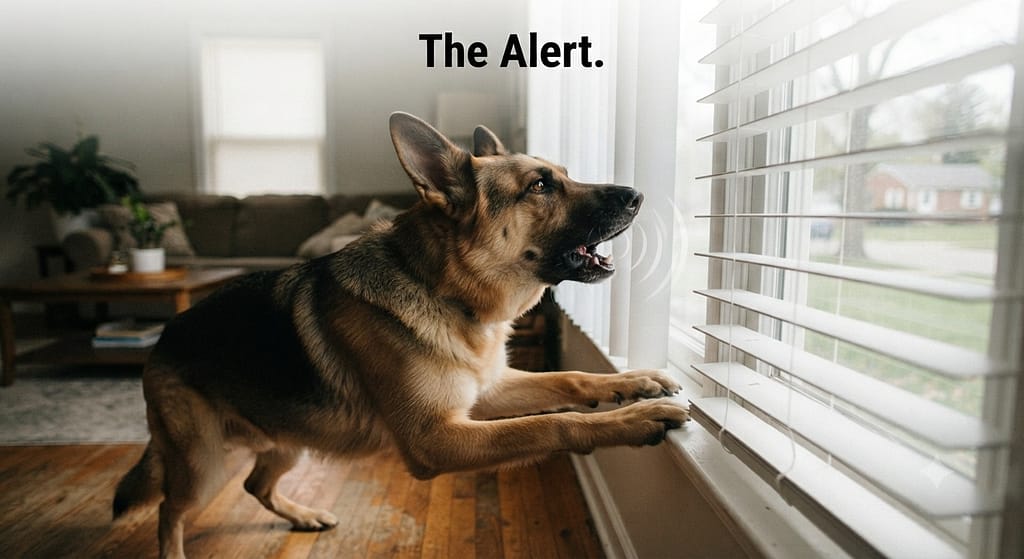
This is the dog that sits by the window and announces the arrival of every pigeon, Amazon delivery driver, and passing jogger.
Their tail is usually high, and the bark is sharp.
- The Strategy: Interrupt the line of sight. Close the blinds or use a frosted window film. You are not hiding the world from them; you are reducing their overwhelming “workload.” They feel they are on duty; we are retiring them from that job.

The “Give it to me” Bark (Demand)

This is the spoiled brat of the dog world.
They stare at you and bark because you are holding a toy, or it’s five minutes past dinner time.
It is intensely annoying because it is directed at you.
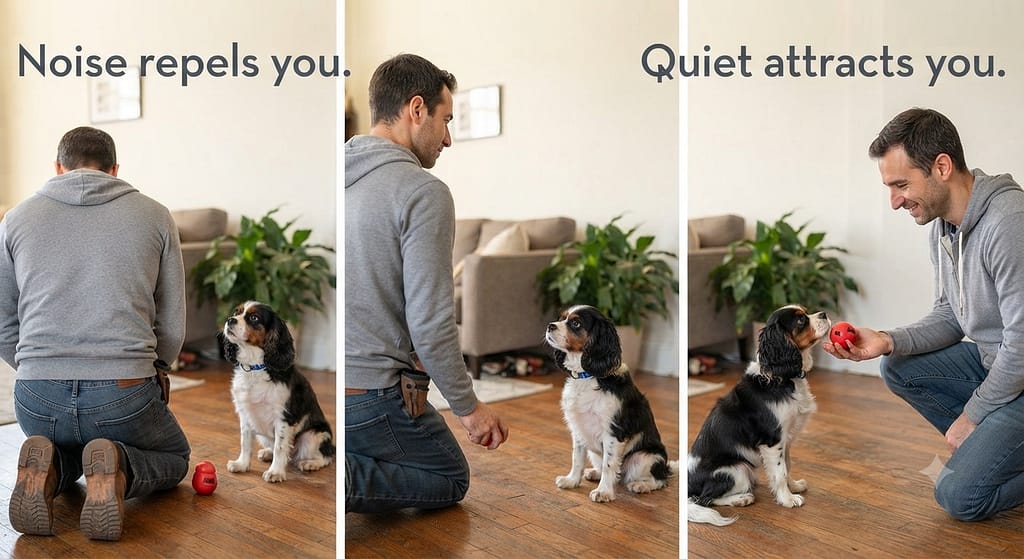
- The Strategy: Absolute and total ignoring. No eye contact, no shouting. Turn your back. Fold your arms. The second they stop barking, even for a microsecond, you turn around and reward that silence. You are teaching them that noise repels you, and quiet attracts you.
The “I’m losing my mind” Bark (Boredom)

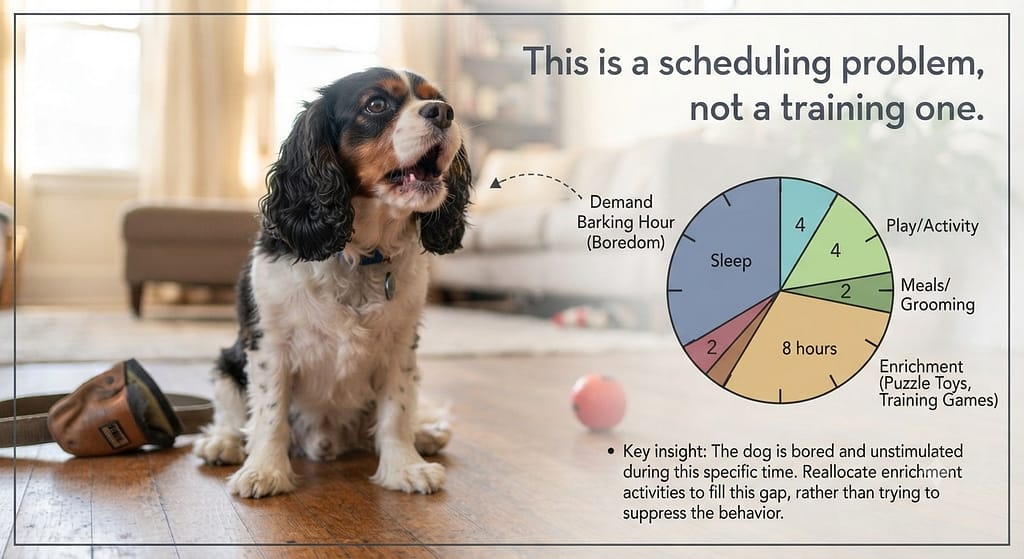
This is the dog that barks at nothing, just to hear a sound. They are usually under-exercised and under-stimulated.
- The Strategy: This is a scheduling problem, not a training one. We fix this in Section 3.
The “Terrified” Bark (Fear)

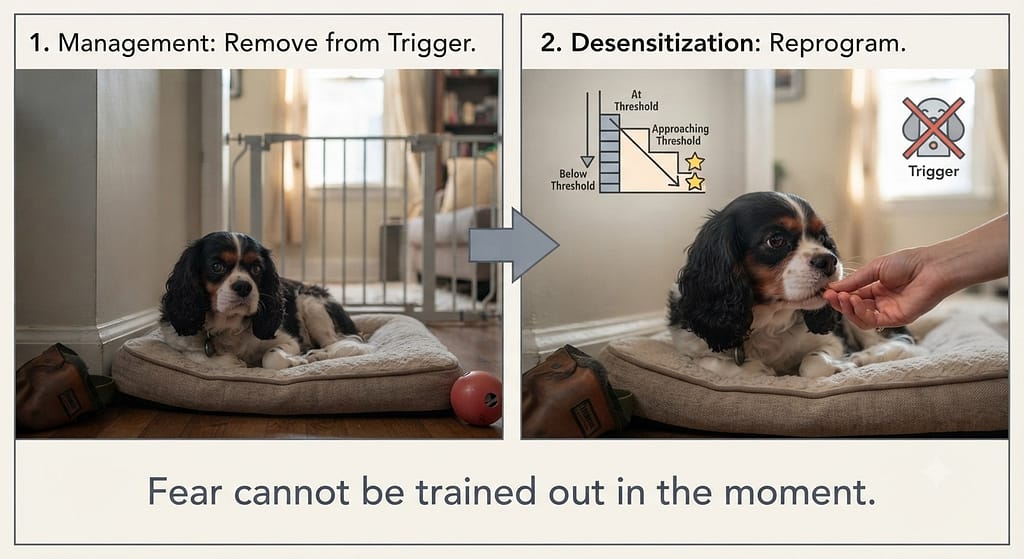
This bark is frantic, high-pitched, and coupled with trembling or pacing.
- The Strategy: Management first. Remove them from the trigger. Then, address the root desensitization. You can’t train fear out in the moment; you have to reprogram it over time.
Section 3: The “Drain” – The Sniffari & Nose Work Protocol
A tired brain is a quiet brain. Physical exercise builds an athlete; mental exercise builds a philosopher.
We are focusing on mental stimulation for dogs and specific indoor dog activities that drain their battery without requiring a backyard.
The 25-Minute Sniffari Walk
Forget the power walk. That raises their adrenaline. We want to lower their heart rate.
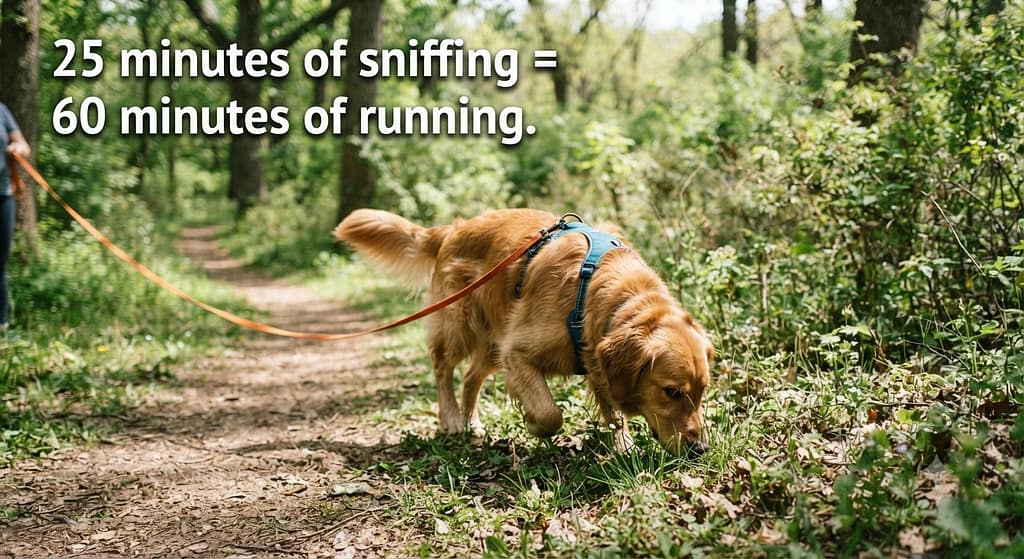
- The Science: When a dog sniffs, their heart rate drops. They process scent information, which requires immense cognitive energy. Twenty-five minutes of unrestricted sniffing (let them lead, stop when they stop) is neurologically equivalent to a 60-minute run.

- The Routine: Take them to a grassy patch. Put them on a long leash. Do not direct them. Let them wander, sniff, and sort the “pee-mail.” By the time you get back, their brain is drained of the cortisol that causes reactive barking.
For the complete sniffari walk protocol, see our 25-minute sniffari walk guide
The Apartment Nose Work
No walk? No problem.
These indoor dog activities provide immense mental stimulation.
- The Muffin Tin Game: Place a few pieces of kibble in random slots of a muffin tin. Cover all the slots with tennis balls. Your dog must use their nose and paw to remove the balls to get the food. This is 15 minutes of pure cognitive fatigue.

- The “Find It” Hunt: Hide smelly treats (cut-up hot dogs work best) around the apartment while your dog is in the crate. Release them with “Find It!” and watch them exhaust themselves triangulating the scent sources.

The Post-Walk Cool Down
After a walk, your dog is wired from sensory input. Do not just let them crash.
- The Routine: Give them a high-value chew (like a frozen Kong) immediately upon entering the apartment. This allows them to “process” the walk mentally while licking (which releases calming endorphins).

Section 4: Trigger Zones – Conquering the Hallway & Elevator (Addressing City Noises)
The most stressful moments occur at the “thresholds”—the front door, the elevator lobby, and the stairwell. These are echo chambers of anxiety.
This is where we focus on barking during city walks and specific dog walking protocols to manage the chaos.
The Elevator Protocol
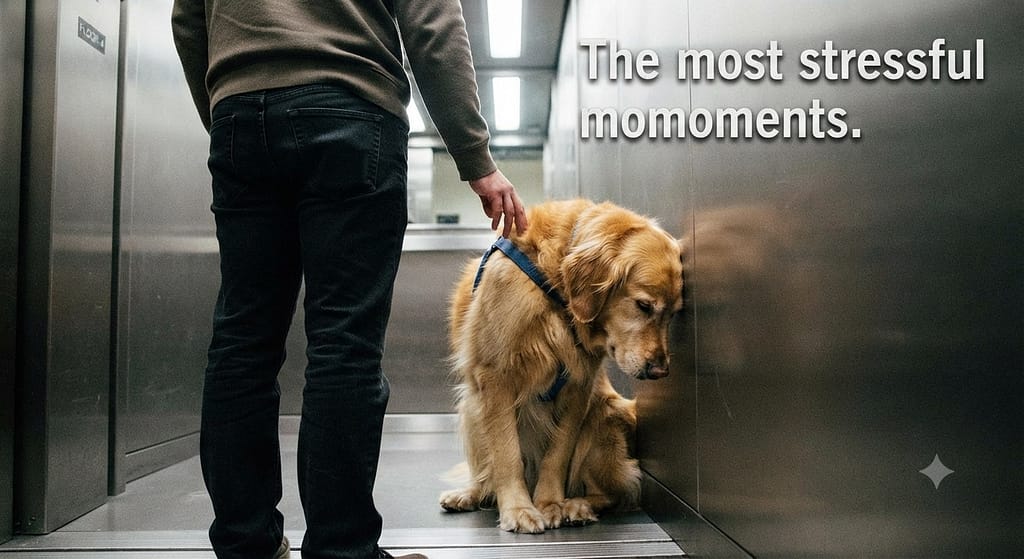
The elevator doors open to a cacophony of noise and stranger faces.
The key is to position yourself as a physical barrier.
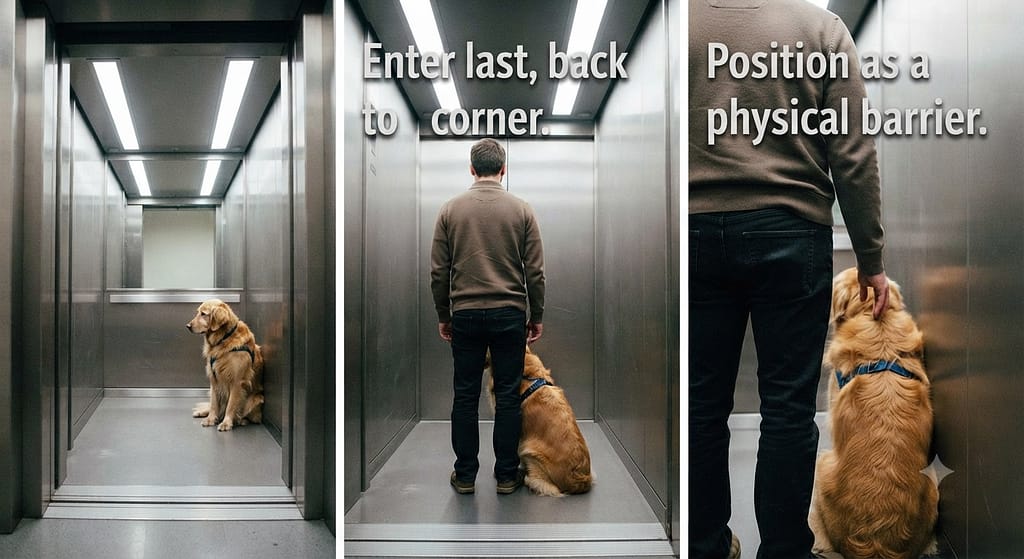
- Step 1: As you approach the elevator, have your dog sit in the corner of the hallway, facing you, not the doors.
- Step 2: When the doors open, do not ask them to walk in. Wait. Ask the other passengers to go in first. You enter last, backing into the corner.
- Step 3: Have your dog sit in the corner, facing the wall. You are blocking their visual field. They are now “safe” because the action is behind them. This prevents the “door guardian” reflex.
For complete elevator and stairwell training, see our elevator and stairwell etiquette guide
The Stairwell Echo
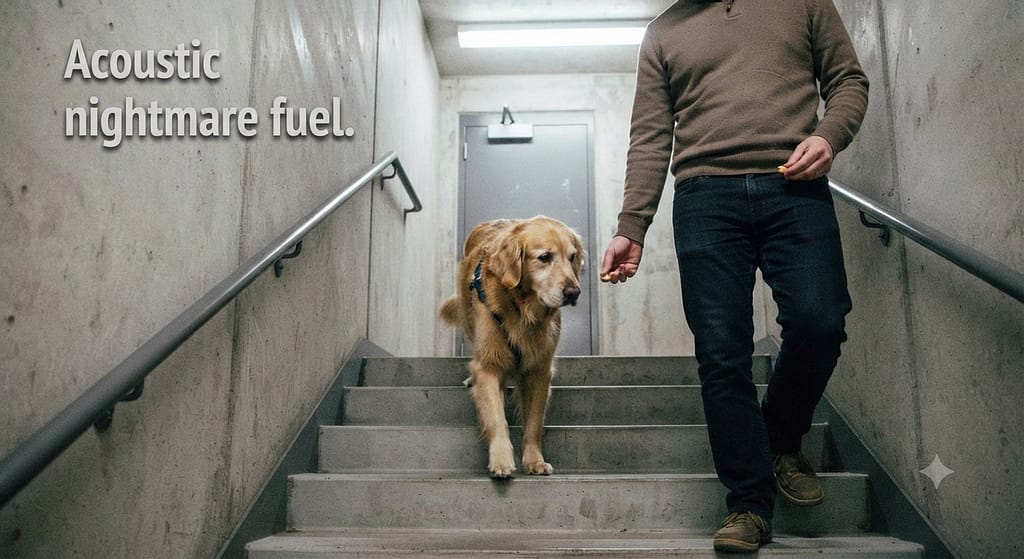
Stairwells are acoustic nightmare fuel. Footsteps echo, and voices reverberate.
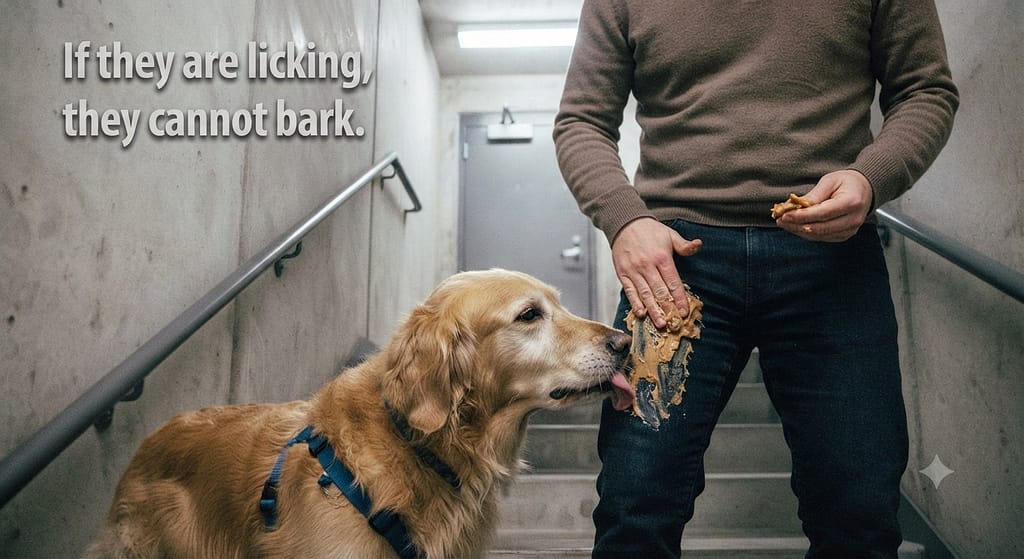
- The Strategy: Use a high-value treat (like roast chicken) and “smear” it on the inside of your thigh as you walk down the stairs. Keep your dog’s nose glued to your hip. If they are licking and smelling, they cannot bark. This creates a positive association with the dangerous space.
Pro-Tip for Muffling Noise: To physically reduce the acoustic stress, place thick rugs on hardwood floors and use a white noise machine. This directly helps how to muffle dog barking in apartment settings by absorbing ambient sounds that trigger your pup before they even start.
The Front Door Protocol
The delivery person is the ultimate trigger.
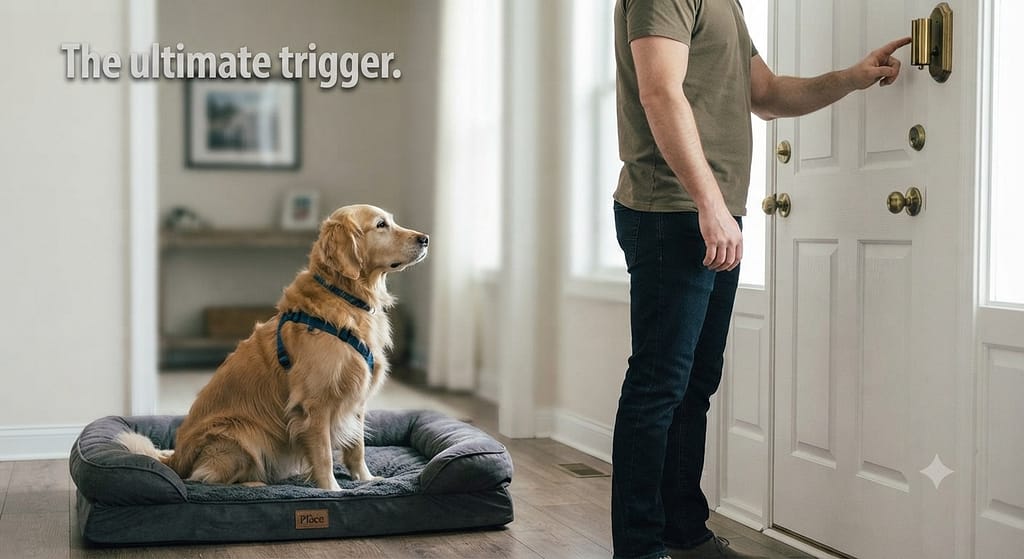
- The Routine: Teach “Place.” Send your dog to their bed when the doorbell rings. They are not allowed to leave the bed until you release them. This removes them from the trigger zone.
For building introductions and neighbor goodwill, see our apartment building introduction guide.
Section 5: The “Quiet” Installation – Quiet Training Commands & Positive Reinforcement
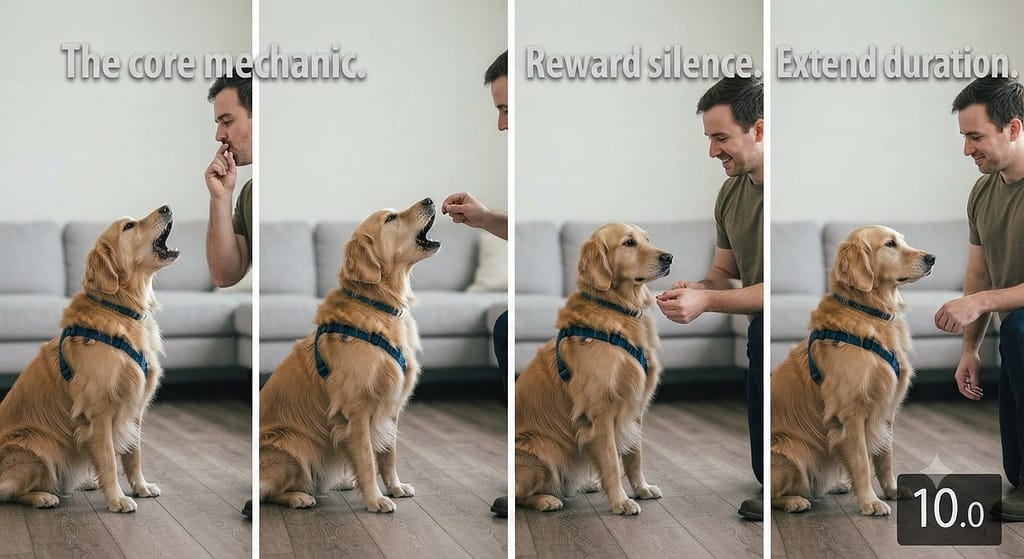
This is the core mechanic. We are going to make “silence” a profitable business proposition for your dog using positive reinforcement methods and dog training using treats. This is the essence of quiet dog training and quiet training commands.
Step 1: Create the Trigger
You need a bark to train a quiet. Have a friend knock on the wall or ring the doorbell. Capture the bark.
The moment they bark, say “Speak!” and reward the bark.
We need them to understand that barking on command is the first step to turning it off.
Step 2: The Interruption
Now that you have control, you need an interruptor.
When they are barking spontaneously (or on command), hold a treat right in front of their nose. They will stop barking to sniff the treat.
The millisecond that the barking stops, say “Quiet!” and give the treat.
This is classic dog training using treats to shape behavior.
Step 3: Extend the Duration
Now, instead of rewarding them for a 1-second pause, wait for 2 seconds. Then 5 seconds. Then 10. You are stretching their “pause muscle.”
The Golden Rule: If they start barking again while you are waiting, you have stretched the duration too far. Go back to a shorter window. You want them to succeed, not fail.

Step 4: Generalize the Cue
Practice this in different rooms, with different distractions, and with different triggers.
The quiet training commands must work during a genuine doorbell ring, not just during a training session. This is how we build dog confidence in their ability to handle noise.
For complete quiet command training, see our quiet command training guide
Section 6: The Sidewalk Reactivity Fix
City walks are a minefield—skateboards, electric scooters, and giant delivery carts.
Understanding city dog behavior is critical here. This isn’t about “training”; this is about management.
We employ specific canine reactivity strategies that double as essential leash reactivity solutions.
The 5-Foot Rule

Every dog has a “threshold” distance where a trigger is just a thing, and a “reactive” distance where the trigger is a monster.
- The Practice: When you see a trigger (a stroller, a bike), cross the street before your dog stiffens up. Distance is your best friend.
For stopping barking during walks, see our guide to stopping dog barking on city streets
The “Magnet Hand”
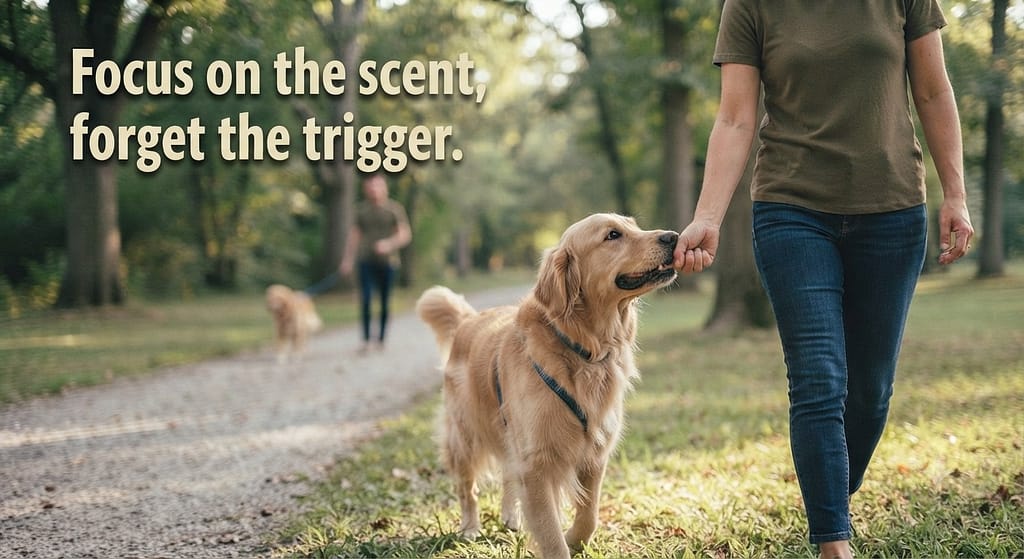
Keep a treat in your closed fist at your dog’s nose level. Walk past the trigger.
The dog is so focused on the scent of the treat that they forget to react. Once the trigger is gone, reward heavily.
The U-Turn Maneuver
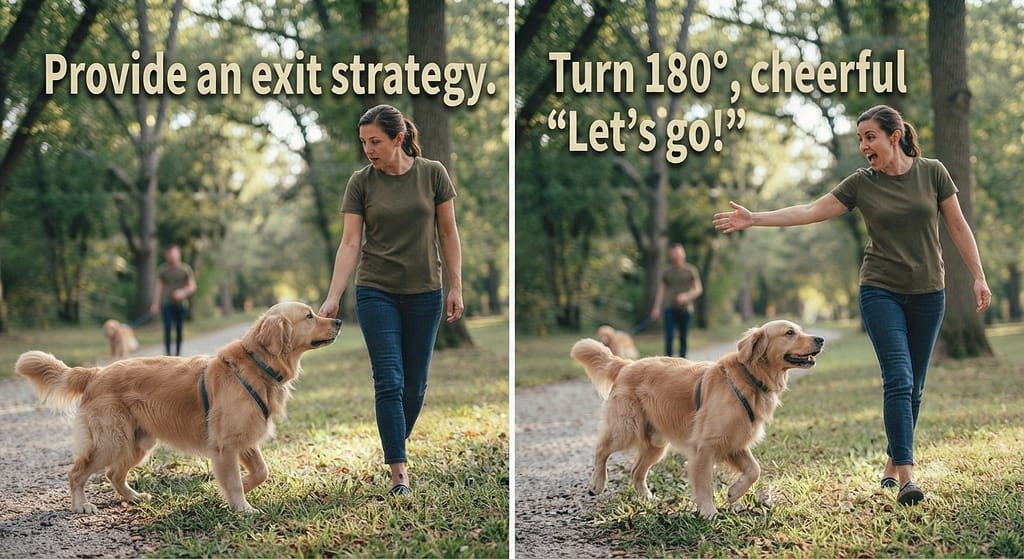
If you are caught off guard and your dog starts to fixate, do not brace for the explosion.
- The Action: Calmly turn 180 degrees and walk the other way. Say “Let’s go!” in a cheerful tone. You are not punishing the reactiveness; you are providing an exit strategy. The dog learns that disengaging is the safe option, effectively reprogramming dog behavior in real-time.
For complete loose leash walking exercises, see our apartment loose leash walking guide
Section 7: The Desensitization Playlist (The Rewrite)
This is the long-term, high-tech solution. We are going to turn your apartment into a controlled audio laboratory.
This is the gold standard of sound desensitization for dogs, applying desensitization techniques specifically aimed at addressing city noises.
The “City Sounds” Protocol
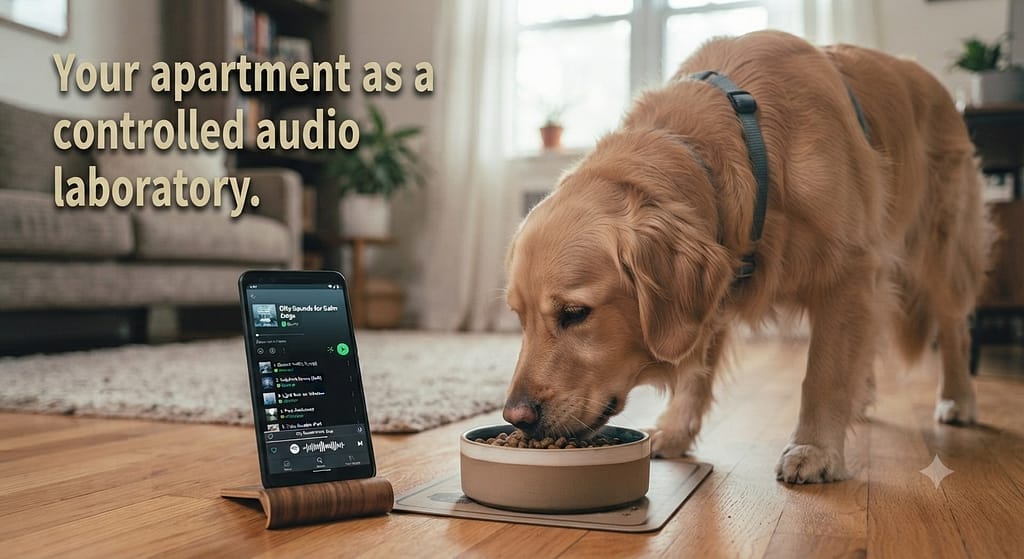
Download a playlist of city sounds—sirens, jackhammers, barking dogs, and traffic. Play it at a barely audible volume while your dog is eating their breakfast or chewing a bone.
- Week 1: Volume at Level 1 (whisper). Low threat, high reward.
- Week 2: Volume at Level 2 while they are playing with a puzzle toy.
- Week 3: Volume at Level 3 while you are in the other room.
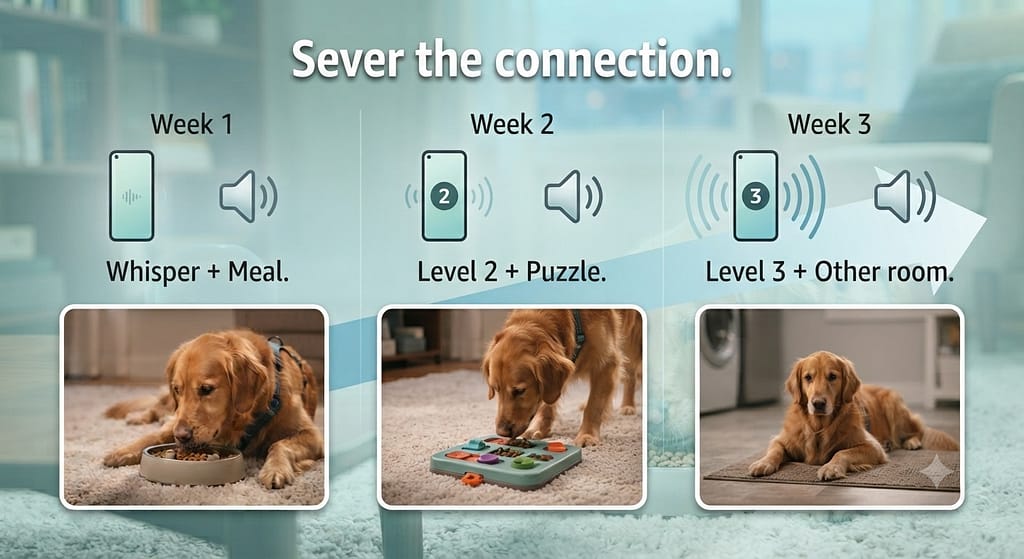
- The Goal: We are managing urban noise exposure and severing the connection between the scary sound and the actual event. By the time they hear a real siren, their brain says, “That’s just the boring background music.”
The “Treat Party” for Real Triggers
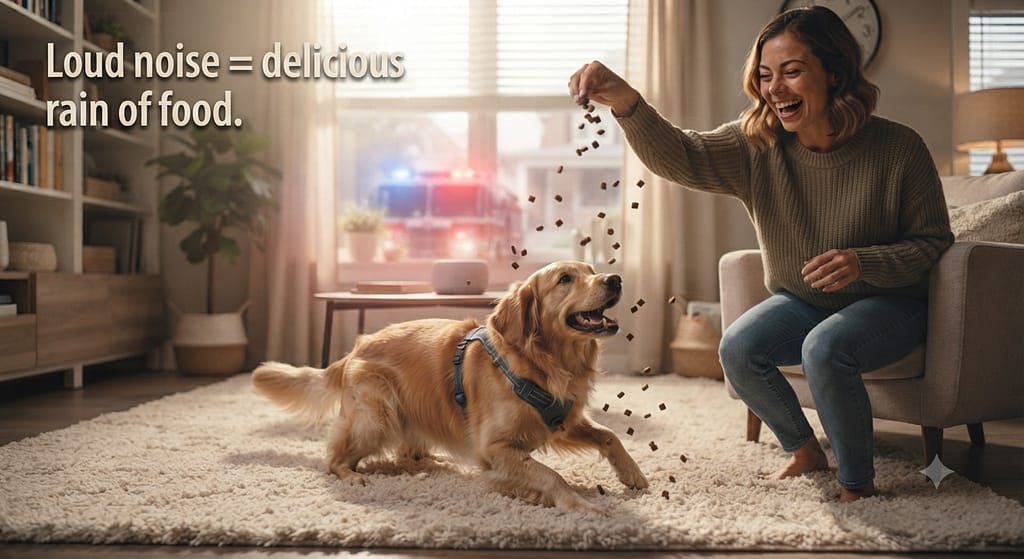
When a real siren or loud noise occurs, don’t comfort them (that reinforces fear).
Instead, throw a spontaneous “treat party” – scatter 20 pieces of kibble on the floor and cheer.
You are rewiring the wiring. “Loud noise = delicious rain of food.” This is classical conditioning at its finest, and a core component of canine fear training—turning panic into a party.
For complete leash reactivity management, see our leash reactivity guide.
The Sound of Silence (Overcoming Barking Challenges)
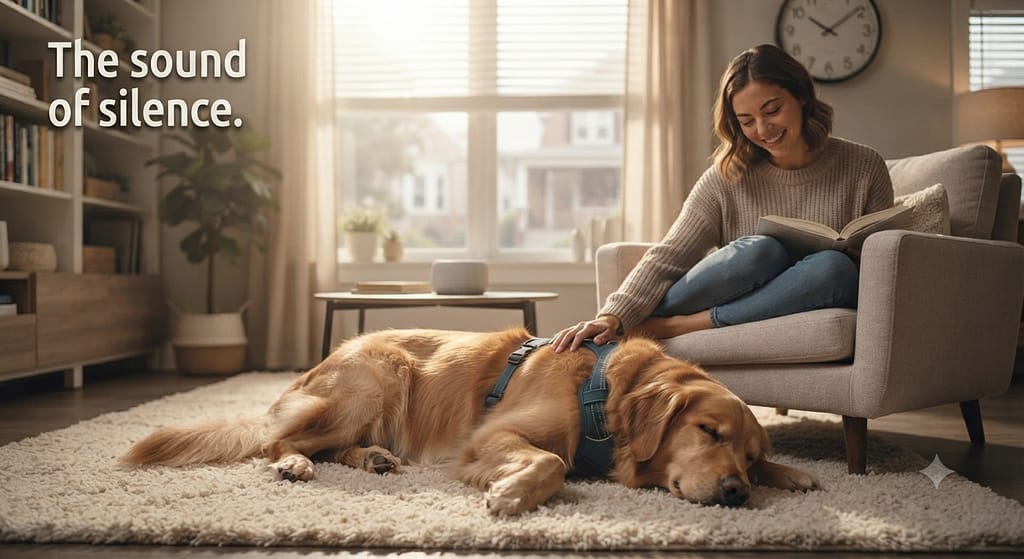
A quiet apartment dog isn’t a miracle; it is a consequence of meticulous management and understanding.
When you stop viewing barking as an act of defiance and start viewing it as a symptom, everything changes.
Whether your pup is a barking dog apartment resident, a notorious dog barking in an apartment complex nuisance, or a dog that barks at every noise in an apartment, the solution lies in consistent application of these drills. We aren’t just focused on managing barking at home; we are focused on treating urban dog anxiety at its source.
Your role is not to silence them through fear, but to guide them through the acoustic chaos of city life.
You are their sound engineer, their therapist, and their anchor.
With patience, these effective dog calming methods and training dogs to be quiet strategies will ensure you never dread a knock on the door again.
Your Next Steps:
- If your dog struggles with separation anxiety, this Protocol is the foundation—visit our Separation Anxiety Guide [Link].
- For an exhaustive list of quiet breeds, return to the Selection Bible [Link].
- Download our “Trigger Log” to track exactly what is setting off your pup and map their progress.
🐾 — Apartment Dog Guide (ADG)
Living large in small spaces, one paw at a time. That’s the apartment dog life—see you in the next guide!.


