
Let’s paint a picture:
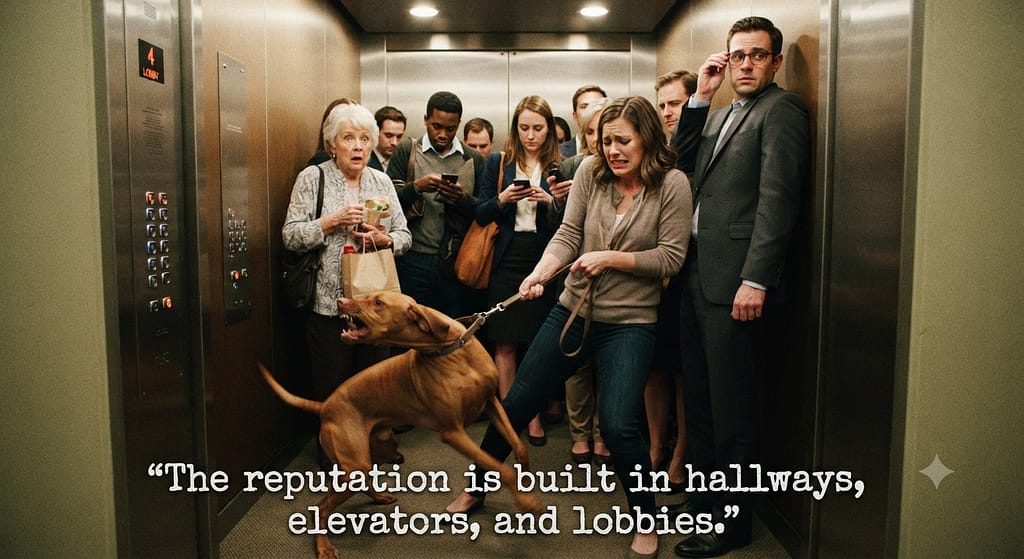
You’re waiting for the elevator.
The doors open.
Inside is your neighbor from 7B—the one you’ve only ever smiled at in the hallway.
Your dog lunges.
Barks. Jumps.
You say, “He’s usually so friendly!” while wrestling a leash and avoiding eye contact.
Sound familiar?
Here’s the truth no one tells you about apartment living with a dog:
Your dog’s reputation is built in hallways, elevators, and lobbies—not the dog park.
In a house, a barking dog is background noise.
In an apartment, it’s a lease non-renewal waiting to happen.
For a complete understanding of why apartment barking is different, see our urban silence protocol for barking.
But here’s the good news:
You can control the narrative.
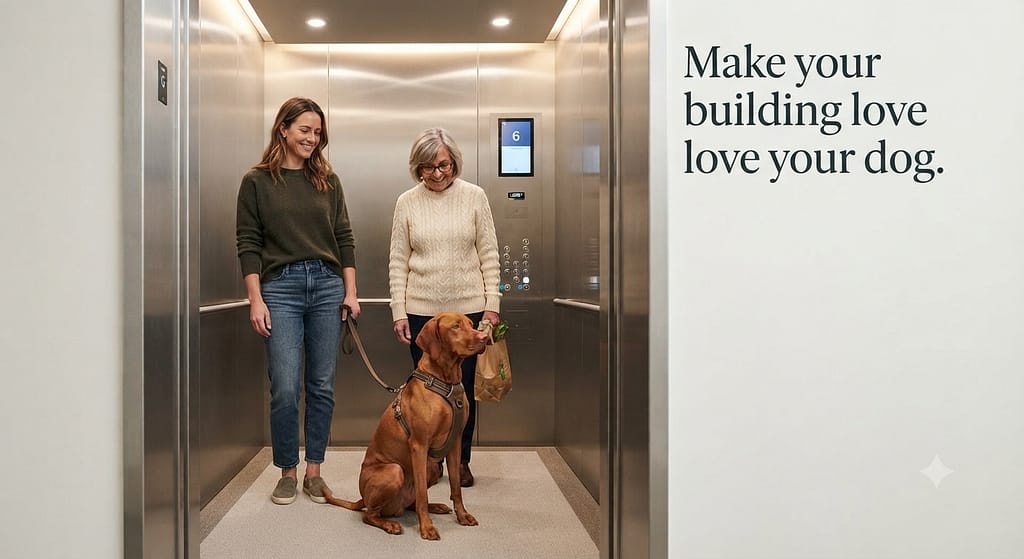
This guide is your 14-day goodwill plan. It’s not just about training your dog. It’s about training your building to love your dog.
We’ll cover:
· ✅ The pre-move prep most owners skip
· ✅ Elevator & hallway bootcamp
· ✅ Neighbor introduction scripts (copy/paste these)
· ✅ How to turn complainers into fans
· ✅ Red flags that signal you need to adjust course
Let’s make you and your dog the neighbors everyone loves. 🏢🐕
🔍 The Apartment Dog Introduction Mindset
Before we get to the step-by-step, we need to talk about how apartments actually work.
🧠 Truth #1: Your Neighbors Are Not Your Dog’s Fans (Yet)
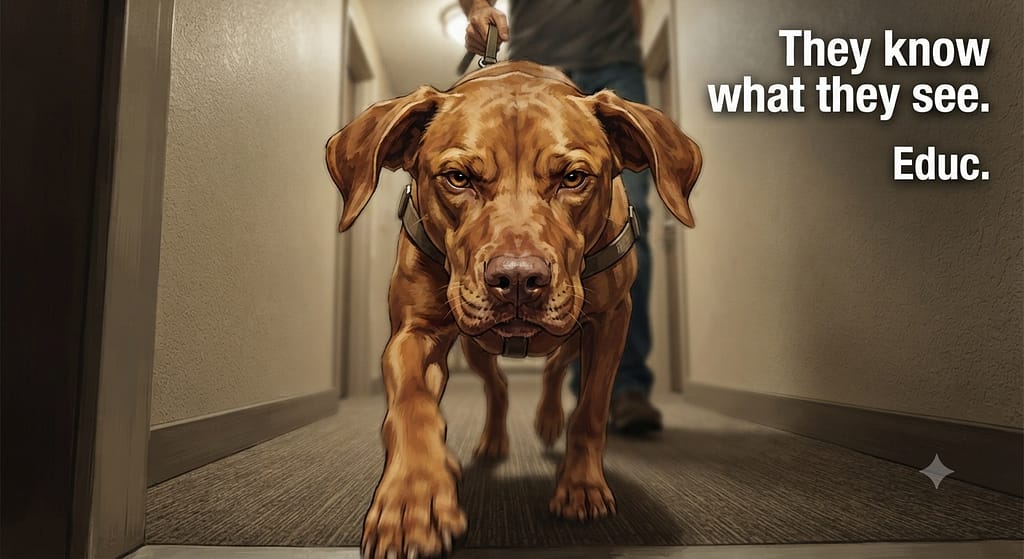
They don’t know your dog is sweet. They don’t know he’s “friendly, just excited.”
They know what they see:
A large animal moving toward them with intensity.
Your job isn’t to convince them your dog is harmless.
Your job is to make interactions feel safe and predictable.
🧠 Truth #2: The Building Has Memory
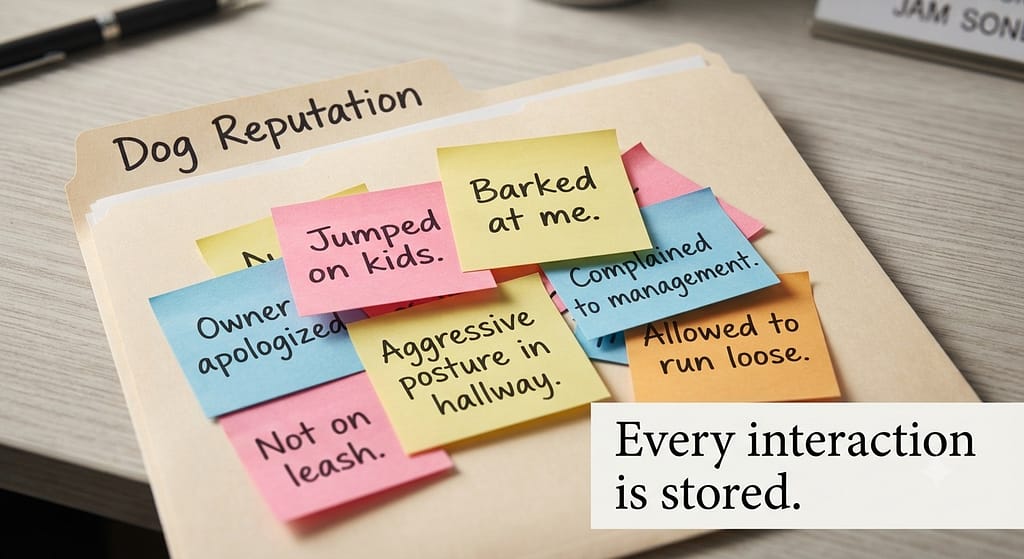
In a house, a bad moment disappears.
In an apartment, neighbors remember the dog that barked at them for 10 months.
Every interaction is stored. You’re building a reputation file on your dog whether you realize it or not.
🧠 Truth #3: Control Creates Comfort
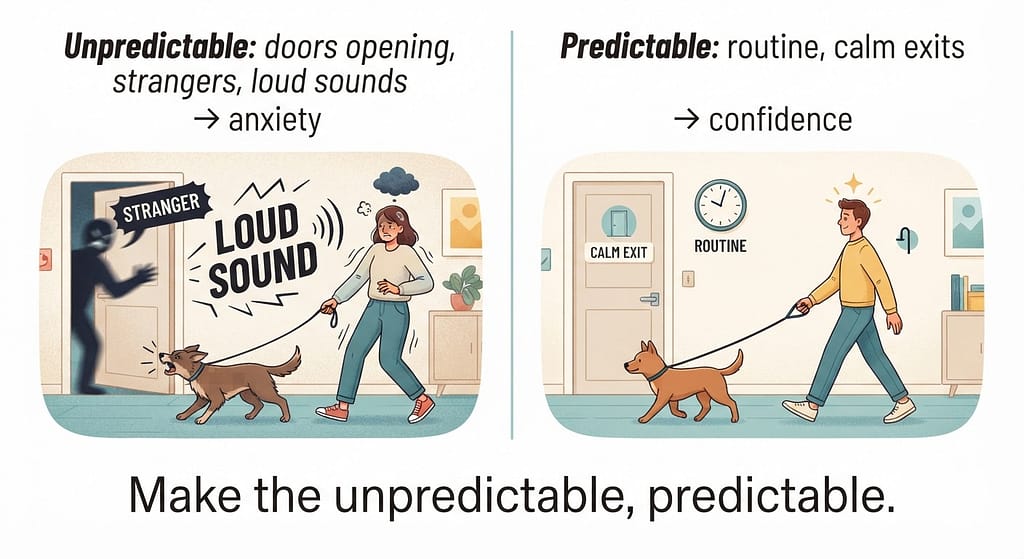
Dogs act out in apartments because apartments are unpredictable.
Doors open unexpectedly. Strangers appear at eye level. Loud sounds echo.
Your job is to make the unpredictable predictable.
Understanding your dog’s barking triggers is the first step — see our guide to apartment barking triggers and hallway noises
💬 Interactive Pause:
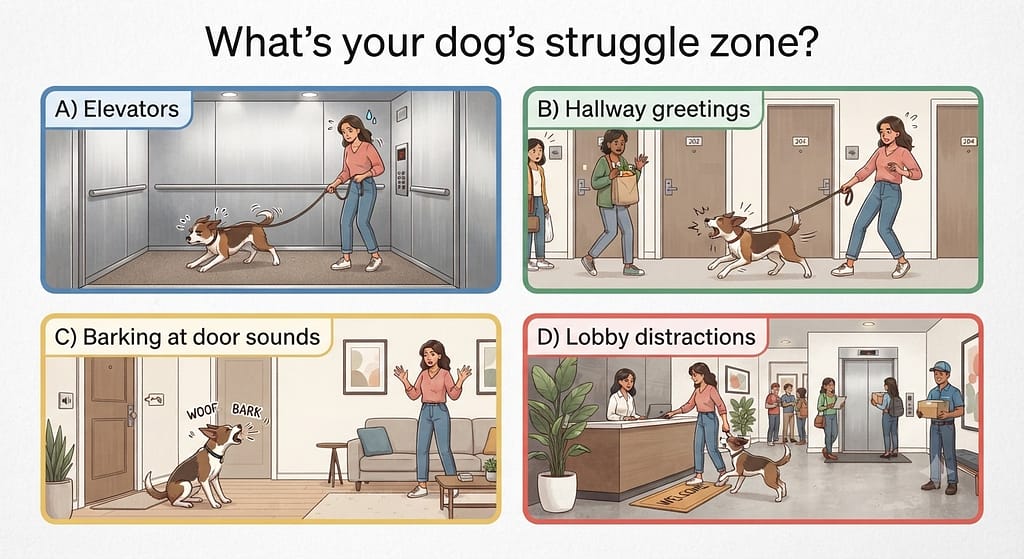
What’s the #1 apartment scenario your dog struggles with?
(A) Elevators
(B) Hallway greetings
(C) Barking at the door sounds
(D) Lobby distractions
Keep this in mind—we have solutions for each.
📦 Pre-Move & Day 1 (The Foundation)
#1: The Welcome Note Strategy
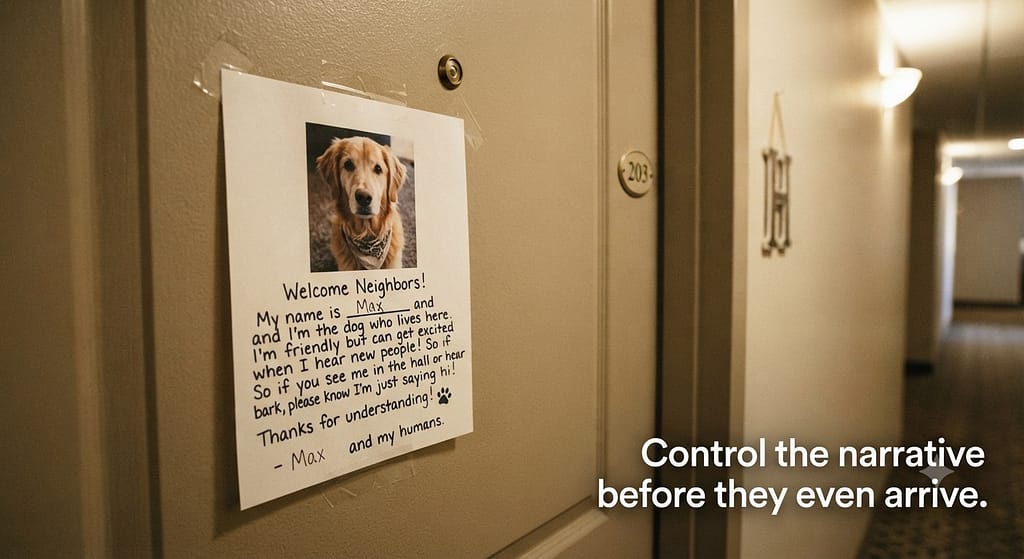
Before your dog ever sets paw in the building, control the narrative.
What to do:
Write a brief, friendly introduction note to immediate neighbors (both sides, across the hall, and anyone who shares your elevator bank).
The Script (copy/paste this):
Hi neighbor! I’m [Name] in apartment #[Number]. Just moving in with my dog, [Dog Name], a [Breed]. We’re working on our apartment manners, so you might hear some adjustment barking at first—we’re on it! Please never hesitate to text me at [Number] if [Dog Name] is ever bothering you. Looking forward to being neighbors! 🐾
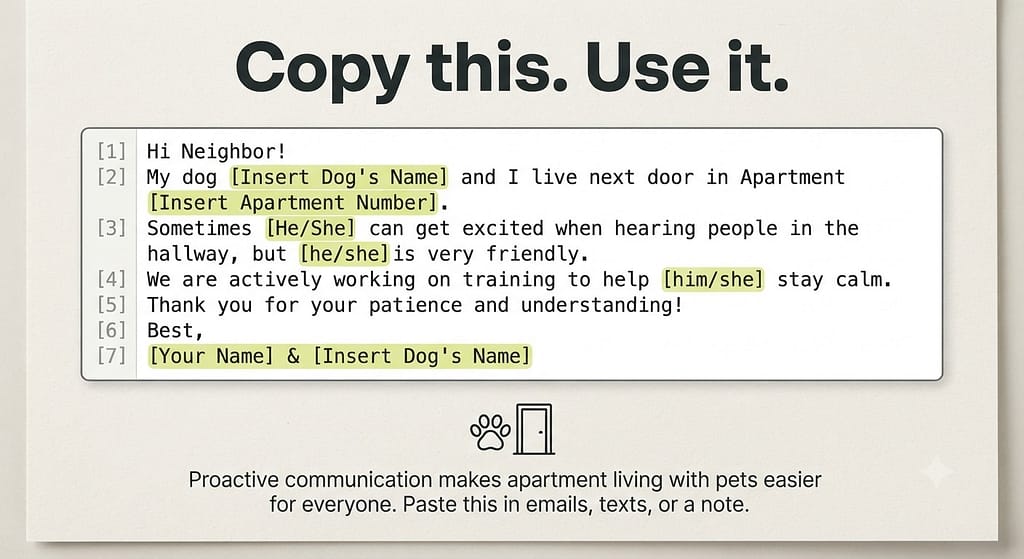
Why this works:
- It pre-frames your dog as friendly and responsible
- It gives neighbors direct contact (reduces management complaints)
- It shows you’re proactive, not defensive
🛒 Affiliate Pick:
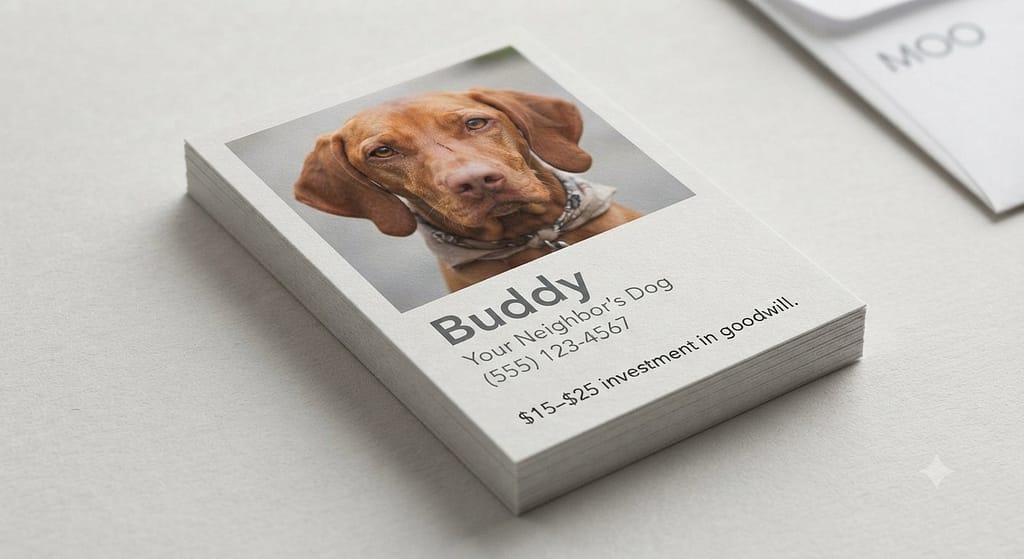
Moo Cards Custom Pet Business Cards – Leave these with the note. Includes your dog’s name, your number, and a cute photo. $15–$25
👉 Shop: Moo Pet Cards
#2: The Lobby Recon Mission
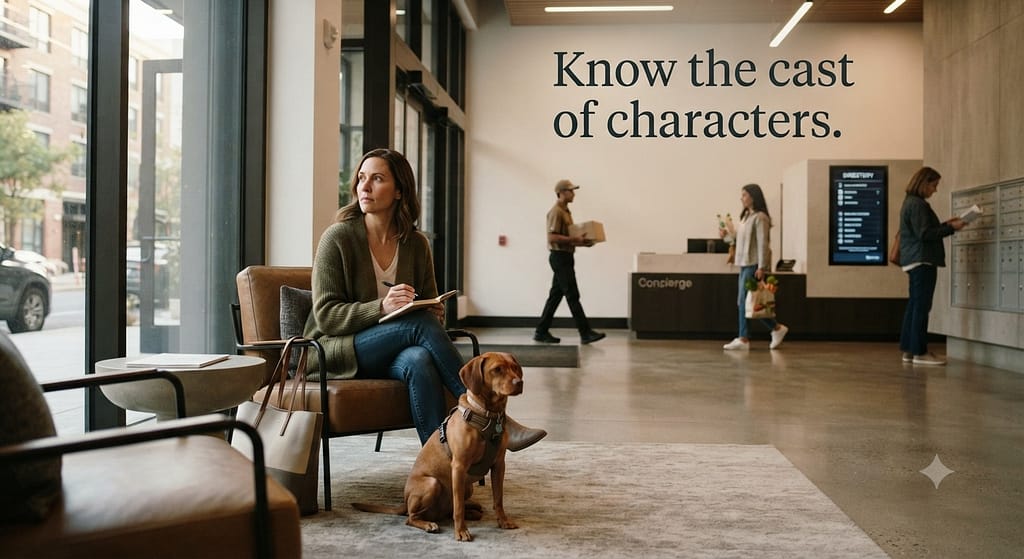
What to do:
Before bringing your dog, visit your building at different times.
- 7:45 AM (rush hour)
- 5:30 PM (after work)
- Saturday 10 AM (weekend flow)
Note: When are the busiest times? Are there kids? Other dogs? Delivery people?
Why this works:
You can’t prepare for what you don’t expect. Now you know the cast of characters.
#3: Threshold Conditioning (Day 1)
The problem:
Most dogs explode out the apartment door because inside = safe, outside = exciting.
The fix:
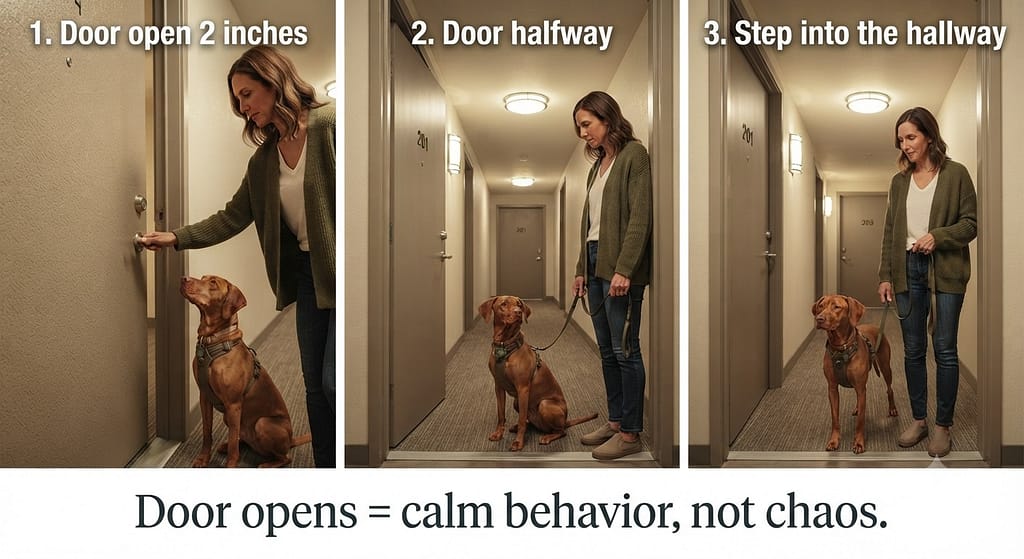
For the first 3 days, every single exit is a training moment.
- Leash up inside.
- Open the door 2 inches.
- Dog looks at you? Mark & treat.
- Door open halfway. Calm? Treat.
- Step into the hallway. Loose leash? Treat.
Goal: Door opens = calm behavior, not chaos.
🛒 Affiliate Pick:
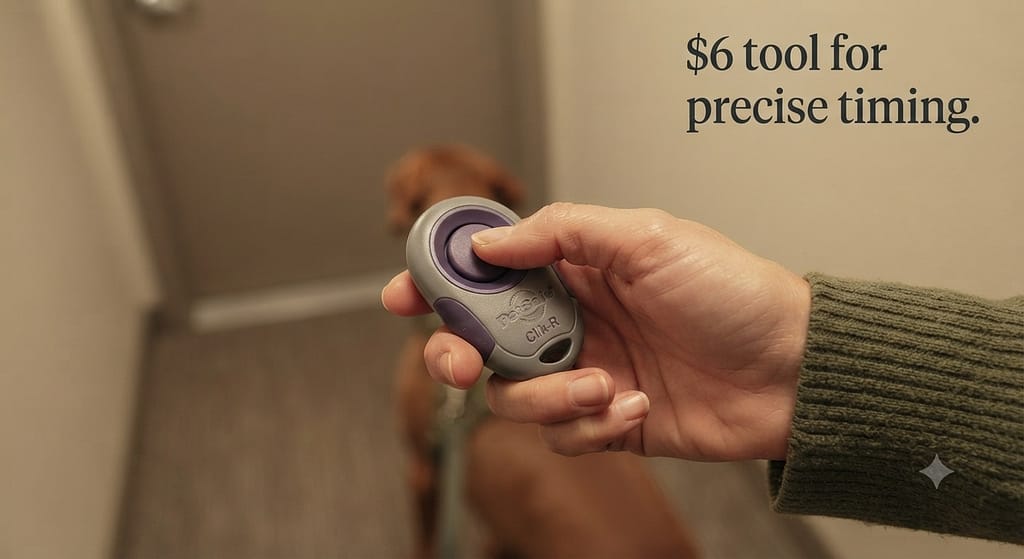
PetSafe Clik-R Trainer Clicker – Precise timing matters in threshold training. $6
👉 Shop: PetSafe Clicker
🚪 The Elevator & Hallway Bootcamp (Days 2–7)
#4: The Empty Elevator Game
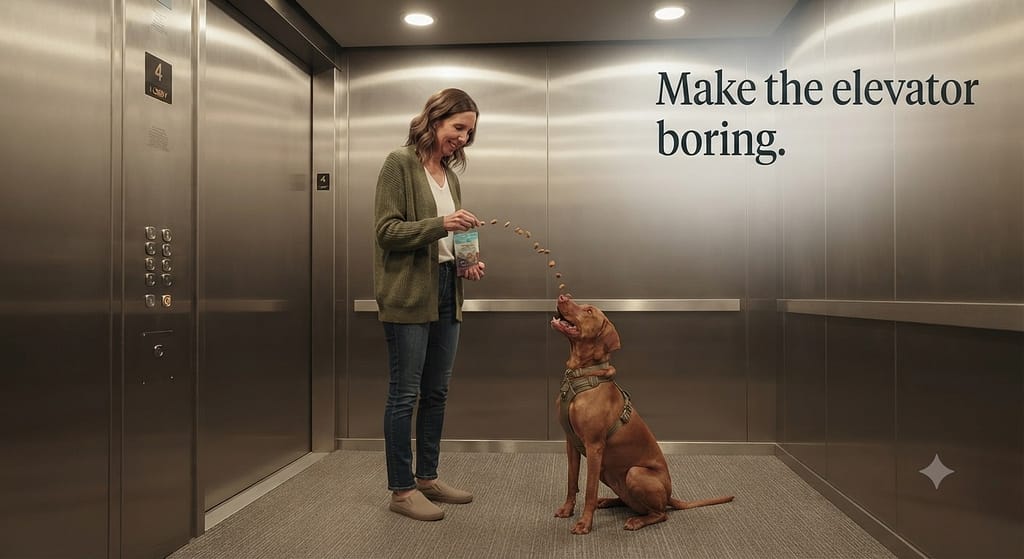
What to do:
Call an empty elevator. Step in with your dog. Treat continuously. Step out. Repeat.
Then add duration: stand in the empty elevator for 10 seconds. 30 seconds. 1 minute.
Why this works:
The elevator itself becomes boring. The movement, the ding, the doors—all neutral.
#5: The Elevator Guest Star
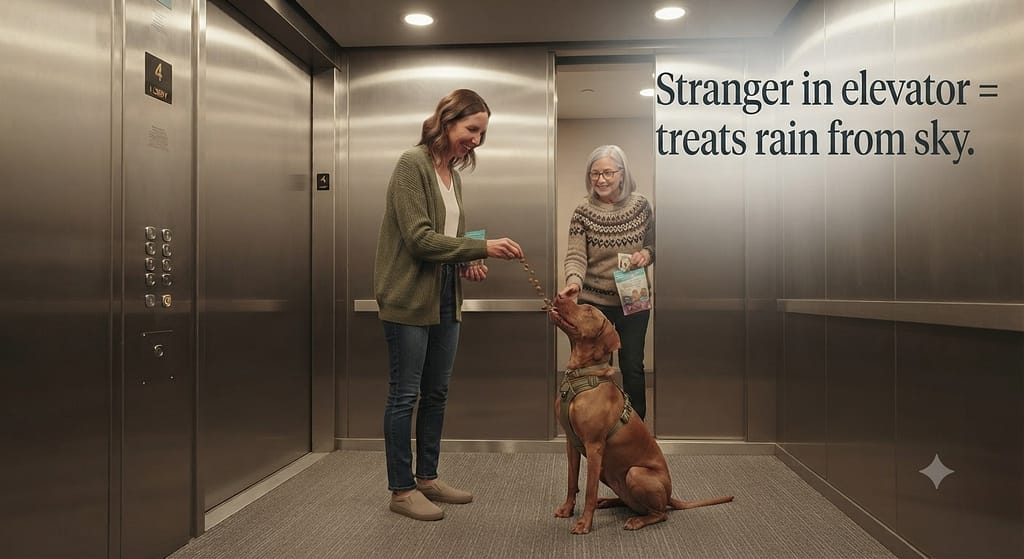
Once your dog is chill in an empty elevator, recruit a neighbor for 5 minutes.
Protocol:
- Neighbor enters
- Your job: Feed treats non-stop
- Neighbor ignores dog completely
- Neighbor exits
- The dog gets a jackpot treat
No greetings. No eye contact. No petting.
Why this works:
Your dog learns: stranger in elevator = treats rain from sky. Not a threat. Not a greeting opportunity. Just neutral + rewards.
If your dog barks during walks, see our guide to stopping dog barking on city streets.
🛒 Affiliate Pick:
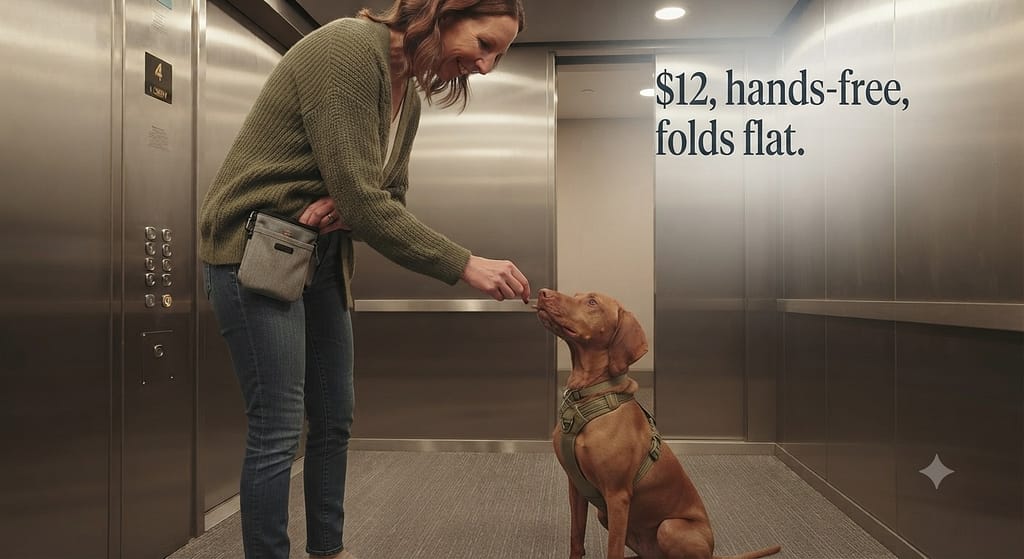
PetSafe Treat Pouch – Hands-free, magnetic closure, folds flat. $12
👉 Shop: PetSafe Treat Pouch
#6: The Hallway U-Turn
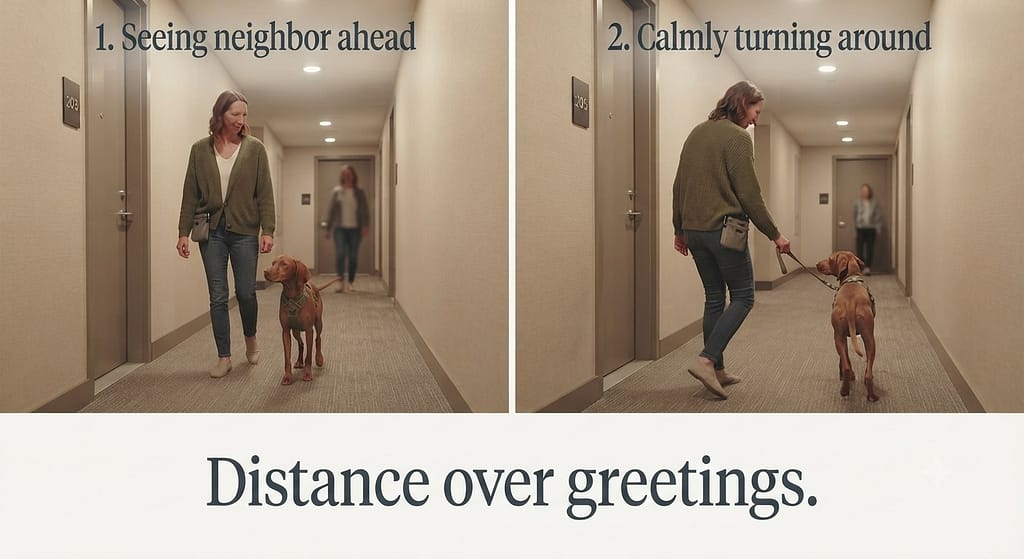
What to do:
When you see a neighbor approaching in the hallway, do not walk toward them.
Immediately: Calm U-turn. Walk the other direction. Create distance.
Why this works:
You’re not avoiding. You’re managing. Forced greetings create anxious dogs. You’re teaching: we don’t always say hi, and that’s fine.
For complete elevator and stairwell training, see our elevator and stairwell etiquette guide.
Script for neighbor:
“We’re still practicing hallway manners! [Dog Name] is learning to stay calm around new friends. Thanks for your patience!”
🗣️ The Neighbor Introduction Playbook (Days 8–12)
#7: The Structured Introduction
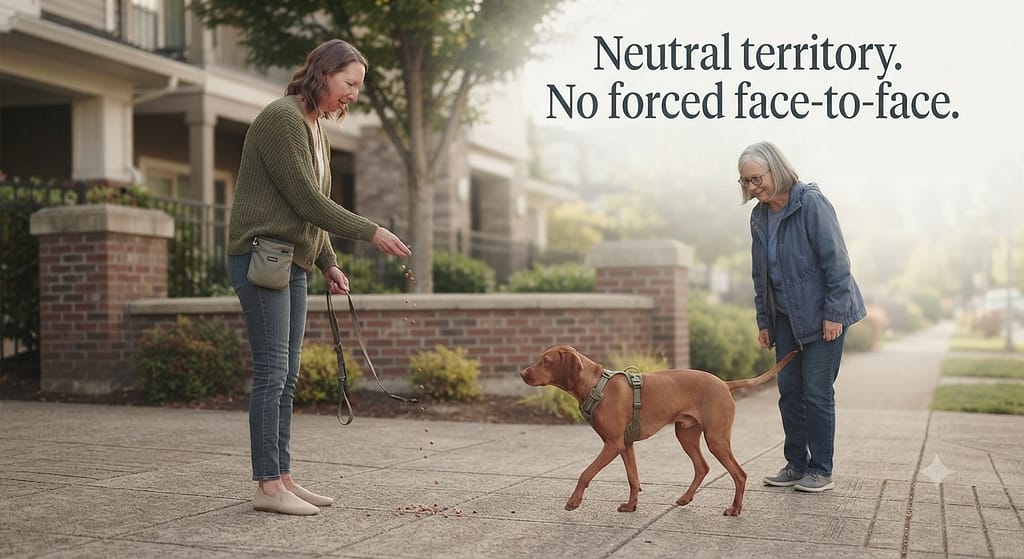
Once your dog is calm in the elevator and hallway, it’s time for formal introductions.
The Setup:
- Outdoor location (neutral territory, not the building)
- The dog is exercised first
- The neighbor has treats
- No forced face-to-face
The Script:
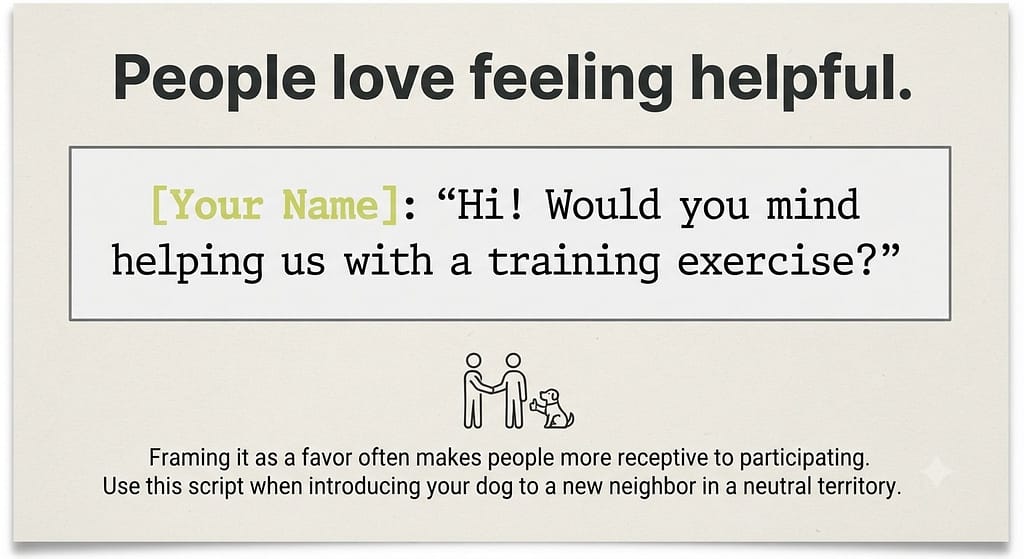
“Hey! So glad we finally get to properly introduce [Dog Name]. He’s been practicing his apartment manners. Would you mind helping us with a training exercise?”
(People love feeling helpful.)
The Exercise:
- Neighbor stands sideways (less threatening)
- The dog approaches at its own pace
- Neighbor tosses treats on the ground (never hands them directly)
- Dog sniffs? Success. No petting required.
🛒 Affiliate Pick:

Zuke’s Mini Naturals Training Treats – Low-calorie, soft, fits in pouch. $5
👉 Shop: Zuke’s Mini Naturals
#8: The Door Greeting Protocol
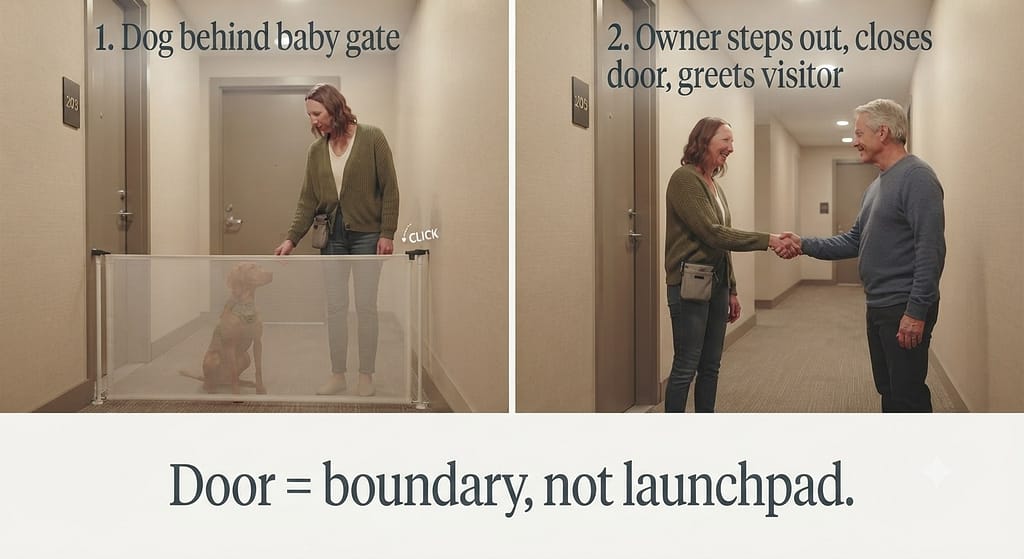
What to do:
Your dog should never greet someone at the door in a heightened state.
The rule:
The door opens. The dog is behind a baby gate or in a down-stay. You step out. You close the door behind you. You greet the person in the hallway.
Why this works:
It prevents door-darting and over-arousal. The apartment door becomes a boundary, not a launchpad.
For structured leash walking in hallways, see our loose leash walking exercises for apartments
🛒 Affiliate Pick:
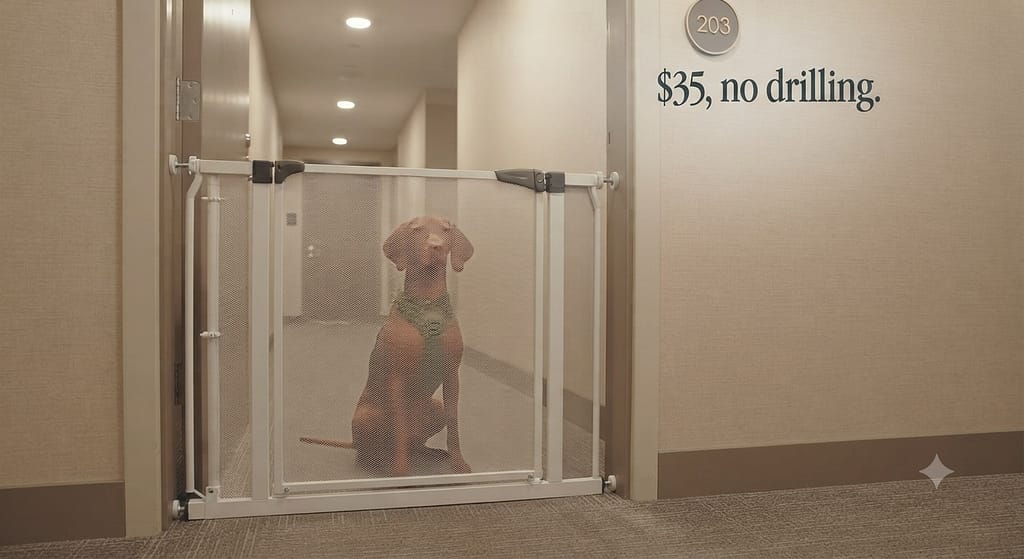
Regalo Easy Step Baby Gate – Pressure-mounted, no drilling, 30” tall. $35
👉 Shop: Regalo Baby Gate
#9: The Complaint-Proofing Strategy
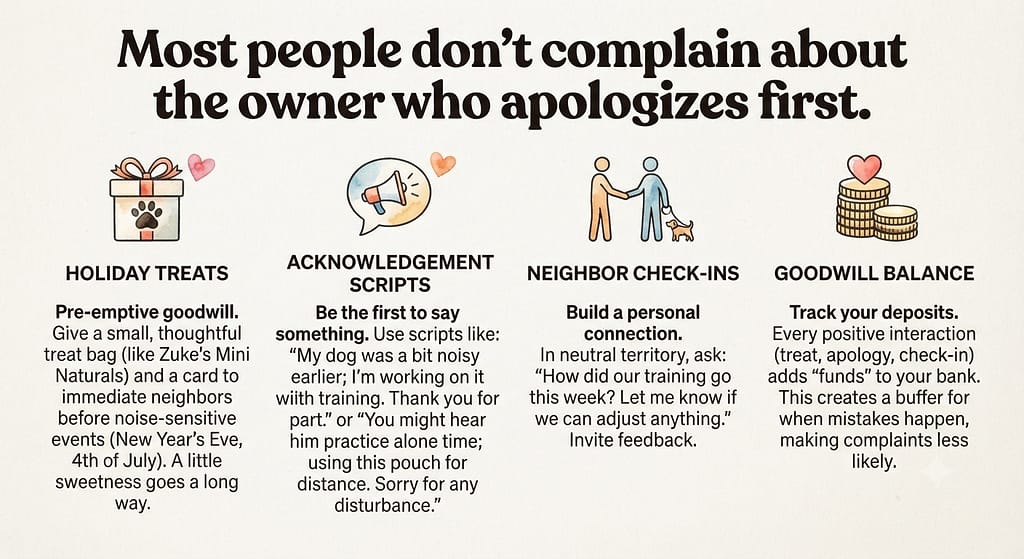
Let’s be real: Even well-trained dogs have bad days.
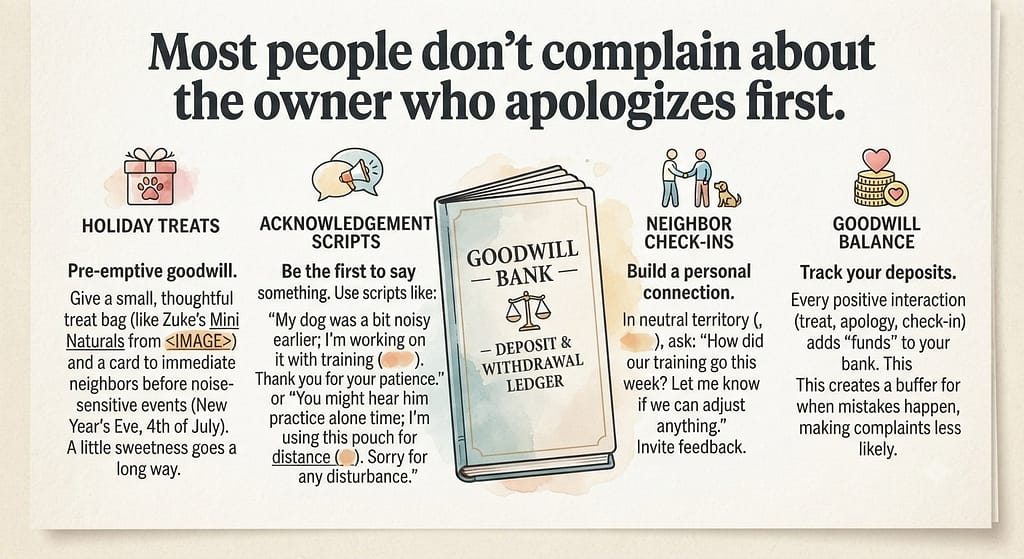
Create a “Goodwill Bank”:
- Holiday treats for your floor (baked goods with a card from your dog)
- Offer to let neighbors meet your dog on their terms
- Always acknowledge barking incidents immediately
Script for when your dog barks, and you know it:
“Hey, I’m so sorry if [Dog Name] was barking earlier. We’re working on it. Please always let me know if it happens again—I want to be a good neighbor.”
Why this works:
Most people don’t complain about the dog whose owner apologizes first. They complain about the owner who pretends nothing happened.
🧠 Chapter 5: Special Scenarios (Reactive, Fearful, Over-Friendly Dogs)
#10: The Reactive Dog Protocol
If your dog lunges, growls, or barks at strangers/other dogs in the building:
Step 1: Management
- Walk at off-peak hours
- Use a “do not pet” leash sleeve or vest
- Physically block your dog’s view in elevators (stand between dog and door)
Step 2: Counter-Conditioning
Every time a trigger appears, offer high-value treats. Distance is your friend. Farther away = easier learning.
For dogs who need more mental stimulation, see our sniffari walk guide
Step 3: The Honest Script
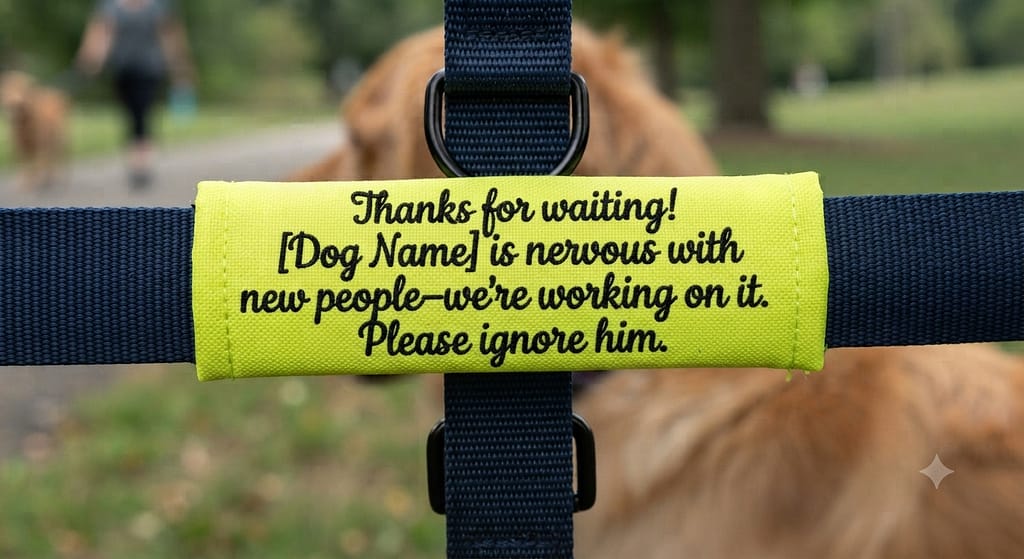
“Thanks for waiting! [Dog Name] is nervous with new people—we’re working on it. Please ignore him; it helps him relax.”
🛒 Affiliate Pick:
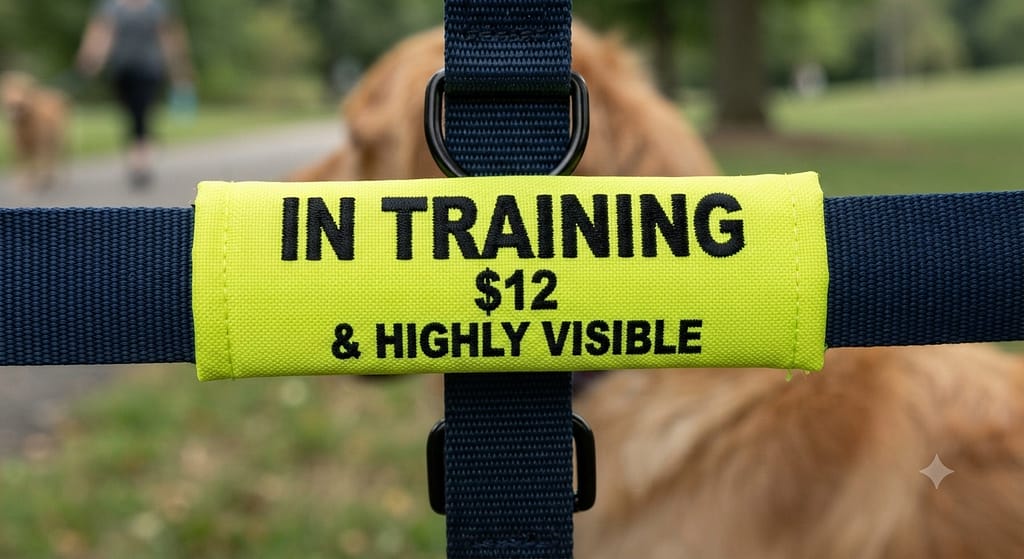
Bark Appeal “In Training” Leash Sleeve – Bright yellow, Velcro, highly visible. $12
👉 Shop: Bark Appeal Leash Sleeve
#11: The Over-Friendly Dog Protocol
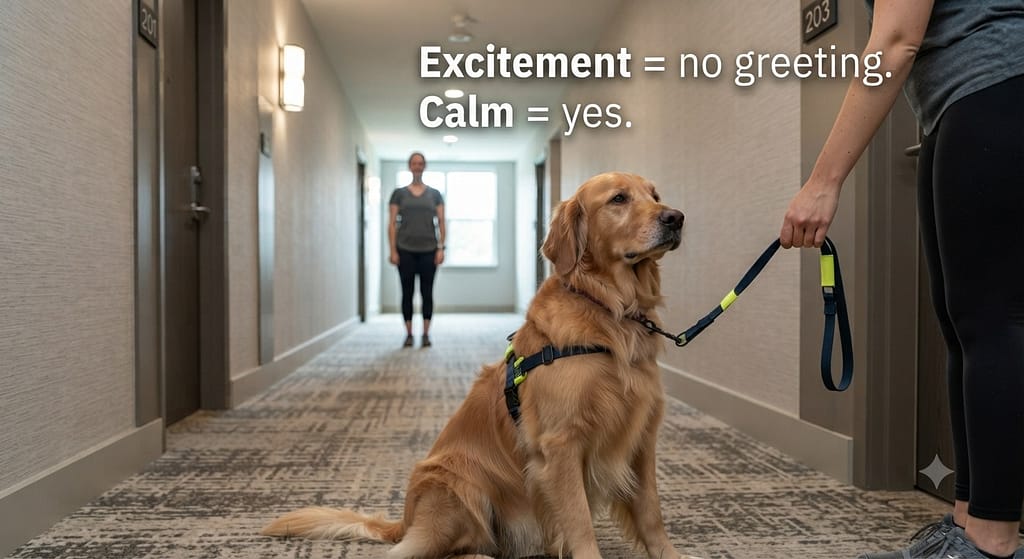
Some dogs don’t want to attack—they want to explode with love. This is equally problematic in apartments.
Fix:
- No greetings in the building. Zero. None.
- All greetings happen outside, off the building property, after the dog is calm.
- Teach “say hi” as a formal behavior: sit first, then gentle sniff, then treat.
Script:
“We’re teaching [Dog Name] that calm greetings get friends. If he’s too excited, we’ll skip it this time!”
📋 Chapter 6: The 14-Day Goodwill Plan Cheat Sheet
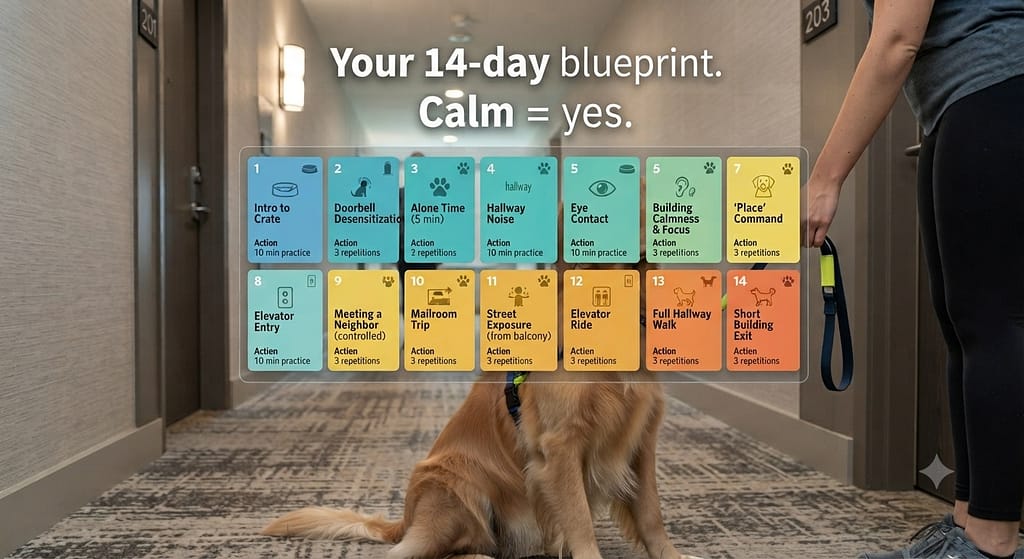
| Day | Focus | Action |
|---|---|---|
| Pre-move | Recon | Note busy times, leave welcome notes |
| Day 1 | Threshold | Door = calm. 10 perfect exits. |
| Day 2 | Elevator | Empty elevator parties. Treats only. |
| Day 3 | Hallway | U-turns. Distance over greetings. |
| Day 4 | Elevator | Add neutral human. No interaction. |
| Day 5 | Lobby | Off-peak lobby hangs. 5 minutes. |
| Day 6 | Doors | Door = boundary. Down-stay practice. |
| Day 7 | Rest | Low-pressure day. |
| Day 8 | Neighbor | Text 1 neighbor. Structured intro outdoors. |
| Day 9 | Routine | Peak-hour walk. Manage, don’t greet. |
| Day 10 | Goodwill | Small gift for 1 neighbor. |
| Day 11 | Proofing | Guest knocks. The dog stays behind the gate. |
| Day 12 | Elevator | Peak hour test. Treats ready. |
| Day 13 | Feedback | Check in with 1 neighbor. |
| Day 14 | Celebrate | You did it. Your dog is a valuable asset. |
❓ Chapter 7: Frequently Asked Questions
Q: What if my building has a “no pets” elevator policy?
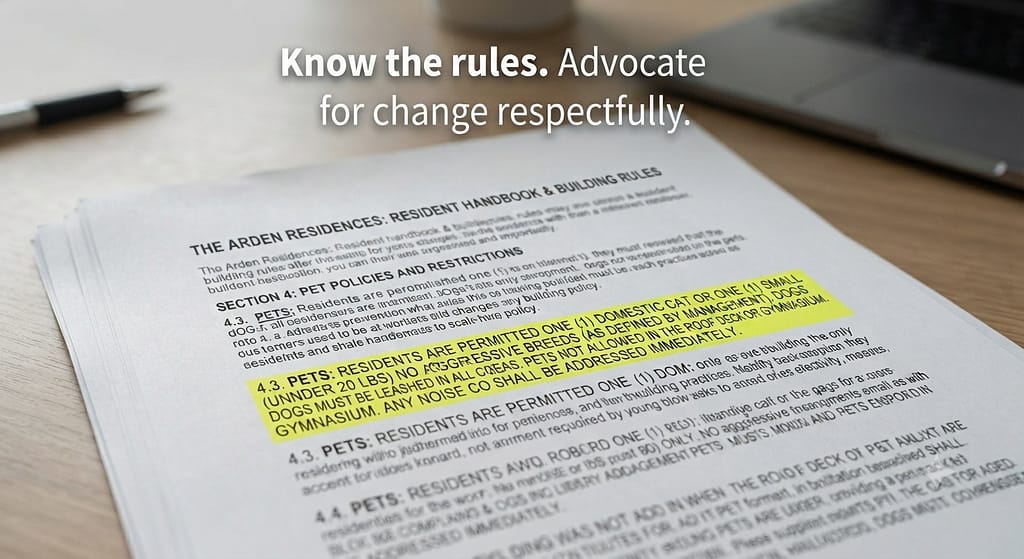
A: Many buildings require dogs to use service elevators or at specific times. Follow the rules, but also advocate. If the policy is unreasonable, organize polite, collective feedback from pet owners. One voice is a complaint. Five voices are a conversation.
Q: My neighbor is terrified of dogs. What do I do?
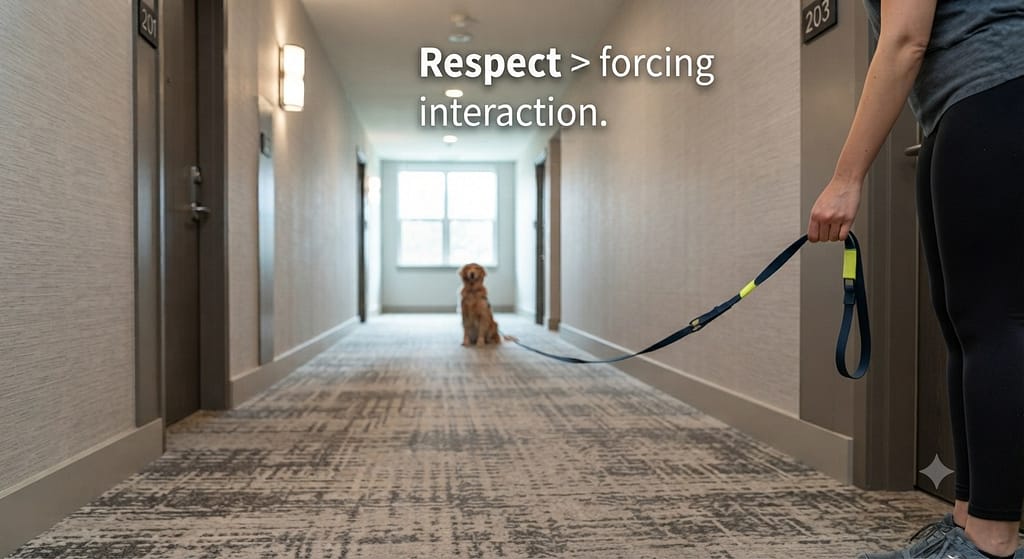
A: Maximize distance. Minimize surprise. If possible, let them know your schedule. Never force interaction. Use the hallway U-turn before they even see you. You can’t make them love dogs, but you can make them feel respected.
Q: How do I handle off-leash dogs in the elevator lobby?
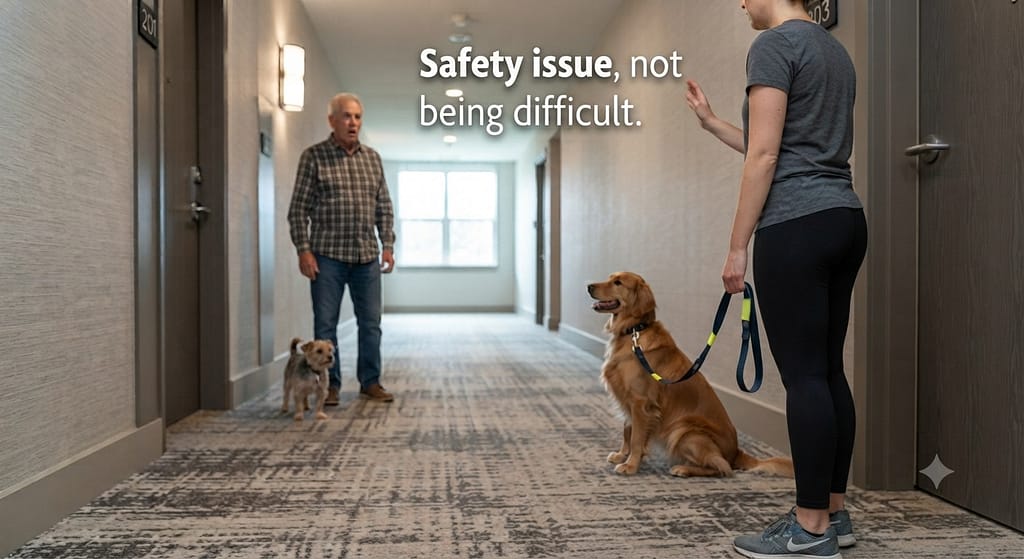
A: This is a safety issue. Calmly say: “Could you please leash your dog? Mine is nervous, and I don’t want an incident.” If it’s a repeat problem, report to management. You’re not being difficult—you’re being safe.
Q: What if I already have a bad reputation with my neighbors?
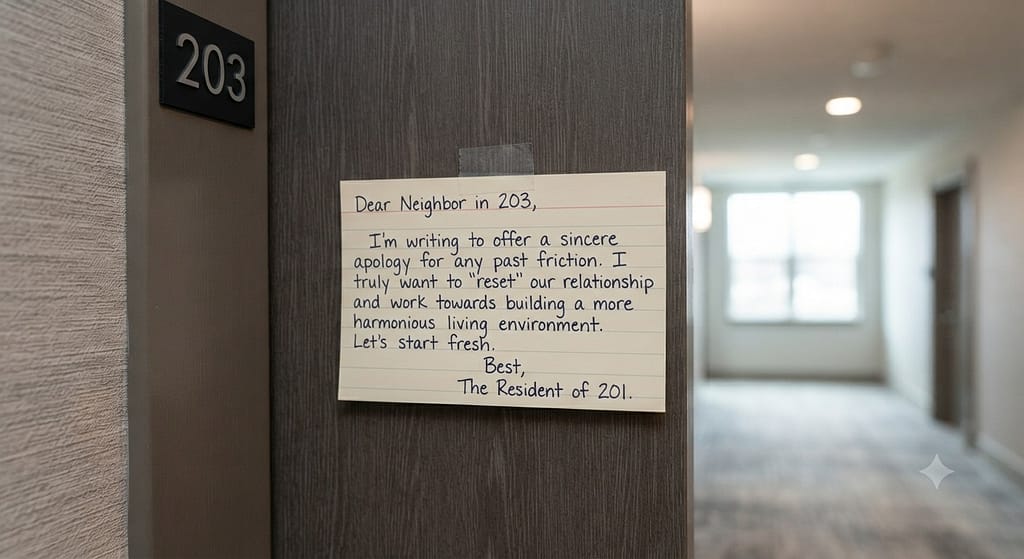
A: Reset. A handwritten apology note goes far. Acknowledge past issues. State what you’re doing now to fix them. Most people want harmony, not grudges.
🧘 The Building Knows Your Dog
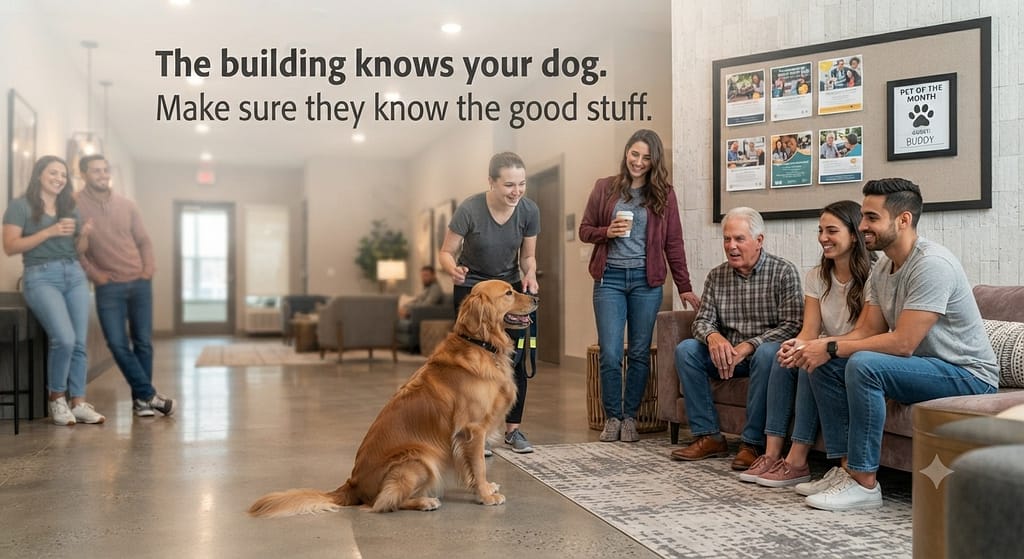
In a house, your dog is your dog.
In an apartment, your dog is part of the community.
The neighbors who nod at you in the lobby? They know your dog.
For demand barking issues, see our guide to stopping demand barking in apartments
The maintenance staff who leave notes on your door? They know your dog.
The property manager who renews your lease? They know your dog.
For leash reactivity on sidewalks, see our leash reactivity management guide.
Make sure they know the good stuff.
This 14-day plan isn’t about perfection. It’s about intention. It’s about showing your building—and your dog—that you’re a team.
Start today. Leave that note. Practice that U-turn.
Your future self (and your neighbors) will thank you. 🐾
🐾 — Apartment Dog Guide (ADG)
Living large in small spaces, one paw at a time. That’s the apartment dog life—see you in the next guide!.


