
Let’s paint a painfully familiar picture.
It’s 10:15 AM on a Tuesday
You’re sitting at your desk, trying to pretend you’re a functional adult, when your phone buzzes.
It’s your building manager. Your heart sinks before you even read the text.
“Hi, we received another noise complaint from Unit 4B. They say your dog has been barking non-stop since 9 AM. Please address this ASAP.”
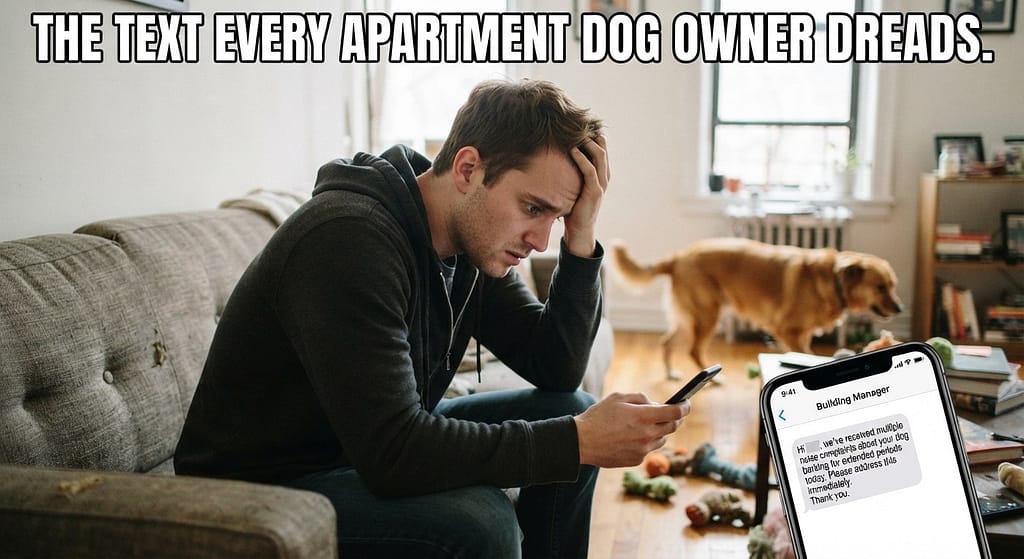
Your eyes dart to the puppy cam on your phone.
There he is—your sweet, fluffy, anxious disaster—pacing frantically in his pen, panting, howling like a wolf who lost his pack.
You’ve tried everything. You left out toys. You left the TV on.
You even left him a shirt that smells like you. Nothing works.
And now, you’re terrified. Terrified of your landlord. Terrified of your neighbors.
Terrified that you might have to choose between your apartment and your dog.
We’ve been there. We’ve gotten that text. We’ve cried in the stairwell.
Why Crate Training For Anxious Apartment Dog?
And we’ve found the one solution that actually saved our lease, our sanity, and our dog’s happiness: Crate Training.
But wait—before you roll your eyes and think, “Oh great, another person telling me to lock my dog in a cage,” hear us out.
We aren’t talking about the cruel, old-school “dungeon” crate training.
We’re talking about turning a crate into a five-star, all-inclusive anxiety-resort for your apartment-dwelling pooch.
When done right, a crate isn’t a prison. It’s a panic room. A fortress of solitude.
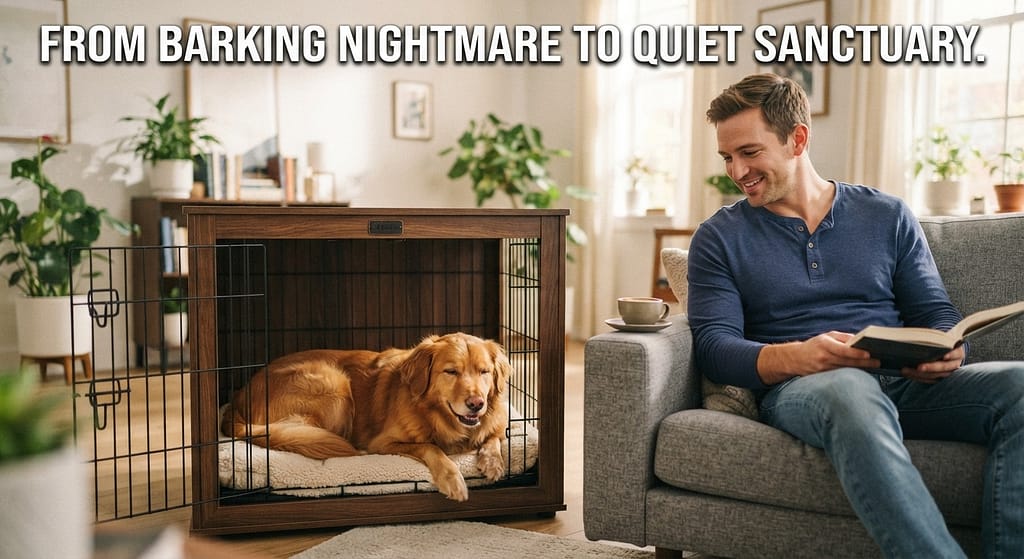
The one place in your tiny, echoey, neighbor-infested apartment where your dog can actually breathe.
This guide is specifically tailored for the high-stakes world of apartment living—where thin walls, tight spaces, and zero tolerance for noise make standard training methods obsolete.
Grab a coffee (or a stress ball), and let’s transform your barking nightmare into a quiet sanctuary.
The Interactive Quiz: Is Your Dog a Crate Candidate?
Before we start, let’s check if crate training is right for your specific anxious mess. Grab a pen and score your pup:

1 = Strongly Disagree | 3 = Neutral | 5 = Strongly Agree
- The “Den” Instinct: When scared (thunder, fireworks), does your dog naturally seek out small, enclosed spaces like under the bed, behind the toilet, or in a closet?
- The “Lazy” Factor: Does your dog enjoy napping in cozy, confined spots (like a cat bed or a corner) for hours?
- The “Chew” Squad: Does your dog love chewing on bones or Kongs for more than 15 minutes at a time?
- The “Velcro” Dog: Does your dog follow you from room to room but doesn’t necessarily need to be touching you?
- The “Patience” Level: Can your dog settle down for a nap without pacing after 20 minutes of quiet time?
The Scoreboard:

- 20-25 (Prime Candidate): Your dog is a natural den-dweller. Crate training will be a breeze.
- 10-19 (The “Project” Pup): It will take time, patience, and a lot of treats, but they will get there. (We were here).
- 5-9 (The Claustrophobe): If your dog panics in small spaces (tries to dig out of closets), traditional crating might not be the answer. Skip to our “Alternative Solutions” section at the end.
The “Big Lie” We Need to Unlearn
Let’s address the elephant in the tiny apartment.
Somewhere along the line, a myth was born: “Crates are cruel. They’re cages. It’s like putting a dog in jail.”
We believed this too. In fact, we started as “anti-crate” activists. We bought the giant playpens, the baby gates, and the expensive “free-roam” setups.
We thought we were being kind. But here’s the plot twist: We were making the anxiety infinitely worse.
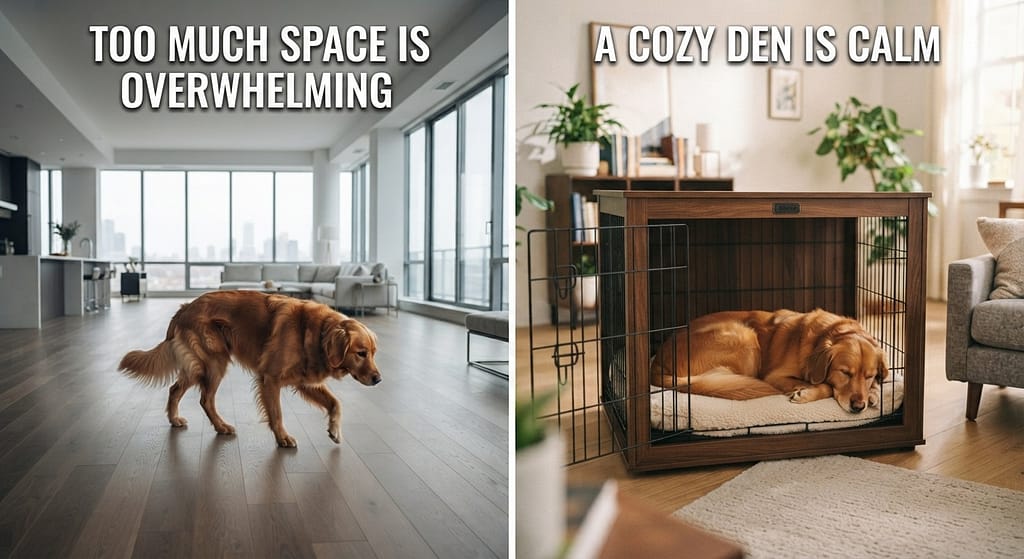
For a dog with anxiety—especially in an apartment—too much space is overwhelming.
Think about it like this:
If you’re an agoraphobic person having a panic attack, do you want to be in the middle of a wide-open football field, or do you want to be in a cozy, dark bedroom with the door closed?
For a dog, the open apartment is the football field.
Every sudden noise (the upstairs neighbor dropping a shoe, the garbage truck outside, the elevator dinging) feels like an attack coming from every angle.
They pace because they don’t know where to put their stress.
A crate, properly introduced, solves this. It shrinks the world to a manageable size.
It becomes the “bedroom” where they can turn their back on the scary world and just… exist.
Step 1: Choosing the Right “Penthouse” for Your Anxious Dog
Apartment living means you probably don’t have space for a monster-sized crate. But size matters—a lot.
The Rule of Thumb:
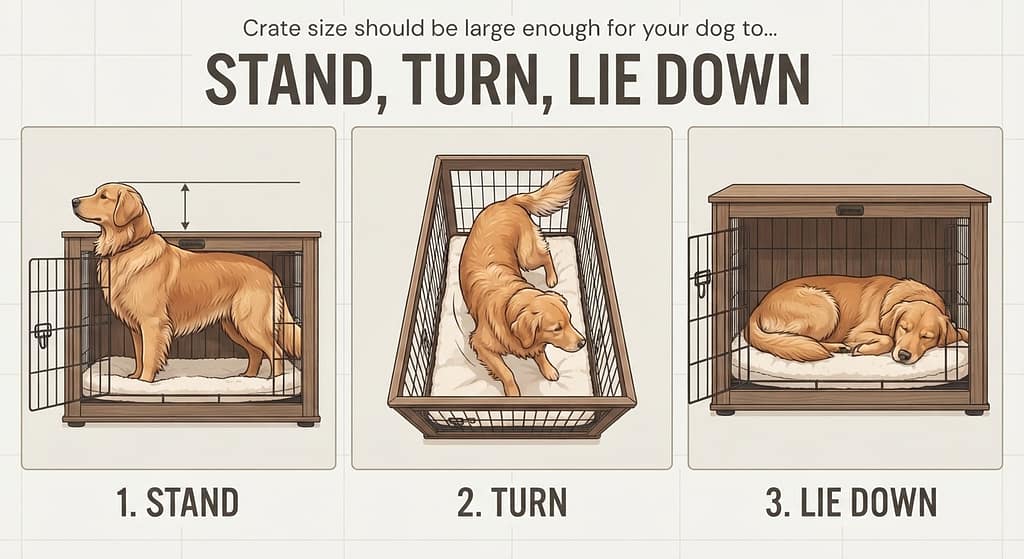
Your dog should be able to stand up, turn around, and lie down comfortably. Too big is actually bad.
If the crate is massive, they’ll pee in the corner and sleep in the other corner.
We want them to treat it like a den—no potty zones allowed.
Material Matters (Crucial for Anxious Dogs):
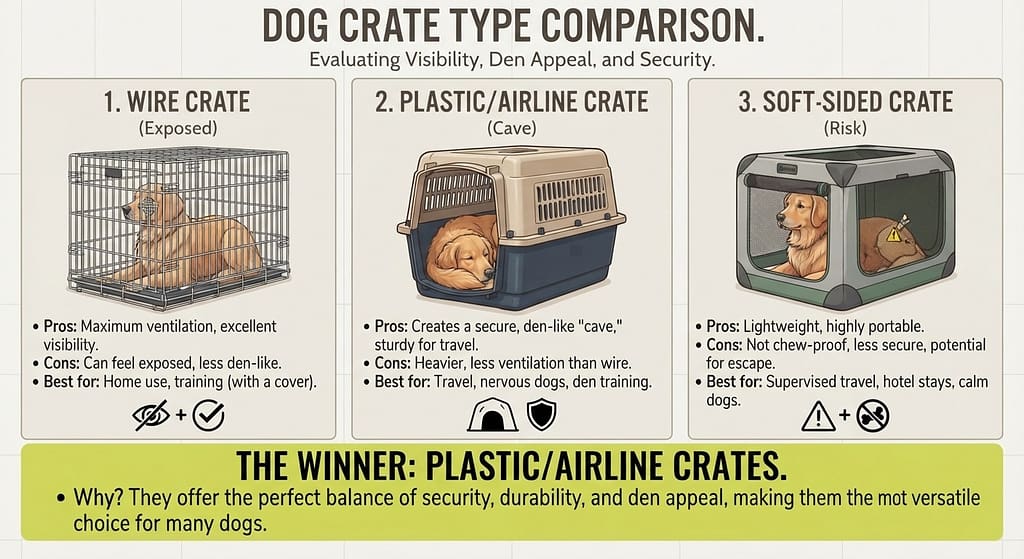
- Wire Crates (The Classic): Good for ventilation, but terrible for anxiety. They feel exposed. If they can see the scary hallway, they can’t relax. (We cover ours with a blanket—more on that later).
- Plastic/Airline Crates (The Winner): These are darker, more enclosed, and dampen sound. They feel like a cave. For an anxious apartment dog, this is the absolute gold standard. It muffles the neighbor’s TV and blocks out the visual triggers.
- Soft-Sided/Fabric Crates (The Risk): Comfy, but if your dog is a digger or chewer, they will destroy this in 2.5 seconds. Skip it.
Our Recommendation: Get a high-quality plastic crate (like the Petmate Sky Kennel or similar) that is just big enough for them. Remove the top door if you want to use it as an open bed later. For now, keep it cozy.
Step 2: Location, Location, Location (In a 500 Sq Ft Box)
In a house, you can put the crate in a quiet spare bedroom. In an apartment, you have… the living room.
Or the corner of the bedroom. That’s it.
So, where do we put it?
The Worst Place: Next to the front door. Every time the elevator dings or a neighbor walks by, your dog will be “on guard” right next to the trigger zone.
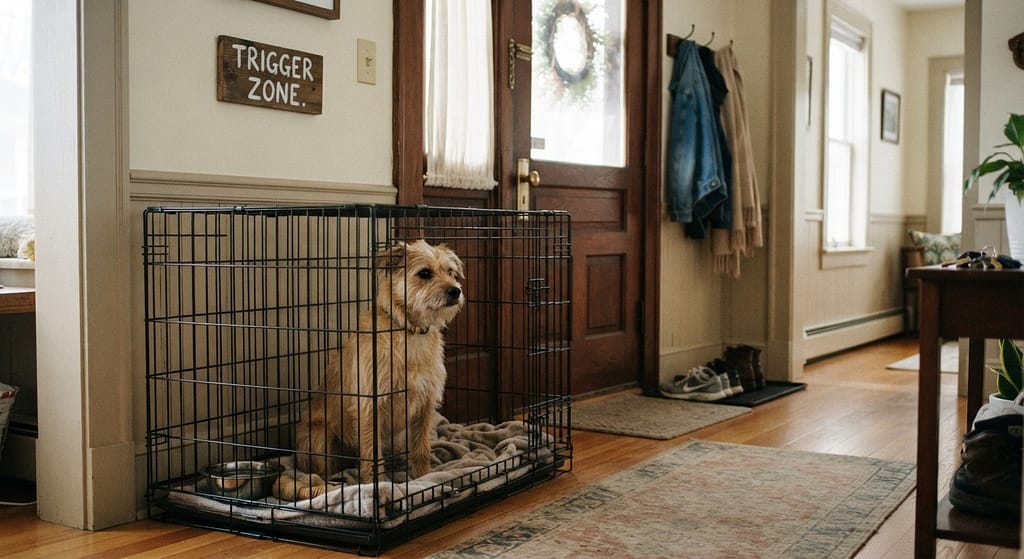
The Best Place: In a quiet corner of your bedroom, away from windows and the main hallway. If you have a walk-in closet, that’s prime real estate.

If not, place it against an interior wall (not the wall shared with the neighbor’s TV).
The “White Noise” Hack:
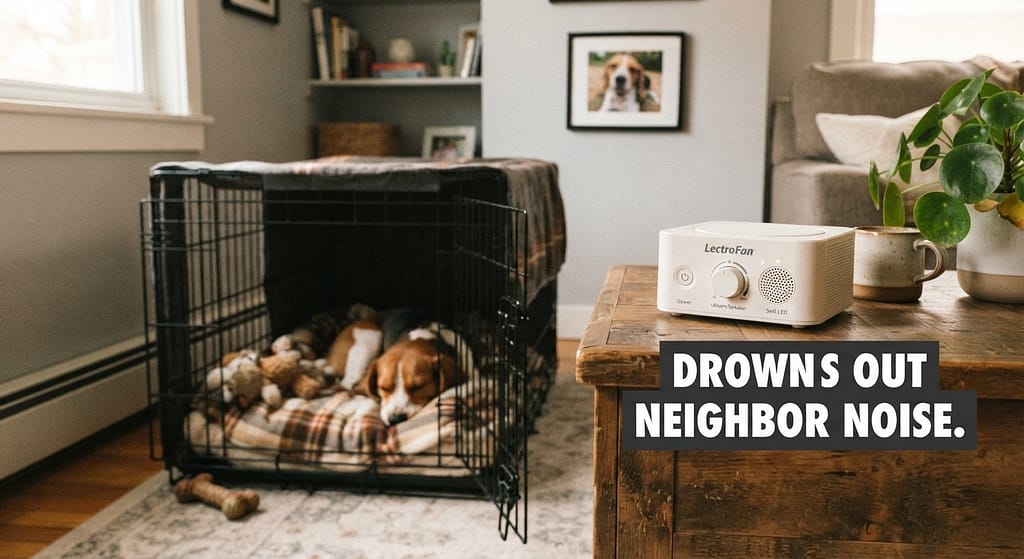
Because we live in apartments, we have to drown out the neighbor noise.
Place a white noise machine or a small fan near (but not pointed directly at) the crate.
The consistent hum masks the unpredictable sounds of apartment living (the slamming doors, the stomping feet).
We swear by this. It reduces startle responses by 70%.
Step 3: The “5-Star Resort” Protocol (Introduction Phase)
This is where we go slow. We mean glacial slow. If you rush this, you’ll create a lifelong fear of the crate.
Day 1-3: The “Open House”
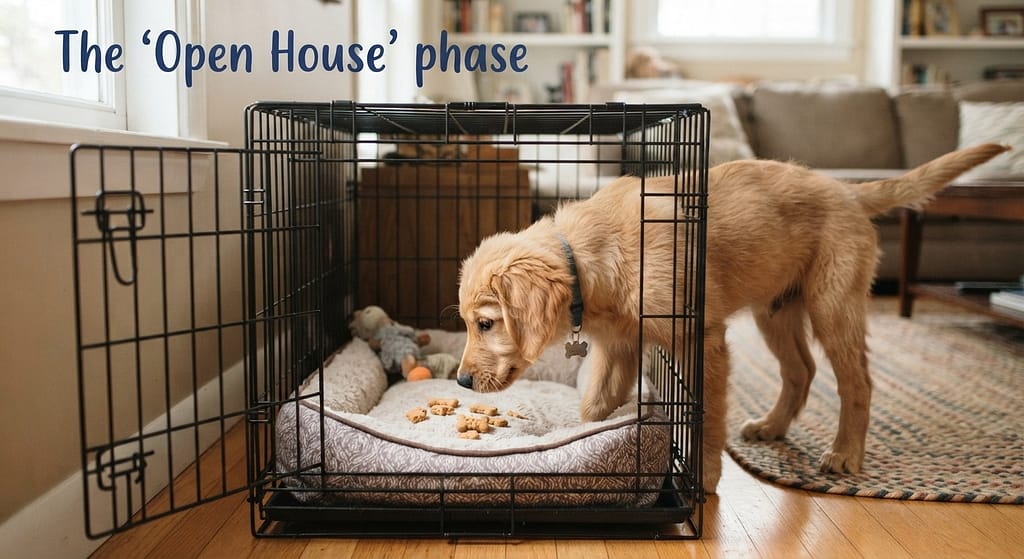
Leave the crate door open. Throw the highest-value treats inside (freeze-dried liver, cheese, boiled chicken).
Don’t force them in. Let them go in and out freely. We attached the crate door to the wall with a bungee cord so it never accidentally swings shut and spooks them.
The Magic Meal Time:
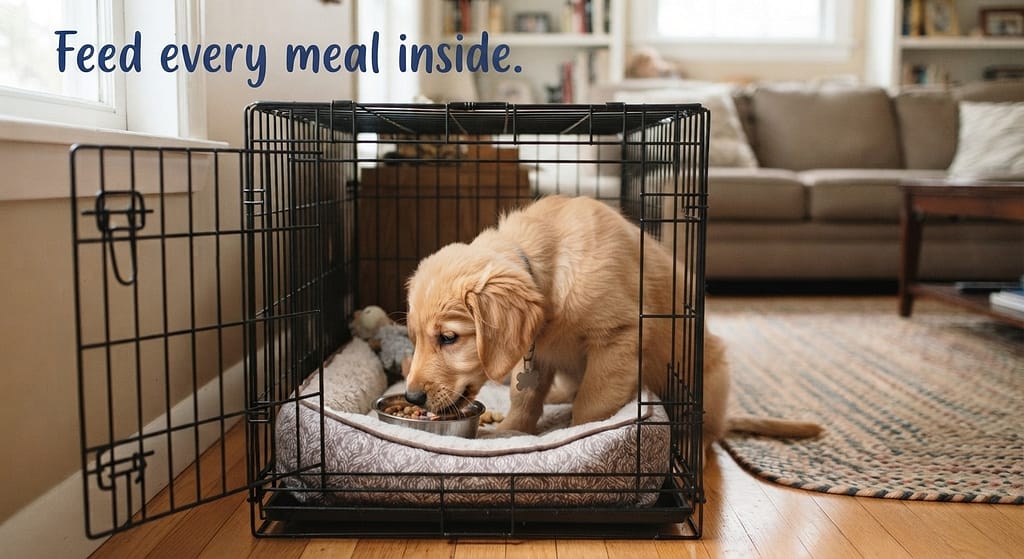
Feed every single meal inside the crate. Put the bowl all the way in the back. If they are nervous, start with the bowl just inside the doorway.
Over a few days, move it further back.
The “Chew” Connection:
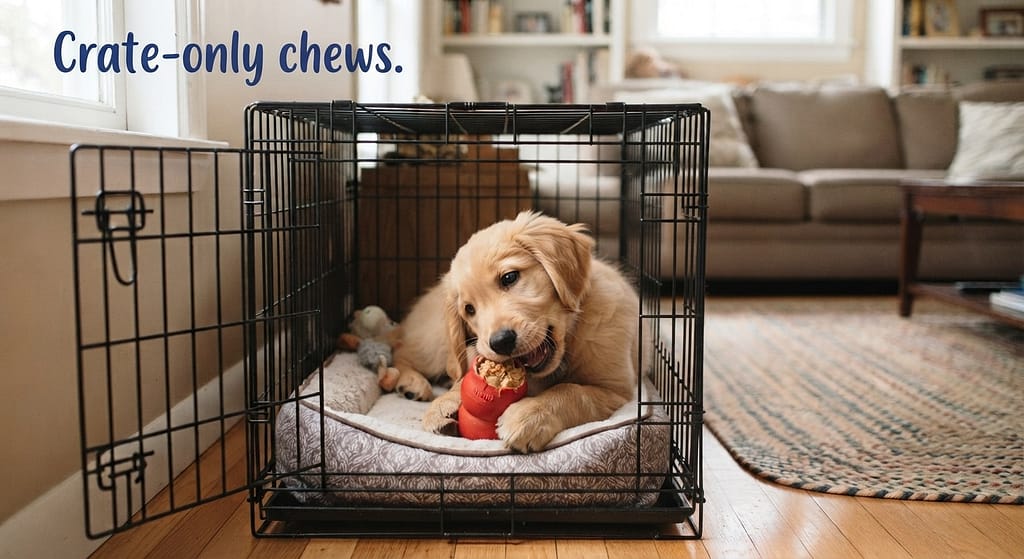
Dogs release endorphins when they chew—it’s nature’s chill pill.
Give them a special “crate-only” chew (like a filled Kong or a bully stick) that they only get when they step inside.
They will start to associate the crate with “good things happen here.”
Step 4: The “Door Close” Dance (Duration Training)
Now that they willingly go inside, it’s time to close the door. But we’re not locking them in for 8 hours. We’re building seconds into minutes.
Our “Pattern Game”:
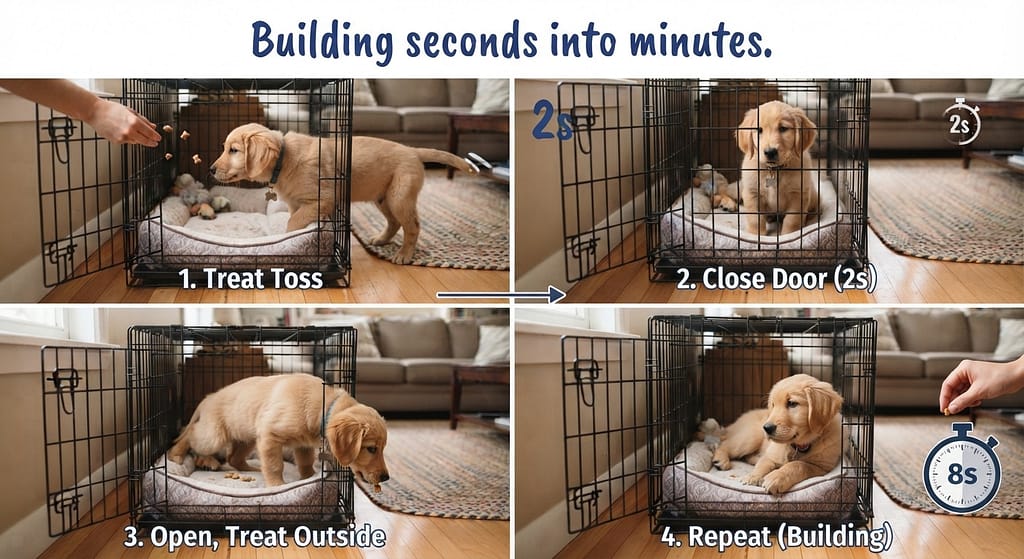
- Toss a treat inside. They run in.
- Close the door for 2 seconds.
- Open the door and toss another treat outside to lure them back out. (Let them choose to exit).
- Repeat. Do this 10 times. Close for 5 seconds. Then 10 seconds. Then 30 seconds.
The Golden Rule: Only open the door when they are calm (or at least quiet). If they are whining, wait for a micro-second of silence before opening. If you open the door while they whine, you teach them, “Whining = Freedom!”
The “Apartment” Challenge:
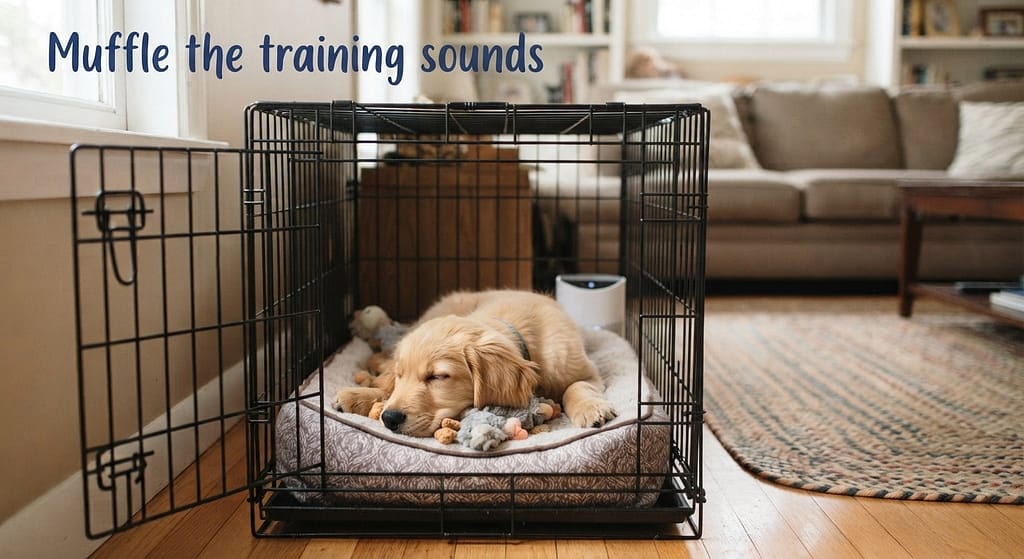
We know you have neighbors.
So, do this duration training at a reasonable time (not 6 AM). Use your white noise machine to muffle the sound of them testing the waters.
If they start to get frantic, we’ve gone too fast.
Go back a step. We want a 10-minute quiet duration before we even think about leaving the room.
Step 5: The “Disappearing Act” (Simulating Your Departure)
This is the true test for an apartment dog with separation anxiety. You must teach them that you leaving the room isn’t the apocalypse.
The “In-Sight” Departure:

Walk out of the bedroom (where the crate is) into the living room.
Come right back. Treat them. Do this 20 times. Then, walk out and close the bedroom door for 1 second. Come back.
The “Building” Separation:

Walk out the front door of your apartment. Literally step into the hallway. Count to 5. Come back in. Treat.
Over several days, extend this time. 30 seconds. 1 minute. 5 minutes. *But here’s the secret—only come back when they are quiet. * If you come back while they are barking to “rescue” them, you reinforce the barking.
The “Leave It” Signal:
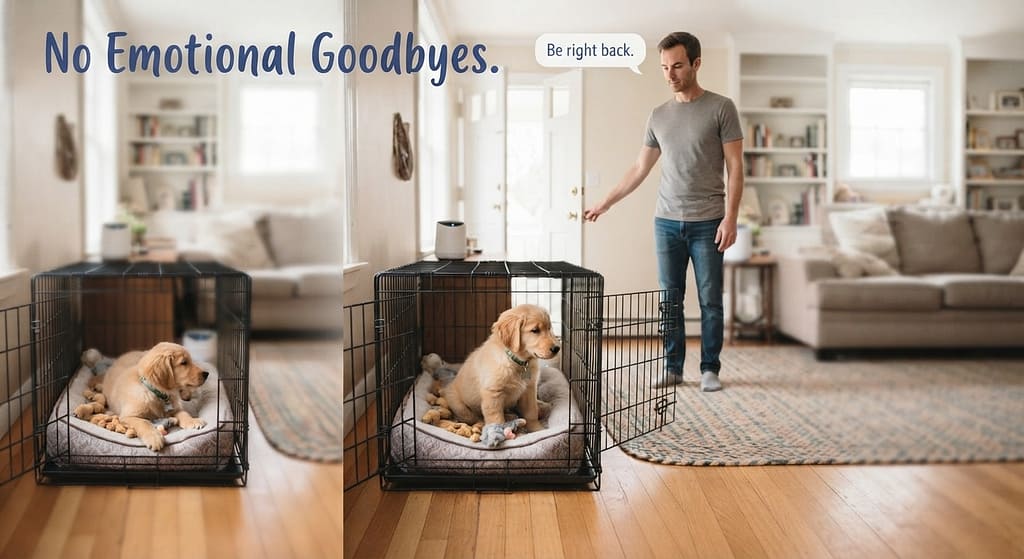
We use a specific phrase when we leave.
We say, “Be right back,” in a super chipper, neutral tone. We never make a big emotional deal out of leaving.
No sad puppy eyes from us. We are a rock. We are confident. If we act like leaving is normal, they will (eventually) believe it’s normal.
The “Nighttime” Protocol (Without the Neighbor Eviction)
The first few nights in a crate can be rough. Whining at 2 AM is a great way to get a note under your door.
Our Nighttime Rule:
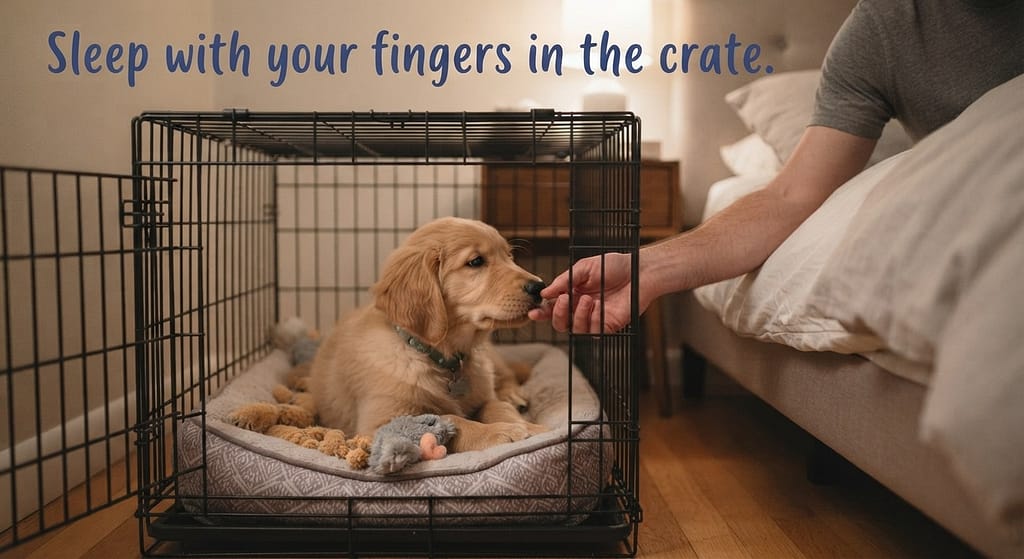
The crate goes right next to our bed. For the first week, we literally slept with our fingers poked through the crate holes so they could smell us. It calms them instantly.
The “Potty” Break:
If they whine at night, they might actually need to pee (especially young puppies).
Take them out on a leash for a boring, no-play, no-talk potty break.
Take them back inside. Back in the crate. Do not turn on the lights. Do not engage. This teaches them: “Nighttime is for sleep, not for parties.”
The “Heavy” Blanket:
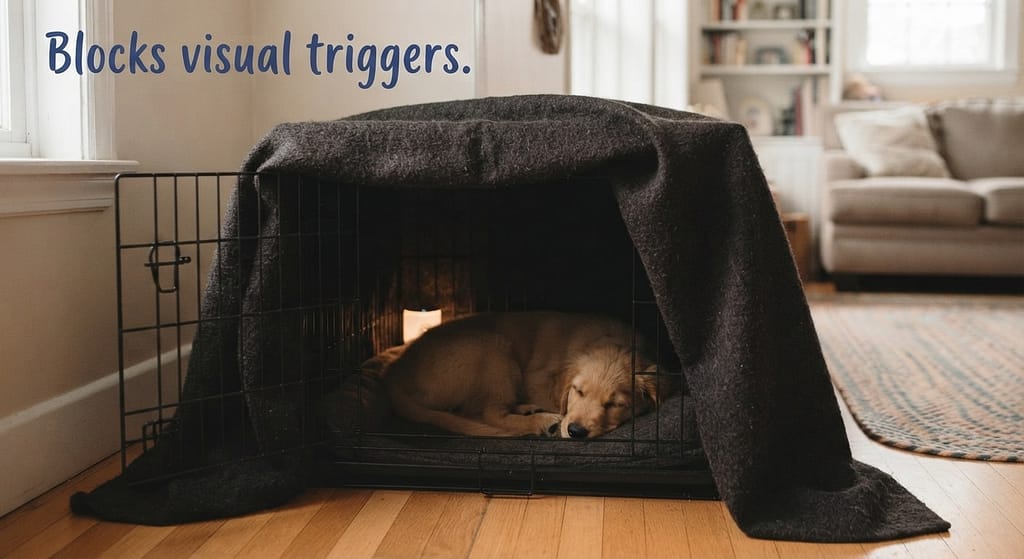
Drape a heavy, dark blanket over the top and sides of the crate.
Leave the front exposed for air. This simulates a dark den and blocks out the dreaded “neighbor flashing the hallway light” trigger.
Make sure it’s breathable (don’t cover the back air vents completely).
The “Extreme Cases”: When They Panic in the Crate
Okay, let’s be brutally honest. Some dogs with severe confinement anxiety will freak out the moment that door latches.
They will drool, bite the bars, and try to escape to the point of hurting themselves.
If this is your dog, STOP the hard-core crating and pivot:
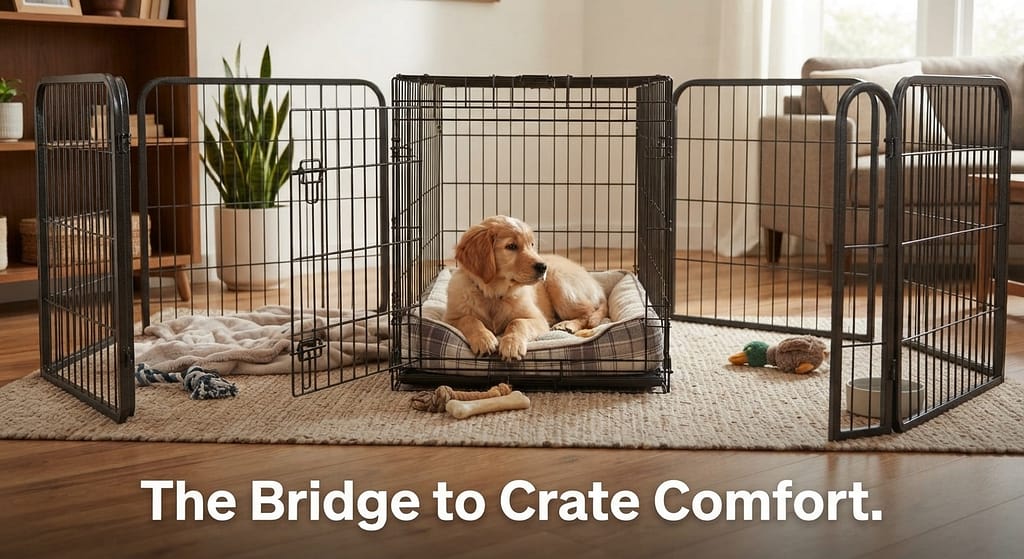
- The “Playpen” Bridge: Instead of a hard crate, use a small, enclosed playpen. Put the open crate inside the playpen. They have the option to go in the crate, but they aren’t locked in. They can decompress in the playpen first.
2. The “Medication” Talk: We are huge advocates of consulting your vet. Sometimes, they need a little pharmaceutical help (Trazodone or Gabapentin) to take the edge off during the training phase. It’s not a forever thing; it’s a “break the cycle of panic” thing. We used this for our rescue, and it was the turning point.

3. The “Thundershirt” Combo: Put the anxiety wrap on them before they go into the crate. The physical pressure + the den = maximum comfort.
Myth Busters: Apartment Edition
Let’s clear up some apartment-specific myths that we hear constantly.
Myth #1: “I can’t crate my dog because I live in an apartment and the neighbors will think I’m cruel.”
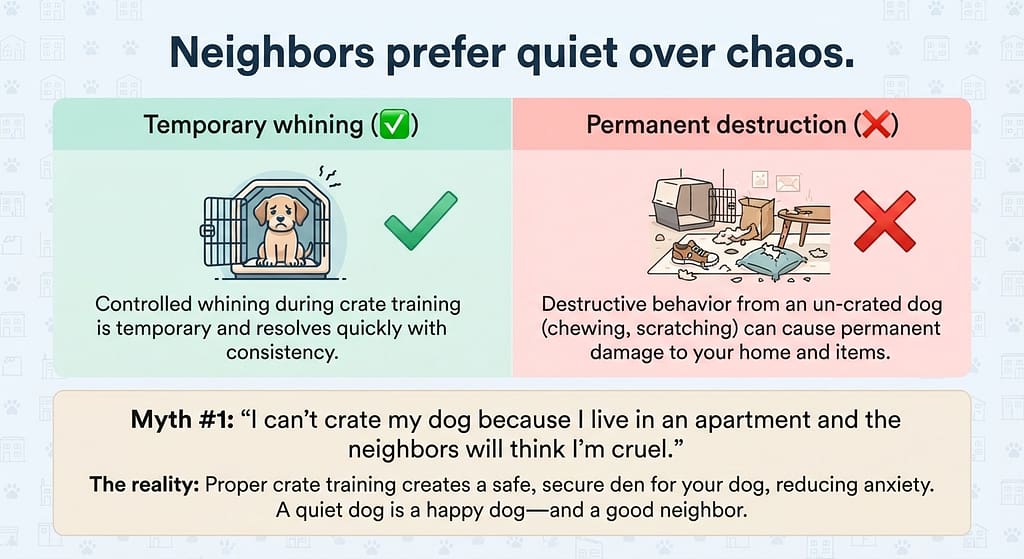
Truth: A few whines during training are temporary. A dog that destroys the apartment and barks incessantly due to anxiety? That’s a permanent nuisance. Your neighbors will thank you for a quiet, crated dog over a destructive, howling one.
Myth #2: “My apartment is too small for a crate.”
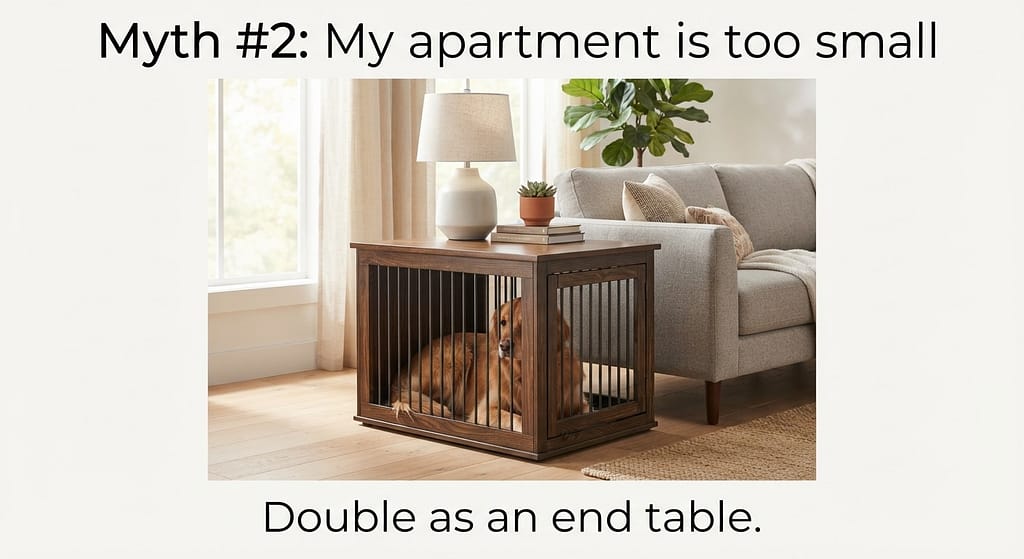
Truth: If you have floor space for a coffee table, you have floor space for a crate. And guess what? It doubles as an end table! Put a piece of wood and a tablecloth on top. Instant furniture.
Myth #3: “Crate training only works for puppies; my adult rescue is too old to learn.”
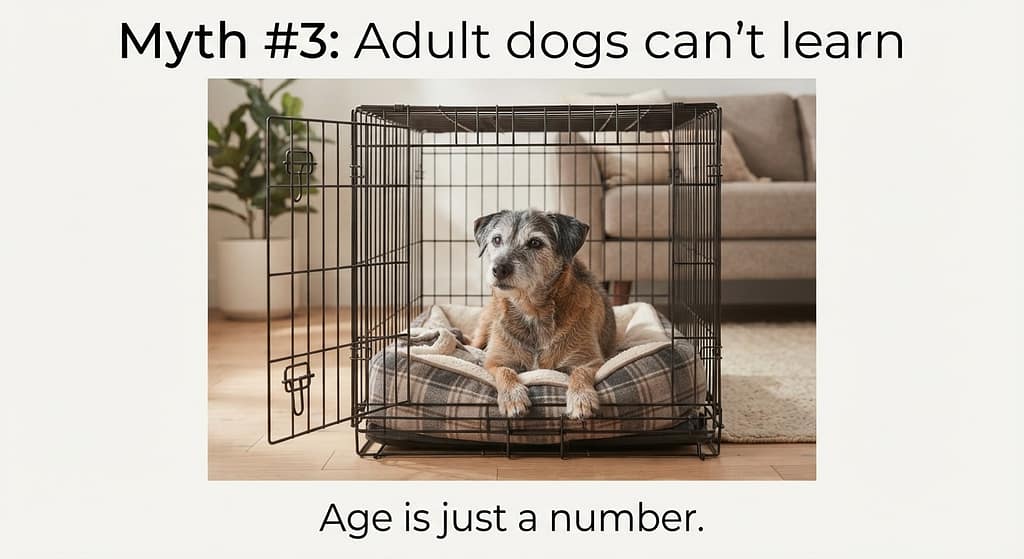
Truth: Age is just a number. We adopted a 6-year-old abused rescue who had never been in a crate. He was the hardest case. It took us 3 months of slow, daily work. Now, he runs to his crate when we grab our keys. Dogs can learn at any age. They just need time.
The “Neighbor Survival” Checklist (Bonus)
Before you start this process, grab a copy of this checklist and physically check it off. We wish we had done this earlier.
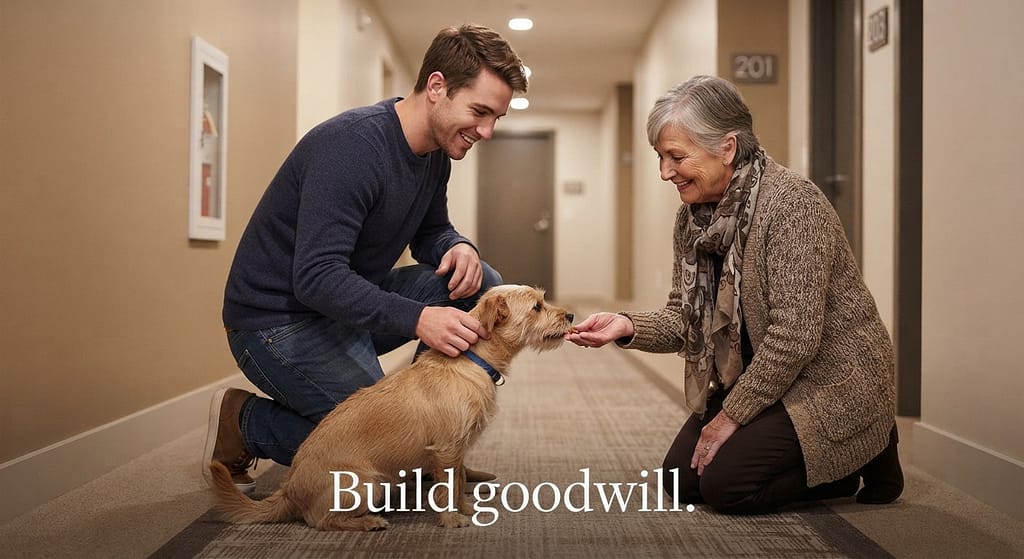
- □ Introduce yourself to neighbors: Knock on their door. Bring a small gift (a bottle of wine, some cookies). Say: “Hi! I live next door. I have a dog who is currently in training. I am working to ensure he is quiet. Please text me directly if he bothers you instead of going to management. I’ll fix it immediately.” This buys you so much goodwill.
- □ Rug the floor: Put a thick, memory foam bath mat or a rubber mat under the crate. It absorbs the sound of them moving around so the downstairs neighbor doesn’t hear the tick-tick-tick of dog nails.
- □ Limit crate time to 4 hours max (during the day): If you work 9-5, this is your reality check. You can’t leave a dog in a crate for 8 hours straight without a potty break. Budget for a dog walker to come mid-day, or use a playpen attached to the crate for longer durations.
The “Exit Strategy” (When to Stop Using the Crate)
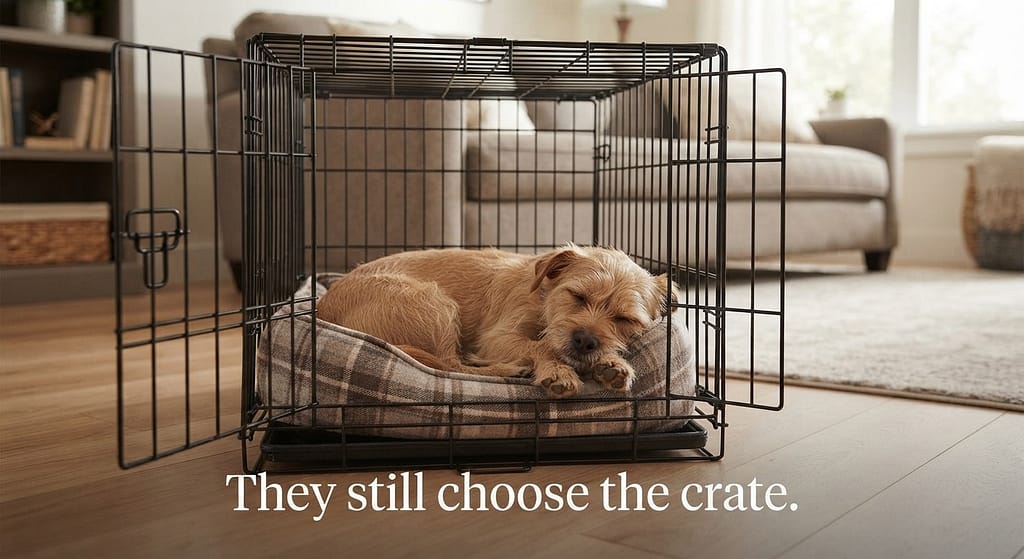
Crate training doesn’t have to be forever.
For many of our dogs, once they hit the 2-year mark and are entirely trustworthy, we leave the crate door open and let them sleep on the dog bed instead.
But guess what?
They still sleep in the crate with the door open 80% of the time. Because it’s not a cage. It’s their safe house.
Our rule for “graduation”: If your dog can be left alone for 2 hours in the crate, calm and quiet, try leaving them out in a single, dog-proofed room for 10 minutes while you grab the mail.
Slowly increase that time. If they are destructive, they aren’t ready. Go back to the crate.
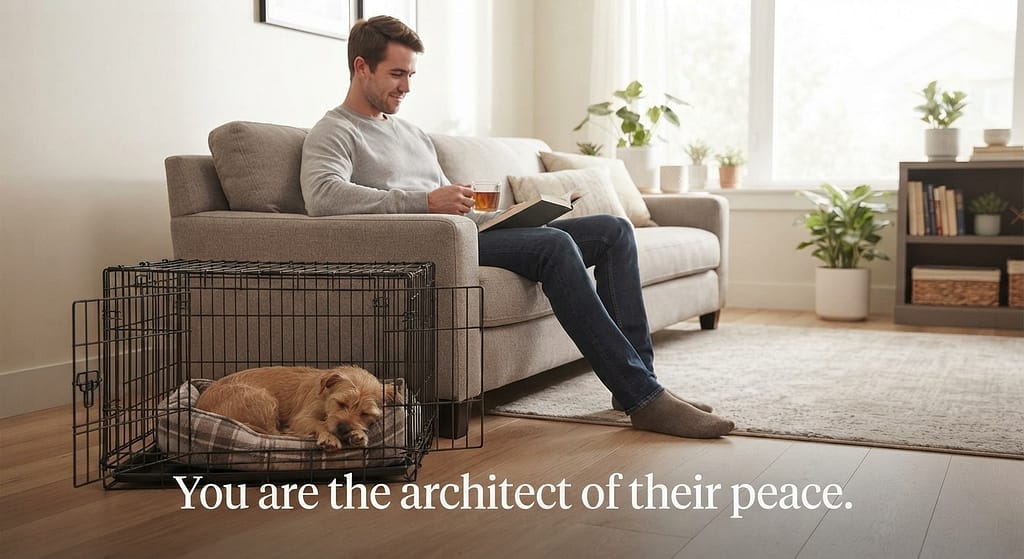
The Final Word: You Are the Architect of Their Peace
We know this journey feels impossible. We know that listening to a whining dog while worrying about eviction notices is a special kind of hell. We’ve sat on the hallway floor, crying next to the crate, wondering if we were “bad owners.”
But we weren’t. And neither are you.
By teaching your anxious apartment dog to love their crate, you aren’t being cruel. You are giving them the one thing they desperately lack: Structure. You are giving them a “brain break” from the overstimulating, noisy, chaotic world of city living.
A calm dog is a happy dog. And a quiet dog is a dog that gets to stay in the apartment.
Start small. Be boring. Be consistent. Use those cheese treats like they are gold. And remember: your dog isn’t trying to give you a hard time. They are having a hard time. They just need a little box to call their own.
You’ve got this. Your neighbors will thank you. And one day, you’ll look at that puppy cam and see your dog sprawled out on their back, snoring peacefully in their crate, completely unbothered by the world outside.
And you’ll think: “We did that.”
Now, go set up that crate. Slow and steady wins the race.
🐾 — Apartment Dog Guide (ADG)
Living large in small spaces, one paw at a time. That’s the apartment dog life—see you in the next guide!.


