
Because what works for a sleepy Shih Tzu won’t cut it for a high-strung Heeler
Let’s Be Real:
Apartment Dog Feeding Is Different
If you work from home, your feeding schedule needs to align with your workday — see our work-from-home-with-a-dog guide.
You love your furry roommate.
But here’s the thing:
Feeding a dog in an 800-square-foot space comes with unique challenges.
No backyard to dash out for middle-of-the-night potty trips. Thin walls that echo every kibble crunch at 6 a.m.
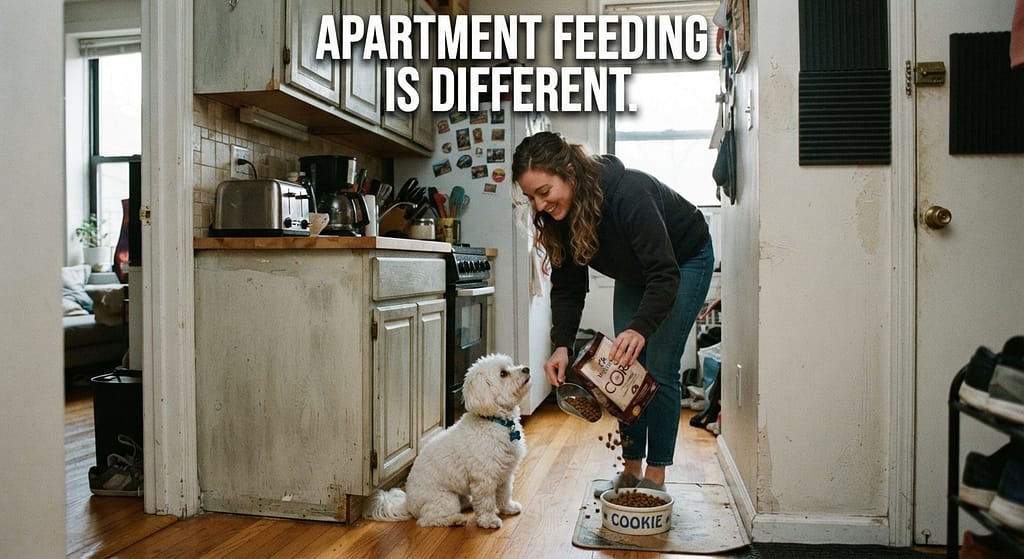
And a leash routine that means meals and walks have to sync up perfectly.
Sound familiar?
We’ve been there. We’ve cleaned up carpet accidents because we guessed the timing wrong.
A hungry husky has woken us up at 4:30 a.m. because his dinner didn’t stick.
And we’ve learned the hard way that a bored, high-energy dog fed on the wrong schedule will redecorate your sofa.
But here’s the good news:
Once you match your apartment dog’s feeding schedule to their age and energy level, everything gets easier.
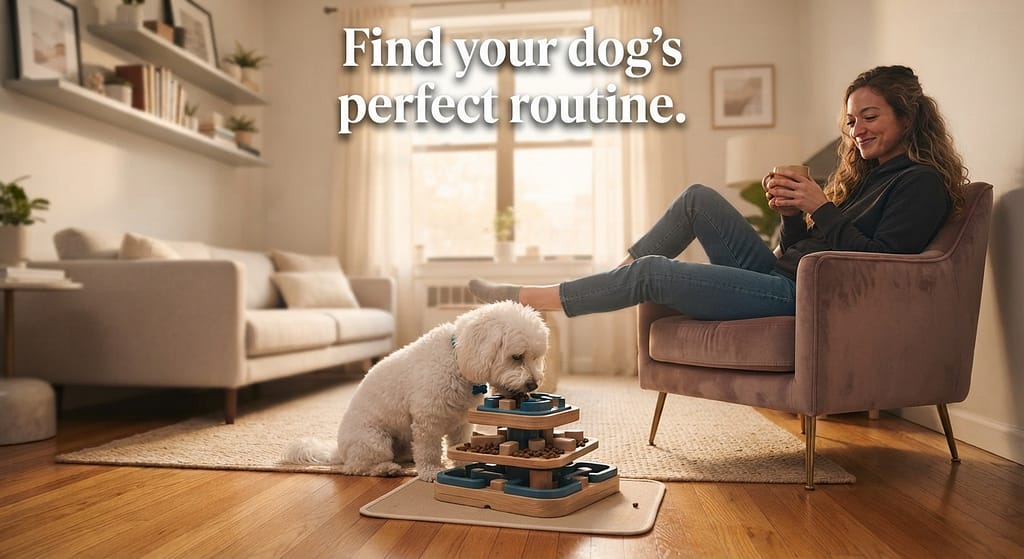
Potty training clicks. Settling down becomes possible.
And you finally stop feeling like a short-order cook for a four-legged tornado.
For quiet, low-barking breeds, see our quietest dog breeds for apartments.
Ready to find your dog’s perfect routine? Let’s bucket-brigade our way through it.
Why “Just Feed Twice a Day” Fails in an Apartment
Wait—don’t most dogs eat twice a day?
Yes. But here’s what most people get wrong:
Two identical meals work fine for a laid-back adult dog in a house with a yard. In an apartment? You need to consider:
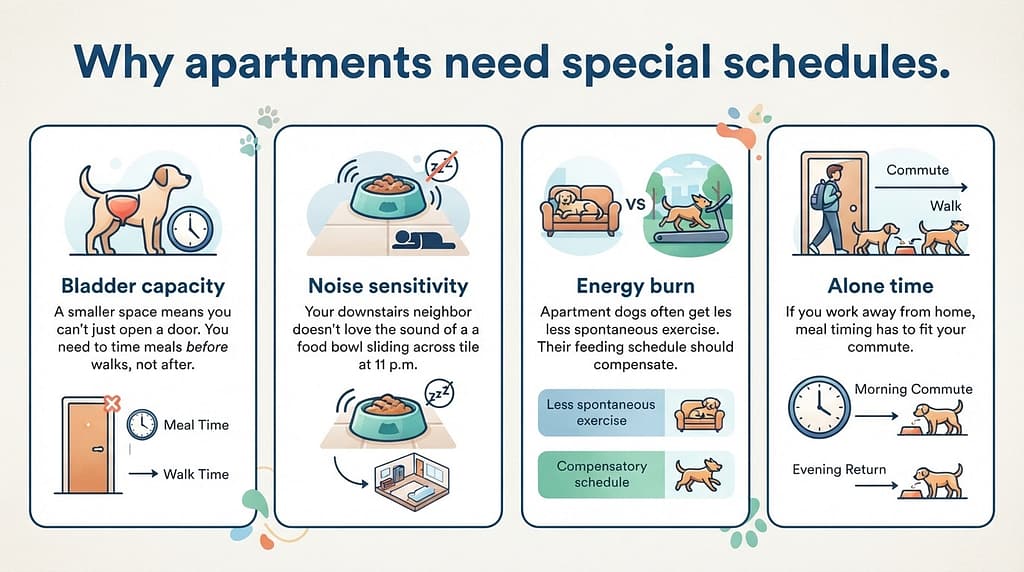
- Bladder capacity – A smaller space means you can’t just open a door. You need to time meals before walks, not after.
- Noise sensitivity – Your downstairs neighbor doesn’t love the sound of a food bowl sliding across tile at 11 p.m.
- Energy burn – Apartment dogs often get less spontaneous exercise. Their feeding schedule should compensate.
- Alone time – If you work away from home, meal timing has to fit your commute.
The breed you choose affects feeding needs — start with our guide: the best small dog breeds for apartments
So we’re going to build a schedule that works for your apartment, your dog, and your sanity.
Before We Dive In: The 3 Golden Rules of Apartment Feeding
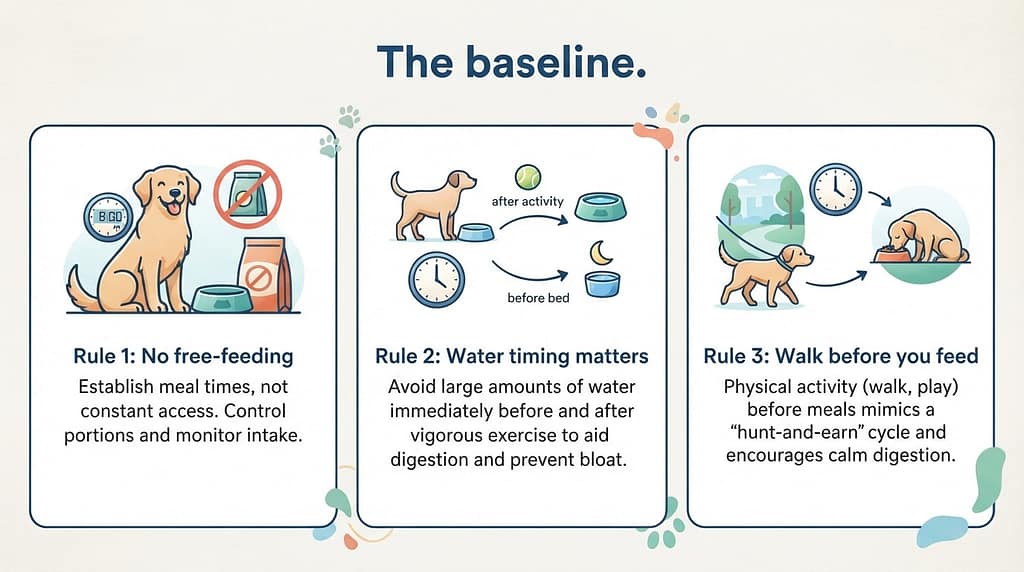
We need a quick baseline.
These rules apply whether you have a Chihuahua or a Great Dane (yes, people keep Danes in apartments—we salute you).
Rule #1: No free-feeding. Leaving food out all day is a recipe for weight gain, picky eating, and midnight potty surprises. Scheduled meals only.
Rule #2: Water timing matters. Lift water bowls 2–3 hours before bedtime. Your carpet will thank us.
Rule #3: Walk before you feed… mostly. For most dogs, a quick potty break before breakfast prevents accidents. After meals, a longer walk happens 30–60 minutes later to avoid bloat.
For Frenchies and other flat-faced breeds, proper walking gear is essential — see our French Bulldog neck safety guide.
Got it?
Great. Now let’s find your dog’s age group.
🐶 PUPPY PHASE (8 weeks – 1 year): The Apartment Potty Training Edition
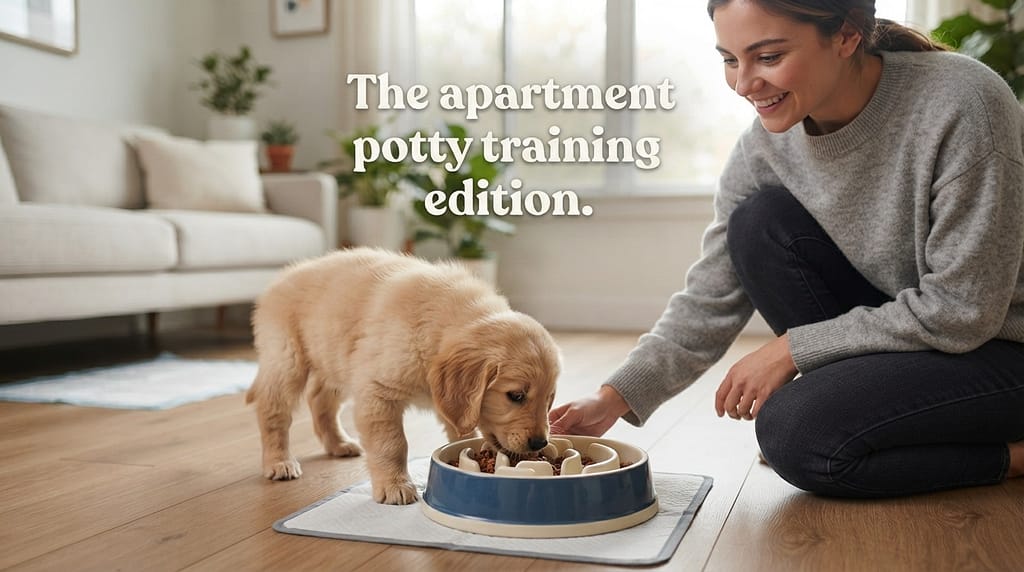
Let’s be honest: Puppies in apartments are hard.
You’re running down three flights of stairs at 2 a.m. in your pajamas.
You’re scrubbing hallway carpets. You’re questioning every life choice.
But here’s the secret: A strategic feeding schedule cuts potty accidents by half.
How Often Should Apartment Puppies Eat?
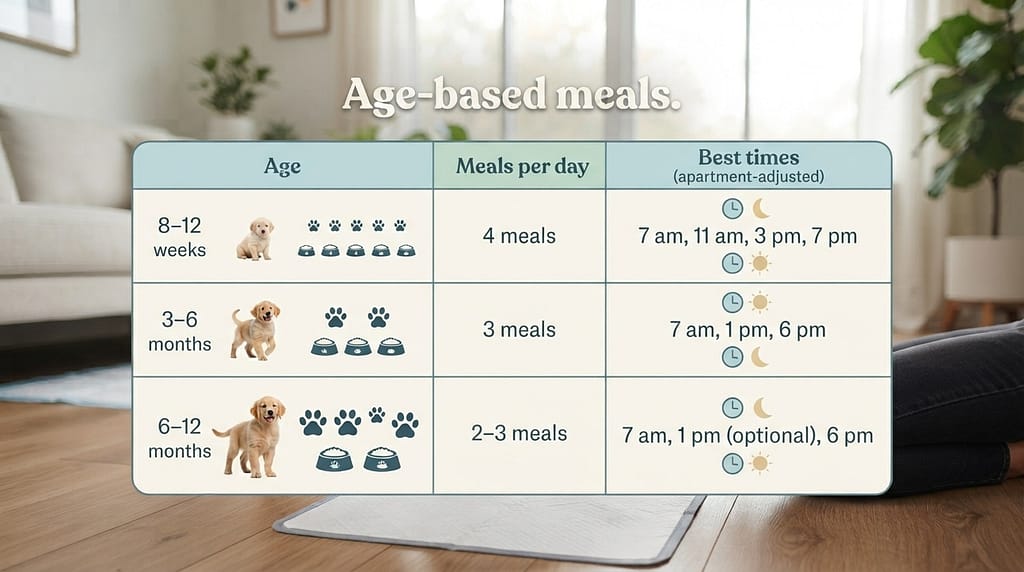
| Age | Meals per day | Best times (apartment-adjusted) |
|---|---|---|
| 8–12 weeks | 4 meals | 7 am, 11 am, 3 pm, 7 pm |
| 3–6 months | 3 meals | 7 am, 1 pm, 6 pm |
| 6–12 months | 2–3 meals | 7 am, 1 pm (optional), 6 pm |
But why those specific times?
Because they align with your commute and your neighbor’s tolerance.
Notice the last meal at 6 or 7 pm? That gives you a solid 3-hour window before bed to take the puppy out again.
Apartment Puppy Feeding Pro-Tips
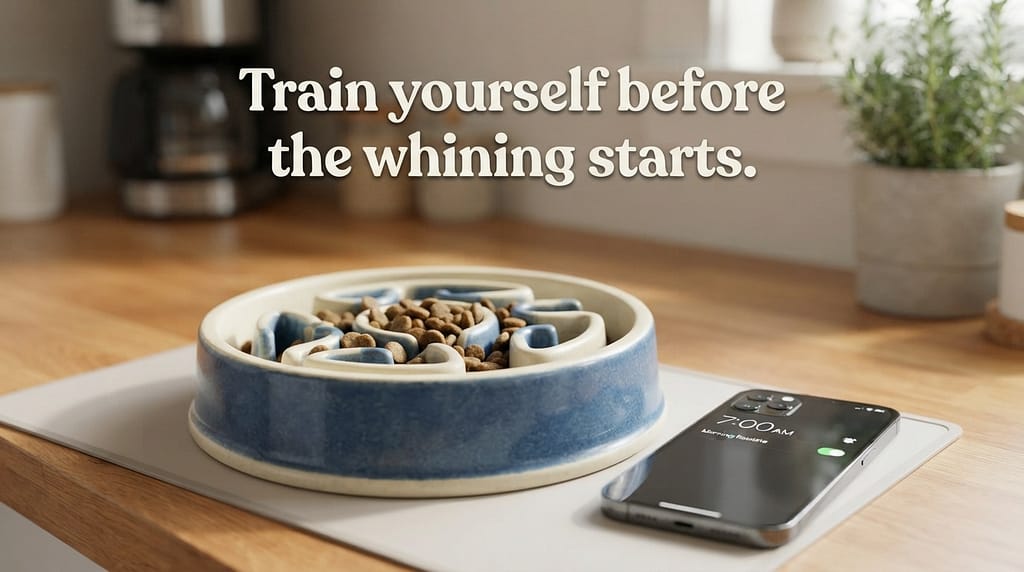
- Use a slow-feeder bowl. Puppies inhale food, then get hiccups, then bark. A slow feeder keeps them calm and quiet.
- Set phone alarms. Your puppy can’t tell time, but you can. The alarm trains you before the whining starts.
- Feed in the same spot every day. A small mat near the kitchen (away from your bedroom) creates a routine. Dogs thrive on predictability.
What if your puppy is super high-energy?
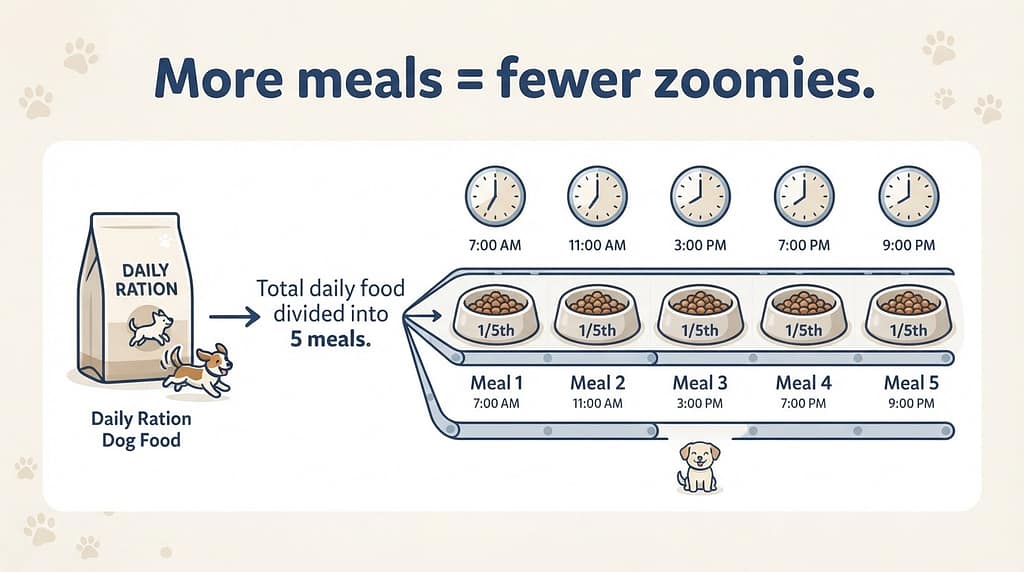
Break their total daily food into five tiny meals. More meals = more even blood sugar = fewer 5 a.m. zoomies.
“But my puppy cries for food every two hours anyway!”
We hear you. That’s normal. But giving in every time creates a monster. Stick to the schedule for one week—we promise the whining drops by 80%.
🐕 ADULT DOGS (1–7 years): This Is Where Energy Level Changes Everything
Here’s where most feeding guides go wrong.
They say “feed adult dogs twice a day” and call it done.
But in an apartment? A couch-potato Bulldog and an agility-trained Border Collie have wildly different needs.
So we’re splitting adult dogs into three energy tiers. Find yours.
How to Calculate Your Dog’s Daily Portion (Quick Math)
Before we go further, you need your dog’s daily calorie count.
Check their food bag or use an online calculator. Most adult dogs need roughly:
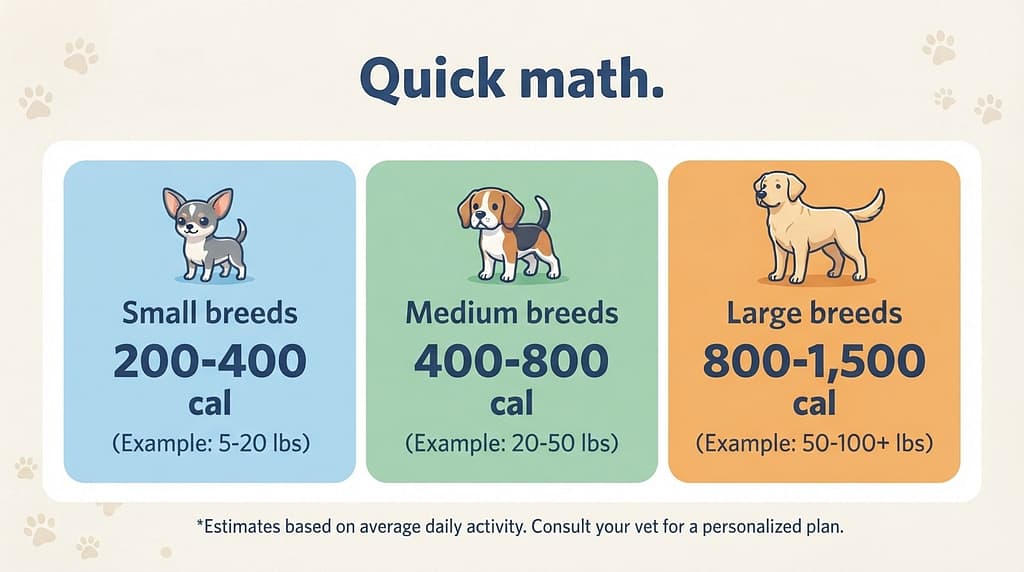
- Small breeds (5–15 lbs): 200–400 calories/day
- Medium breeds (15–40 lbs): 400–800 calories/day
- Large breeds (40–90 lbs): 800–1,500 calories/day
Divide that total by how many meals we recommend below.
Tier 1: Low Energy – The Apartment Couch Potato
Signs you have this dog:
Sleeps 18+ hours a day. Walks to the food bowl like it’s a chore.
Would trade a hike for a heating vent.
Best schedule: 2 meals per day, evenly split
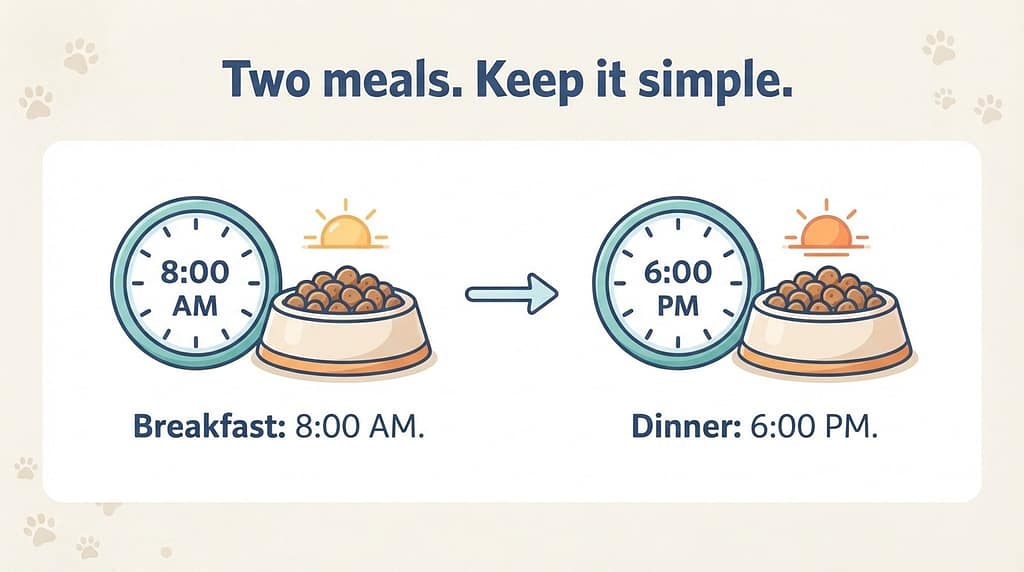
- Breakfast: 8:00 AM (after your first coffee, before your shower)
- Dinner: 6:00 PM (right after you get home from work)
If you work long hours, see our best small dogs for 9-5 professionals
Why this works:
Low-energy dogs don’t need midday fuel.
Two meals keep their metabolism steady without overfeeding.
And here’s an apartment bonus: a sleepy dog at 10 pm means no midnight pacing on hardwood floors.
Watch out for:
Weight gain. Apartment low-energy dogs are prone to obesity.
Measure every single kibble. Use part of their dinner as training treats so you don’t add extra calories.
Tier 2: Medium Energy – The Happy-Go-Lucky Apartment Pal
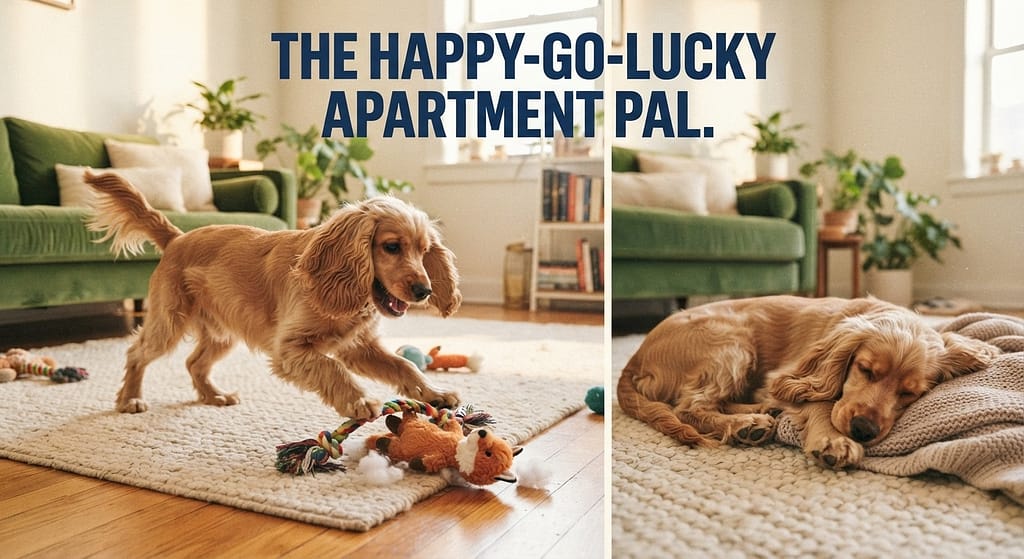
Signs you have this dog:
Enjoys a 30-minute walk but doesn’t lose its mind without it.
Plays fetch for 10 minutes, then naps. Perfect for most apartments.
Best schedule: 2 meals + 1 small snack
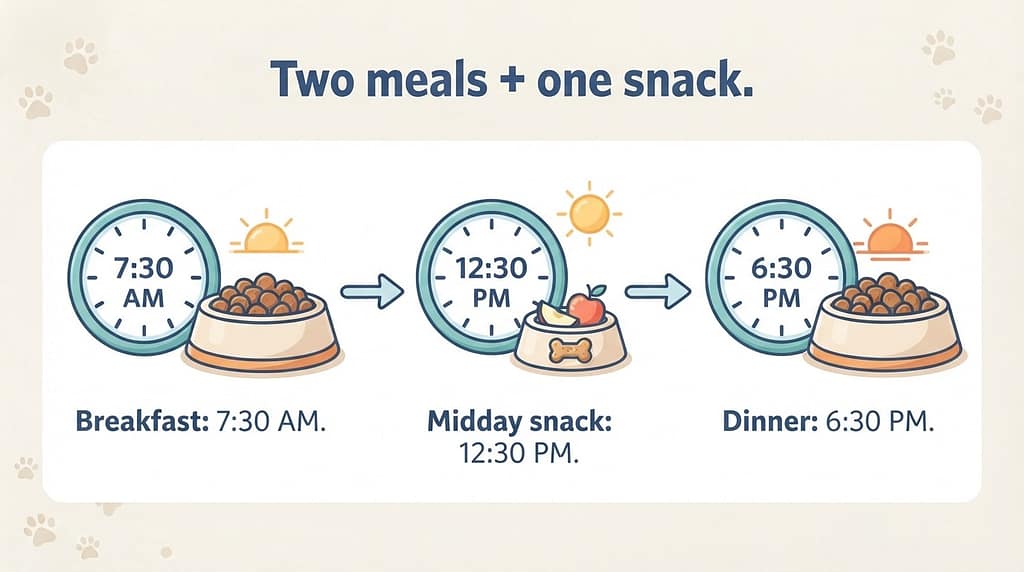
- Breakfast: 7:30 AM (split: 70% breakfast, 30% saved for later)
- Midday snack: 12:30 PM (saved 30% from breakfast, maybe in a puzzle toy)
- Dinner: 6:30 PM
Why this works:
That midday snack is a game-changer for apartment living.
Why?
Because it breaks up the long stretch between breakfast and dinner.
No evening hangry outbursts. No counter-surfing at 4 pm.
Apartment-specific tip:
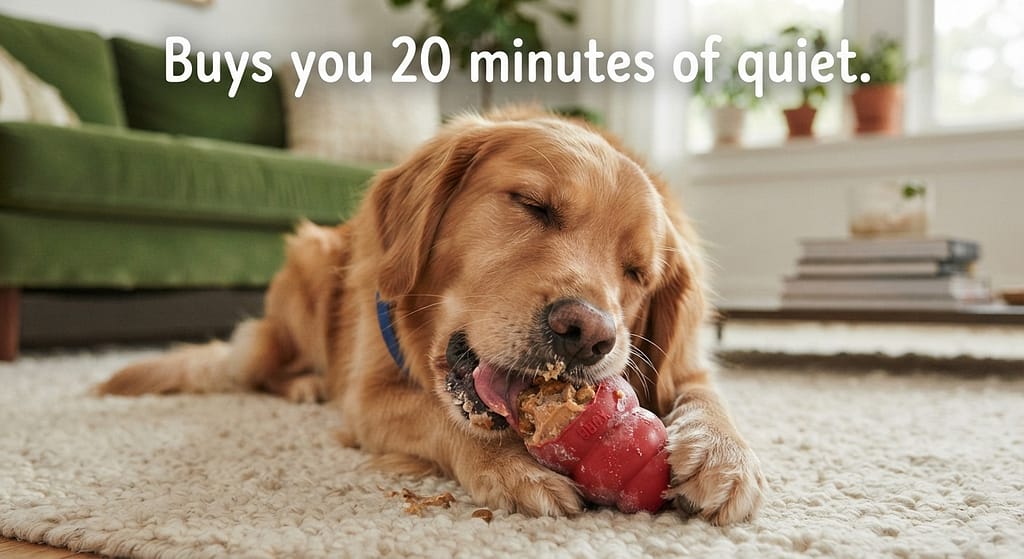
Give the midday snack in a frozen Kong. It buys you 20 minutes of quiet while you take a work call.
“My medium-energy dog gets the zoomies at 9pm no matter what!”
*Try moving dinner to 5pm. An earlier dinner means an earlier post-meal walk, which burns off that evening energy before your downstairs neighbor starts banging on the ceiling.*
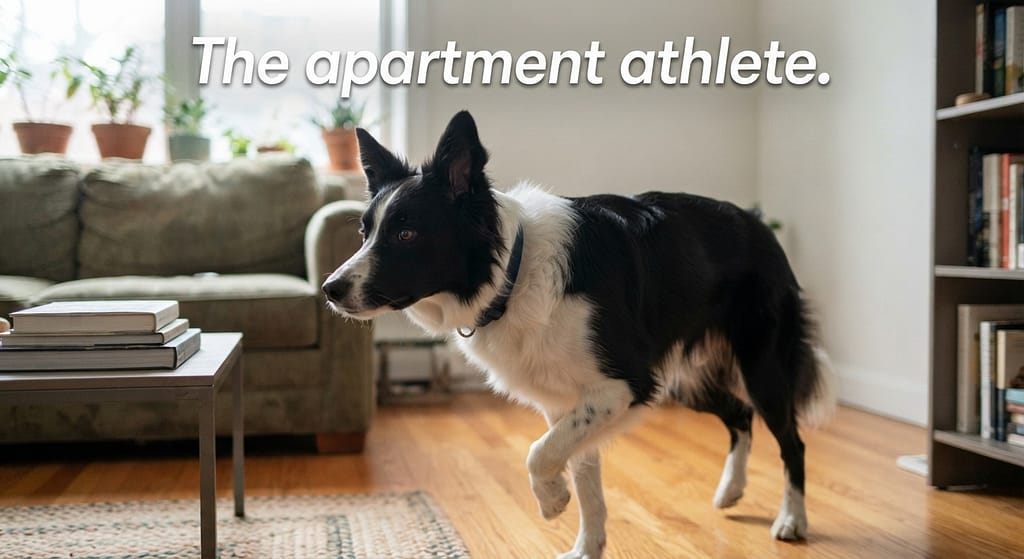
Tier 3: High Energy – The Apartment Athlete
Signs you have this dog:
Needs 90+ minutes of exercise daily.
Paces. Whines at the door. Will run laps around your coffee table if bored.
(We see you, Aussie and Malinois owners in studio apartments—you’re brave.)
Best schedule: 3 small meals + exercise-based feeding
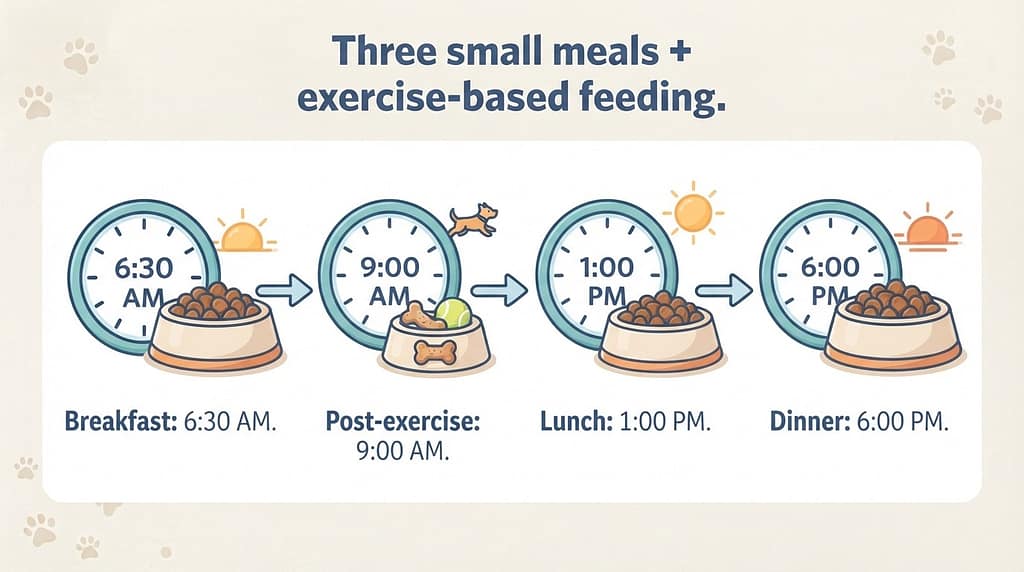
- Breakfast: 6:30 AM (small portion – 25% of daily calories)
- Post-exercise meal: 9:00 AM (after morning walk/run – 25%)
- Lunch: 1:00 PM (25%)
- Dinner: 6:00 PM (25%)
For active dogs, see our how-to exercise a dog in an apartment guide
Why this works:
High-energy dogs burn calories fast.
Three equal meals prevent blood sugar crashes that lead to destructive behavior.
And here’s the apartment secret: Never feed a high-energy dog before exercise.
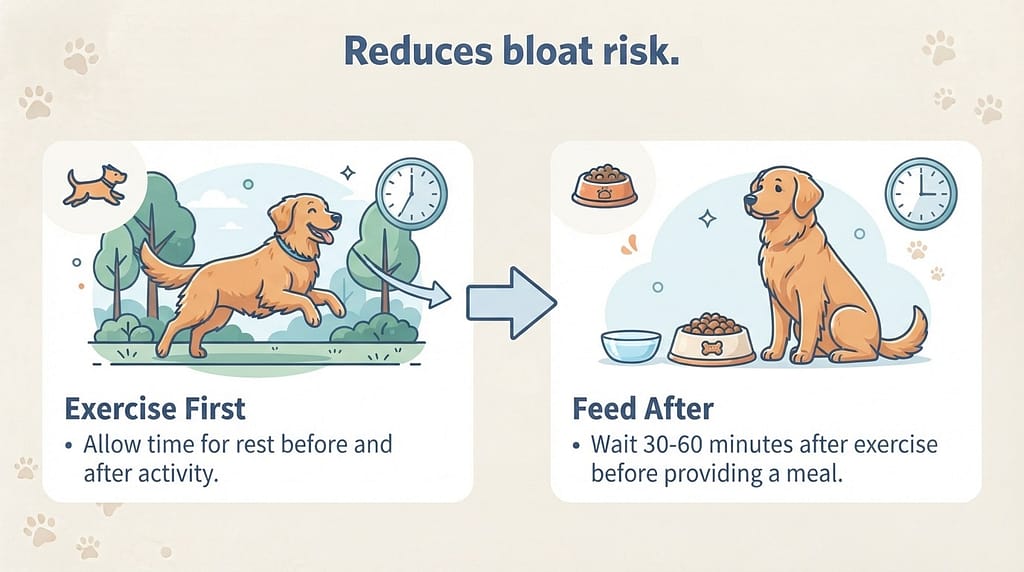
It increases bloat risk. Always walk/run first, then feed.
Pro-tip for apartment athletes:
Use a snuffle mat for one of those meals.
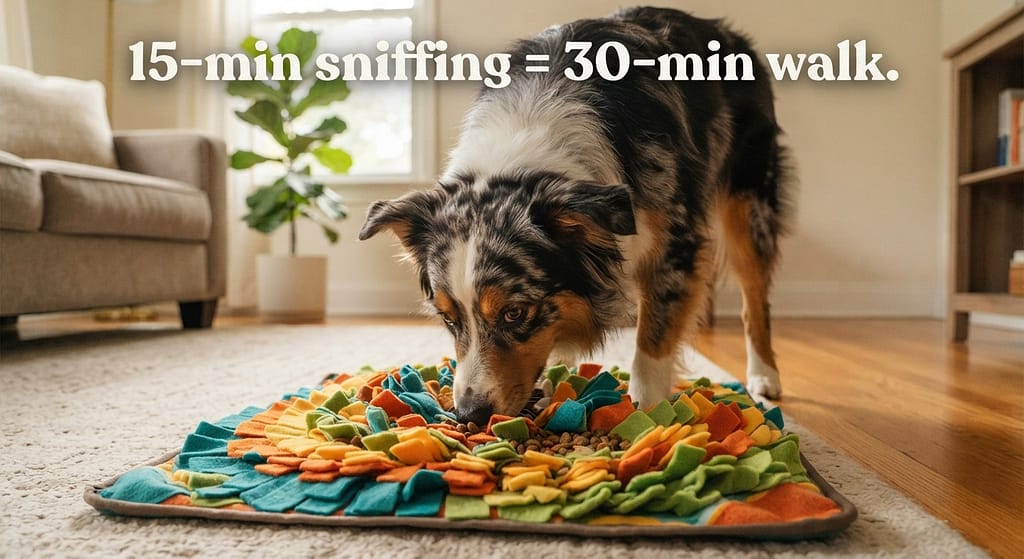
Mental stimulation tires out a high-energy dog faster than physical exercise. A 15-minute sniffing session equals a 30-minute walk.
👴 SENIOR DOGS (7+ years): Gentle Schedules for Apartment Golden Years
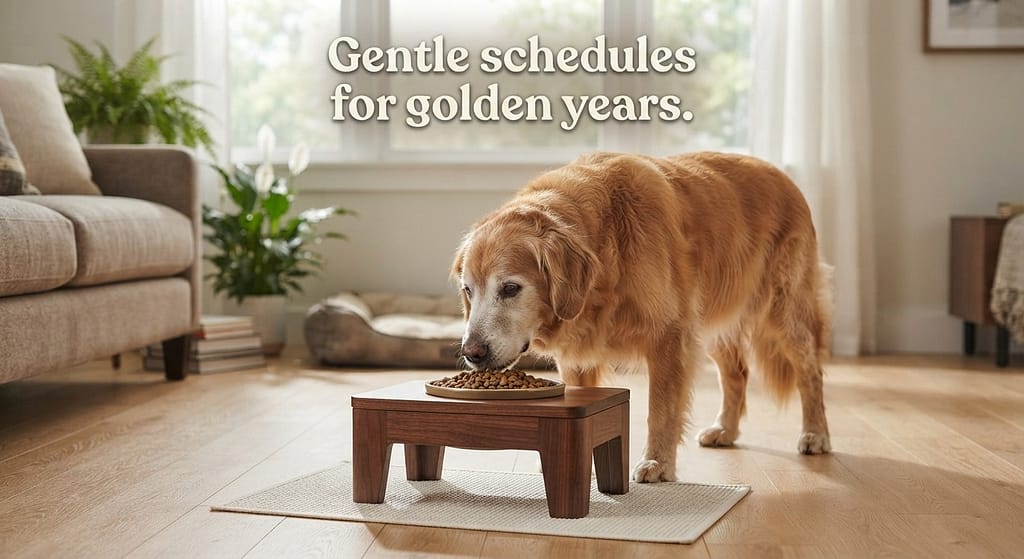
Your old friend needs a different approach now.
Joints are creaky. Teeth might be sensitive.
And that bladder? Not what it used to be.
Here’s the apartment challenge: Seniors often need to eat less (slower metabolism) but more frequently (better for digestion).
Best Senior Apartment Feeding Schedule
3 small meals + late-night tiny snack
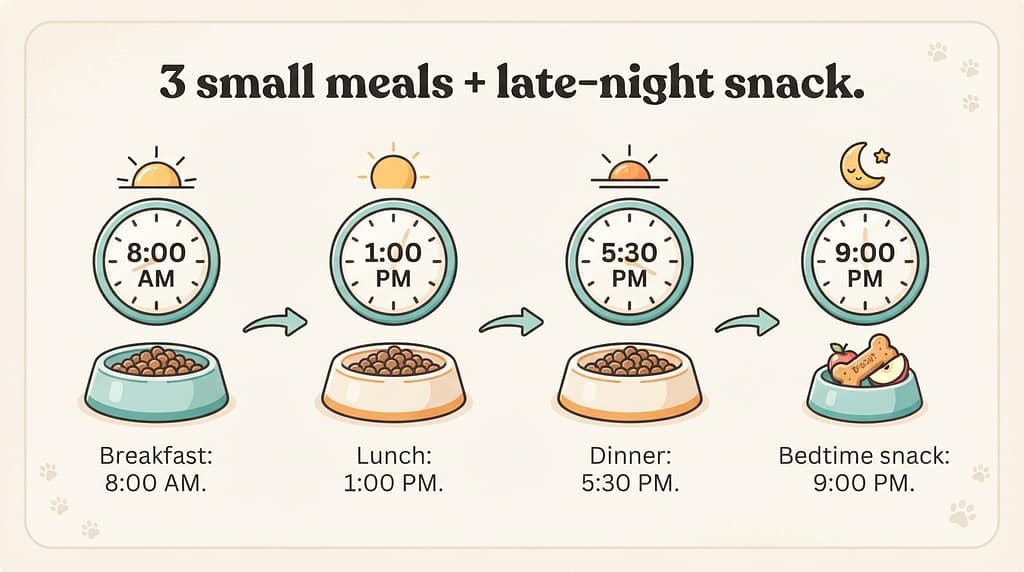
- Breakfast: 8:00 AM (softened food if needed)
- Lunch: 1:00 PM (small – about 25% of daily)
- Dinner: 5:30 PM (main meal – 40% of daily)
- Bedtime snack: 9:00 PM (just a tablespoon or a few treats)
For allergy-friendly breeds that fit your lifestyle, see our hypoallergenic small dog breeds.
Why the bedtime snack?
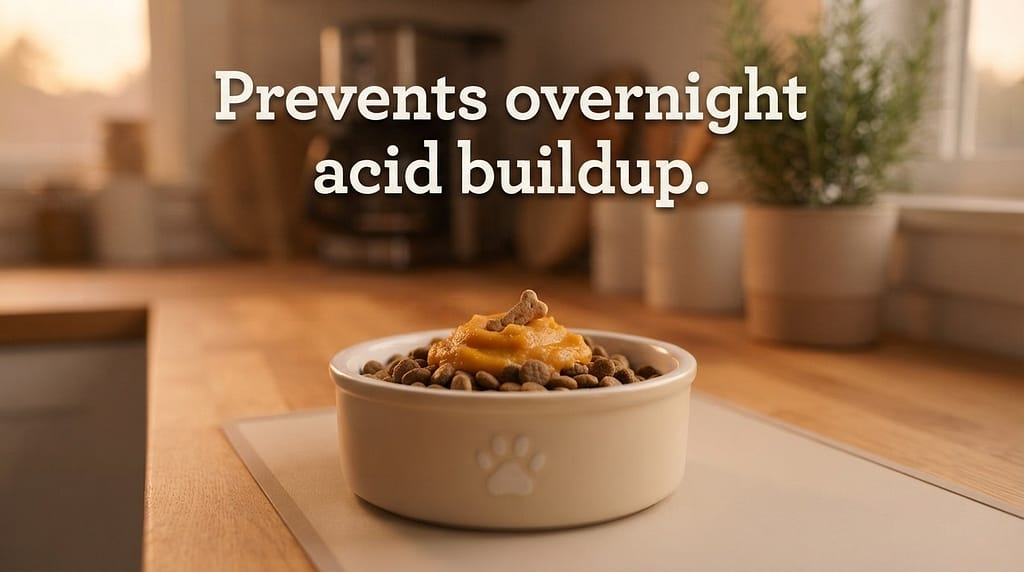
Seniors can go 12+ hours between dinner and breakfast.
That’s too long for an aging body.
That tiny snack prevents overnight stomach acid buildup (which causes whining) and gives you one last potty chance before sleep.
Apartment adaptations for seniors:
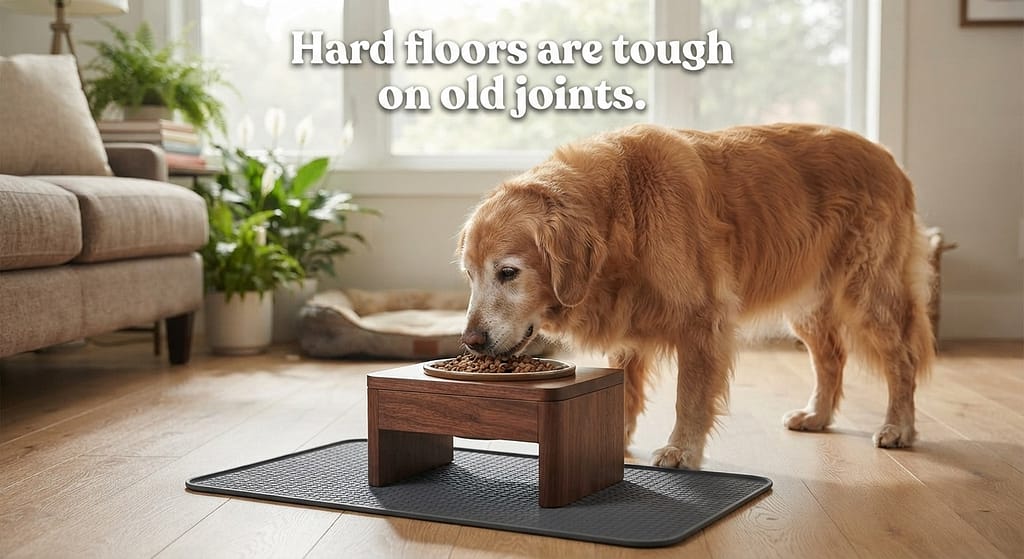
- Place food bowls on a raised stand or a non-slip mat (hard floors are tough on old joints)
- Feed near the door if possible – shorter walk to the potty spot
- Add warm water to kibble. It releases aromas that stimulate aging appetites and help hydration.
The Ultimate Cheat Sheet: Find Your Dog’s Schedule in 10 Seconds
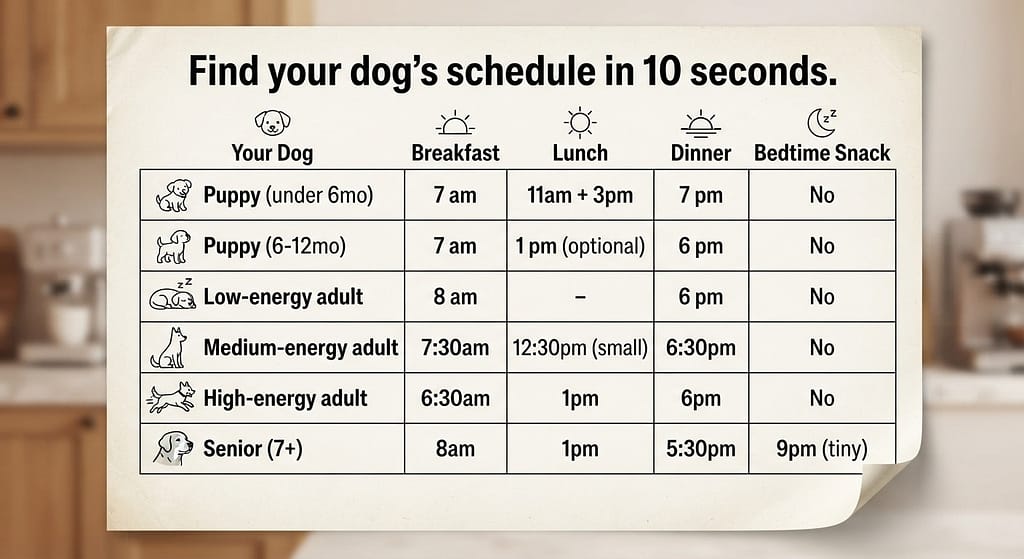
| Your Dog | Breakfast | Lunch | Dinner | Bedtime Snack |
|---|---|---|---|---|
| Puppy (under 6mo) | 7 am | 11am + 3pm | 7 pm | No |
| Puppy (6-12mo) | 7 am | 1 pm (optional) | 6 pm | No |
| Low-energy adult | 8 am | – | 6 pm | No |
| Medium-energy adult | 7:30 am | 12:30 pm (small) | 6:30 pm | No |
| High-energy adult | 6:30 am | 1 pm | 6 pm | No |
| Senior (7+) | 8 am | 1 pm | 5:30 pm | 9 pm (tiny) |
For complete health and wellness, see our complete apartment dog health and nutrition manual
“My dog doesn’t fit neatly into one category!”
*That’s fine—most don’t. Pick the energy tier that describes 80% of their days. And if you have a senior who acts like a puppy (bless you), lean toward the high-energy schedule with smaller portions.*
Interactive: Build Your Apartment Feeding Schedule (Quiz)
Let’s make this personal. Answer these 4 questions, and we’ll give you a custom schedule.
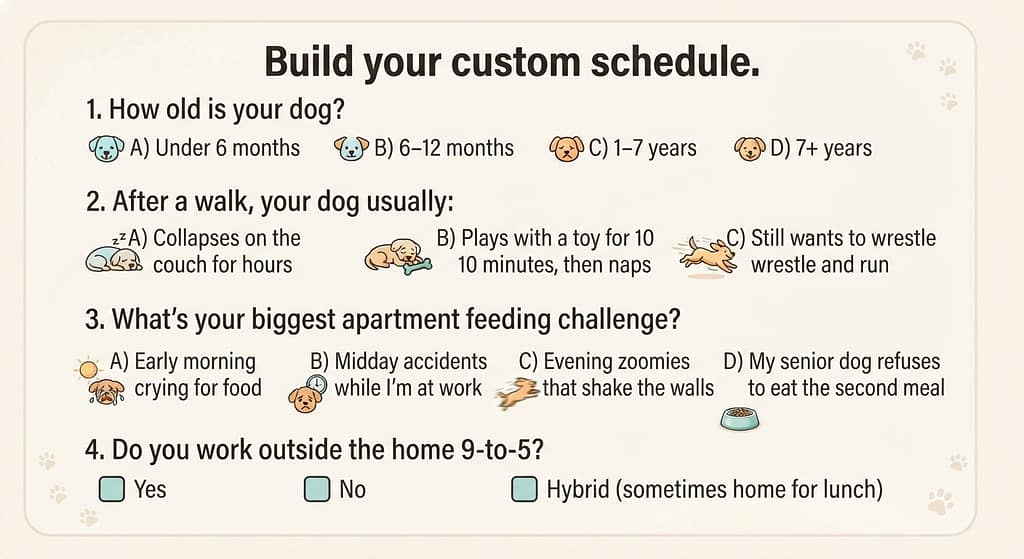
1. How old is your dog?
A) Under 6 months
B) 6–12 months
C) 1–7 years
D) 7+ years
2. After a walk, your dog usually:
A) Collapses on the couch for hours (low energy)
B) Plays with a toy for 10 minutes, then naps (medium)
C) Still wants to wrestle and run (high)
3. What’s your biggest apartment feeding challenge?
A) Early morning crying for food
B) Midday accidents while I’m at work
C) Evening zoomies that shake the walls
D) My senior dog refuses to eat the second meal
4. Do you work outside the home 9-to-5?
Yes / No / Hybrid (sometimes home for lunch)
Families with kids should explore the best apartment dogs for families with kids.
Your custom schedule (find your combo below):
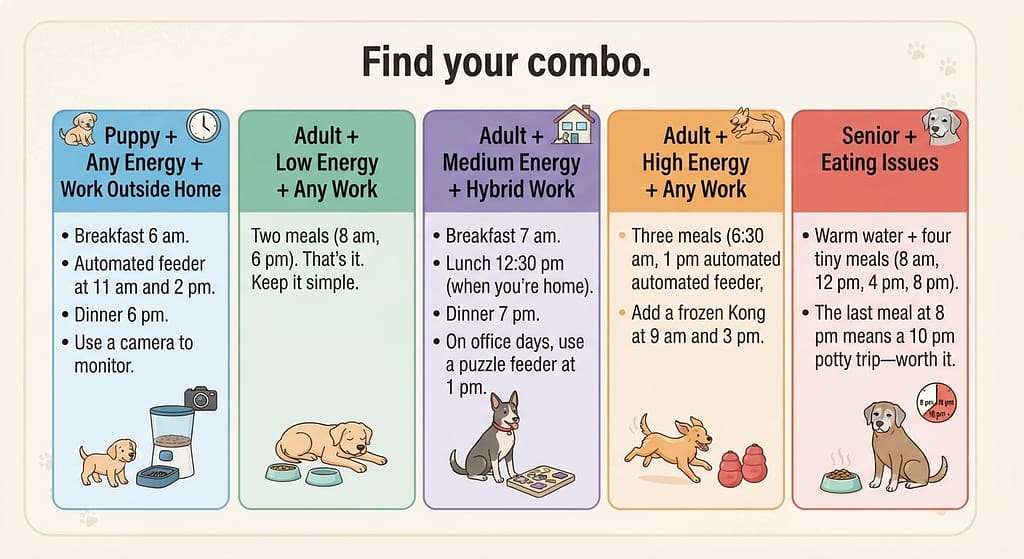
- Puppy + any energy + work outside home: Breakfast 6 am, automated feeder at 11 am and 2 pm, dinner 6 pm. Use a camera to monitor.
- Adult + low energy + any work: Two meals (8 am, 6 pm). That’s it. Keep it simple.
- Adult + medium energy + hybrid work: Breakfast 7 am, lunch 12:30 pm (when you’re home), dinner 7 pm. On office days, use a puzzle feeder at 1 pm.
- Adult + high energy + any work: Three meals (6:30 am, 1 pm automated feeder, 6 pm). Add a frozen Kong at 9 am and 3 pm.
- Senior + eating issues: Warm water + four tiny meals (8 am, 12 pm, 4 pm, 8 pm). The last meal at 8 pm means a 10 pm potty trip—worth it.
5 Common Apartment Feeding Mistakes (And How to Fix Them)
We’ve made every single one of these. Learn from our pain.
Mistake #1: Feeding right before bed
The result: 3 am potty wake-up calls.
The fix: Have your last meal at least 3 hours before your bedtime. Limit water 2 hours before bed.
Mistake #2: Using the same bowl for every meal
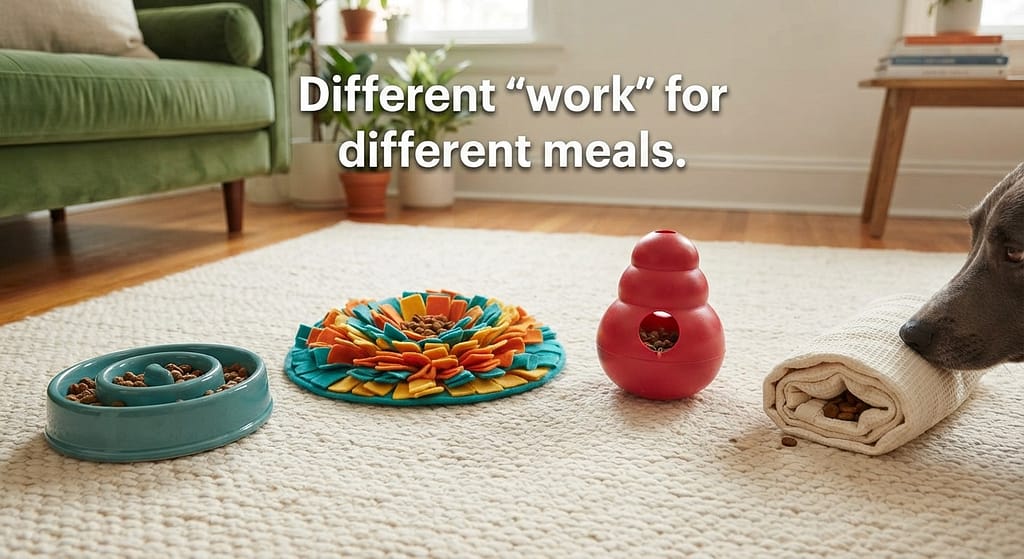
The result: Your high-energy dog eats in 30 seconds, then barks for more.
The fix: Rotate bowls—slow feeder, snuffle mat, puzzle toy, rolled towel. Different “work” for different meals.
Mistake #3: Ignoring the “apartment witching hour.”
The result: A hyper dog right when neighbors are trying to sleep.
The fix: Feed dinner earlier (5 pm) and pair it with a post-meal training session. Mental work + full belly = calm evening.
Mistake #4: Free-feeding because “my dog self-regulates.”
The result: Weight gain and unpredictable potty breaks. Even “self-regulating” dogs overeat in apartments (due to less exercise).
The fix: Switch to two scheduled meals today. Your dog will adjust in 48 hours.
Mistake #5: Forgetting the neighbor factor
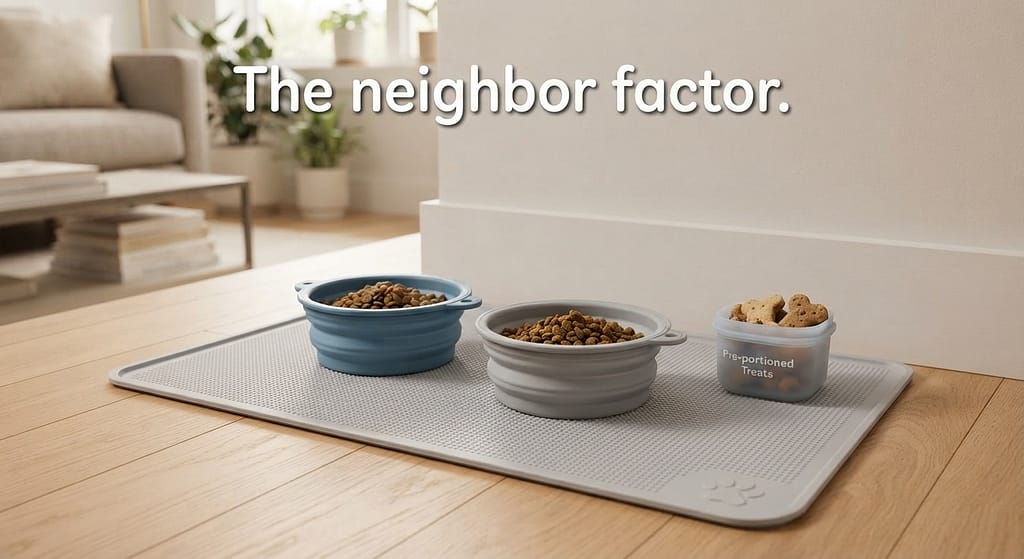
The result: Clanging bowls, whining, and treat bag crinkles at odd hours.
The fix: Use silicone bowls (quieter). Pre-portion treats into small containers, so you’re not crinkling plastic at 6 am. And if you use an automatic feeder, put it on a rubber mat.
City dwellers should consider the most sociable dog breeds for city life
Sample Daily Routines: See It All Come Together
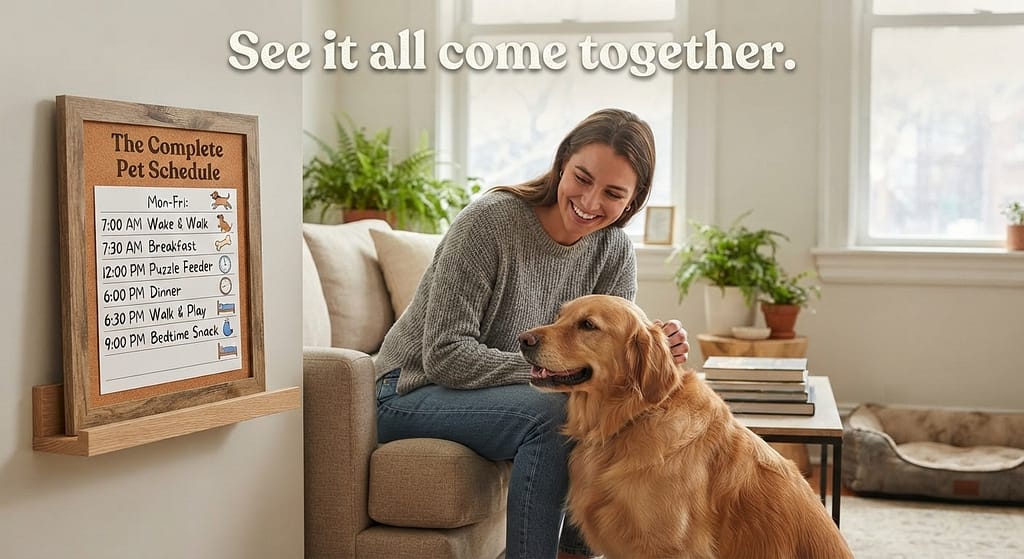
Example 1: You have a 4-month-old Lab puppy (high energy) in a 2nd-floor walk-up
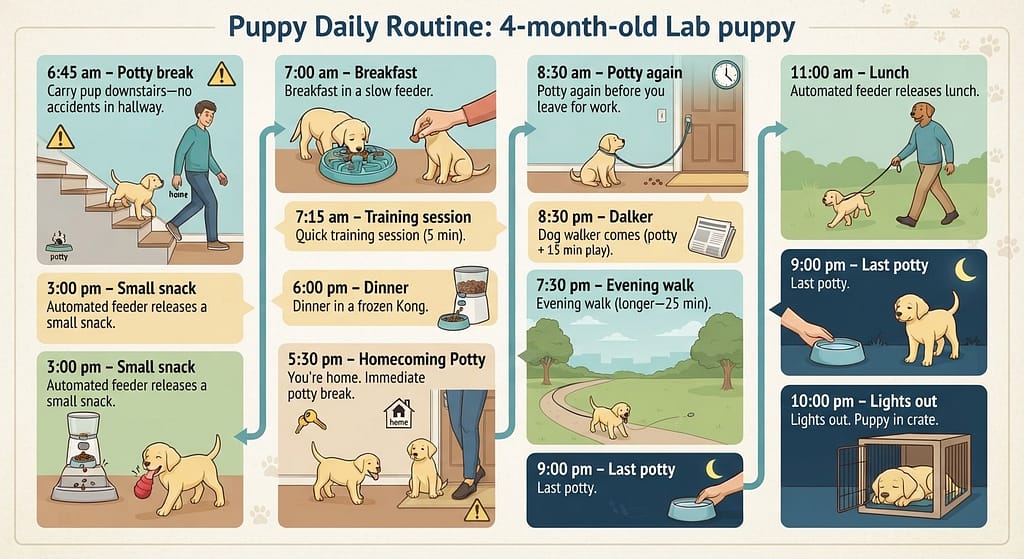
- 6:45 am – Potty break (carry pup downstairs—no accidents in hallway)
- 7:00 am – Breakfast in a slow feeder
- 7:15 am – Quick training session (5 min)
- 8:30 am – Potty again before you leave for work
- 11:00 am – Automated feeder releases lunch
- 12:30 pm – Dog walker comes (potty + 15 min play)
- 3:00 pm – Automated feeder releases a small snack
- 5:30 pm – You’re home. Immediate potty break.
- 6:00 pm – Dinner in a frozen Kong
- 7:30 pm – Evening walk (longer—25 min)
- 9:00 pm – Last potty
- 9:30 pm – Water bowl lifted
- 10:00 pm – Lights out. Puppy in crate.
Example 2: You have a 5-year-old Greyhound (low-medium energy) in a studio
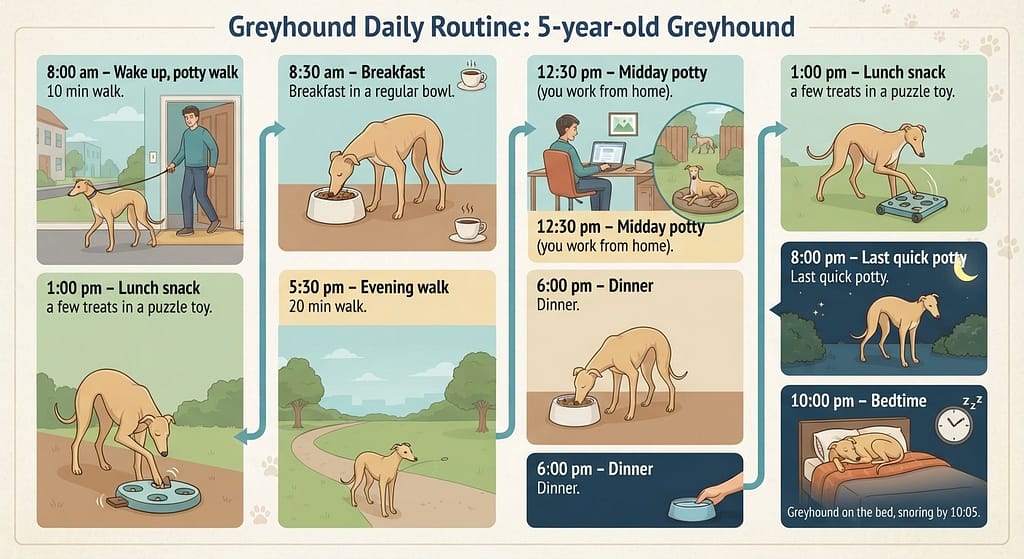
- 8:00 am – Wake up, potty walk (10 min)
- 8:30 am – Breakfast in a regular bowl
- 12:30 pm – Midday potty (you work from home)
- 1:00 pm – Lunch snack (a few treats in a puzzle toy)
- 5:30 pm – Evening walk (20 min)
- 6:00 pm – Dinner
- 8:00 pm – Last quick potty
- 10:00 pm – Bedtime (Greyhound on the bed, snoring by 10:05)
For busy owners who need low-maintenance breeds, see our best compatibility dog breeds for busy owners
Example 3: You have a 10-year-old Shih Tzu (senior, low energy) in a 1st-floor apartment
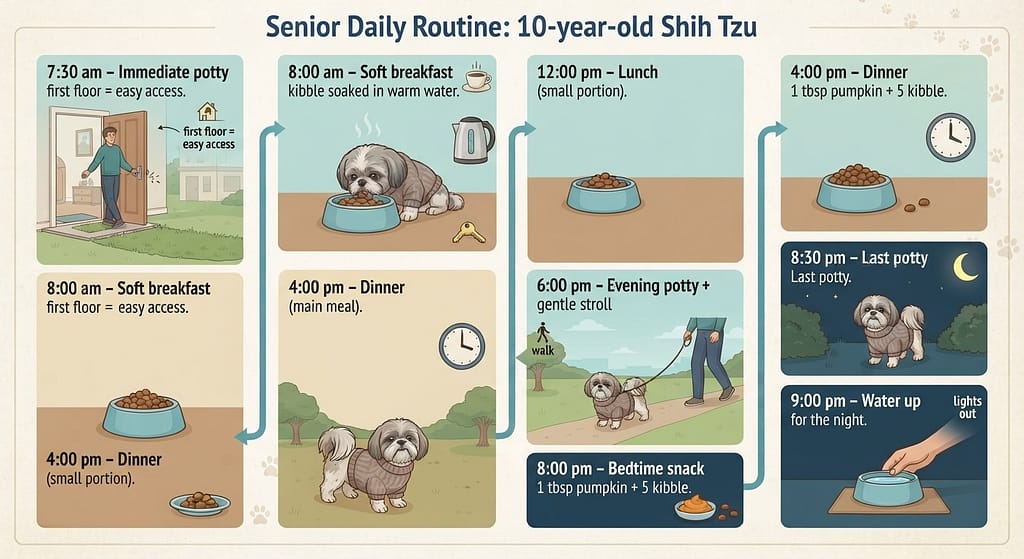
- 7:30 am – Immediate potty (first floor = easy access)
- 8:00 am – Soft breakfast (kibble soaked in warm water)
- 12:00 pm – Lunch (small portion)
- 4:00 pm – Dinner (main meal)
- 6:00 pm – Evening potty + gentle stroll
- 8:00 pm – Bedtime snack (1 tbsp pumpkin + 5 kibble)
- 8:30 pm – Last potty
- 9:00 pm – Water up for the night
Your Turn: The 7-Day Apartment Feeding Challenge
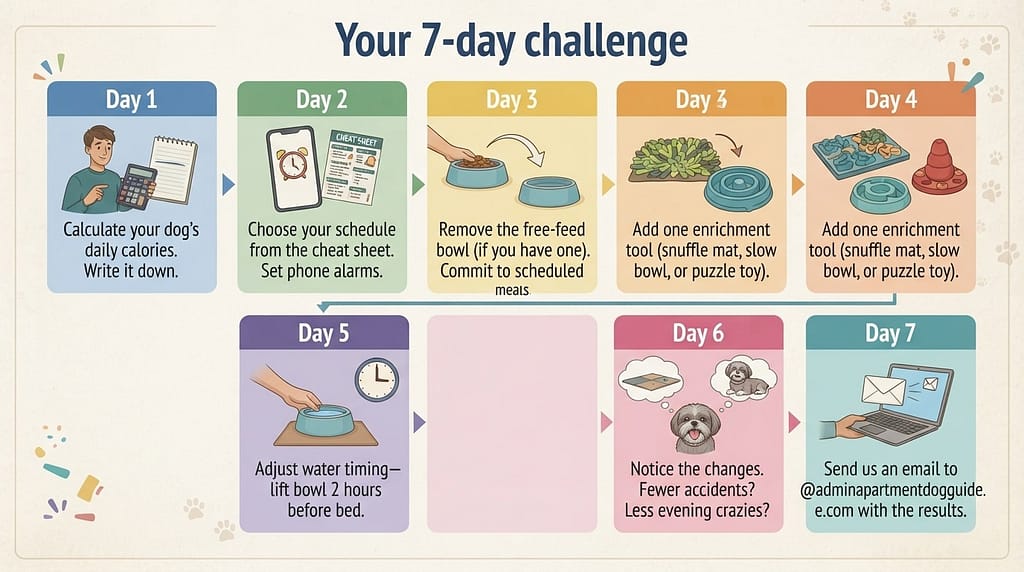
We’ve given you the blueprint. Now here’s what we want you to do:
Day 1: Calculate your dog’s daily calories. Write it down.
Day 2: Choose your schedule from the cheat sheet. Set phone alarms.
Day 3: Remove the free-feed bowl (if you have one). Commit to scheduled meals.
Day 4: Add one enrichment tool (snuffle mat, slow bowl, or puzzle toy).
Day 5: Adjust water timing—lift bowl 2 hours before bed.
Day 6: Notice the changes. Fewer accidents? Less evening crazies?
Day 7: Send us an email to @adminapartmentdogguide.com with the results.
We genuinely want to hear from you.
What’s your apartment dog’s biggest feeding struggle?
Did the senior schedule stop the 3 am whining? Is your high-energy Aussie finally settling down at 9 pm?
Because here’s the truth we’ve learned after years of apartment living with dogs:
For the complete breed resource, see our apartment dog breeds complete compatibility guide
There’s no one “right” schedule. But there is a perfect schedule for your dog and your home. And now you have the tools to find it.
So go ahead—feed that furry roommate.
And enjoy the quiet evenings, the solid potty routine, and the joy of a well-fed, well-timed apartment pup.
You’ve got this. And we’ve got your back.
🐾 — Apartment Dog Guide (ADG)
Living large in small spaces, one paw at a time. That’s the apartment dog life—see you in the next guide!.


