
Let’s paint a picture we know all too well.
The doorbell rings. It’s just the delivery guy with your Pad Thai.
But your 50-pound fur-missile launches off the couch like a cannonball, ricochets off the coffee table, skids across the hardwood, and slams into the front door, barking as the apocalypse has arrived.
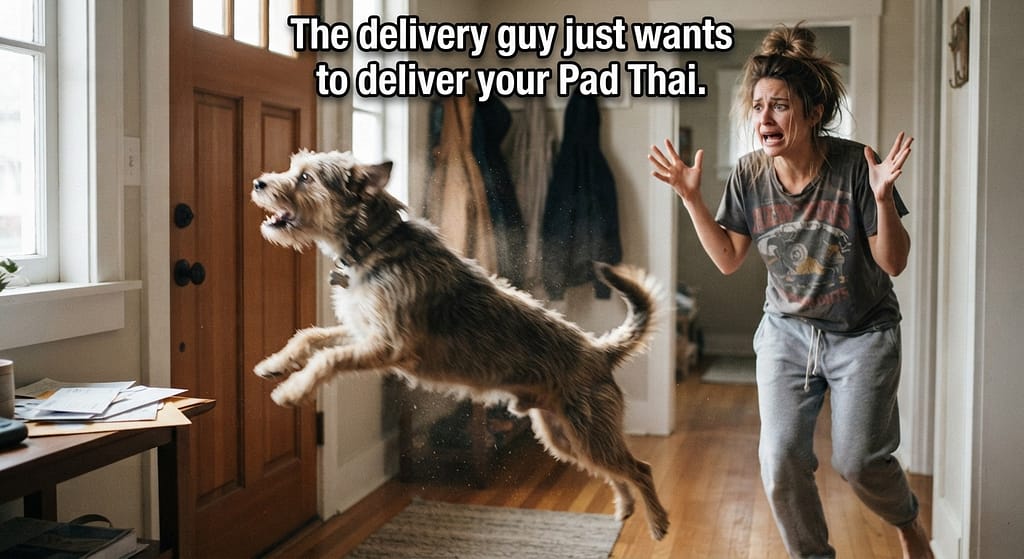
You open the door, red-faced, clutching your dog’s collar while the delivery person eyes you like you’re harboring a werewolf.
You accept the food, shut the door, and then spend the next 45 minutes trying to coax your panting, pacing dog back down to a normal heart rate.
Then, there’s the flip side. You’re trying to work from home. Your dog is staring at you.
Not with love. With intensity. They’re hovering, whining, bringing you toys, pacing back and forth across your tiny studio like a caged tiger.
You haven’t been able to have a phone call without them losing their minds in the background.
We’ve been there. We know the “Apartment Zoomies.” We know the “Velcro Dog” that follows you to the bathroom.
We know the “Window Watcher” that explodes every time a squirrel sneezes outside.
And we discovered the one thing that actually saved us: The Relaxation Protocol.
Now, before you roll your eyes and think, “Oh great, another person telling me to just ‘calm down’ my dog,” hear us out.
This isn’t just saying “Settle” and hoping for the best.
This is a science-backed, step-by-step, math-nerd-approved training schedule that literally rewires your dog’s brain to choose calmness.
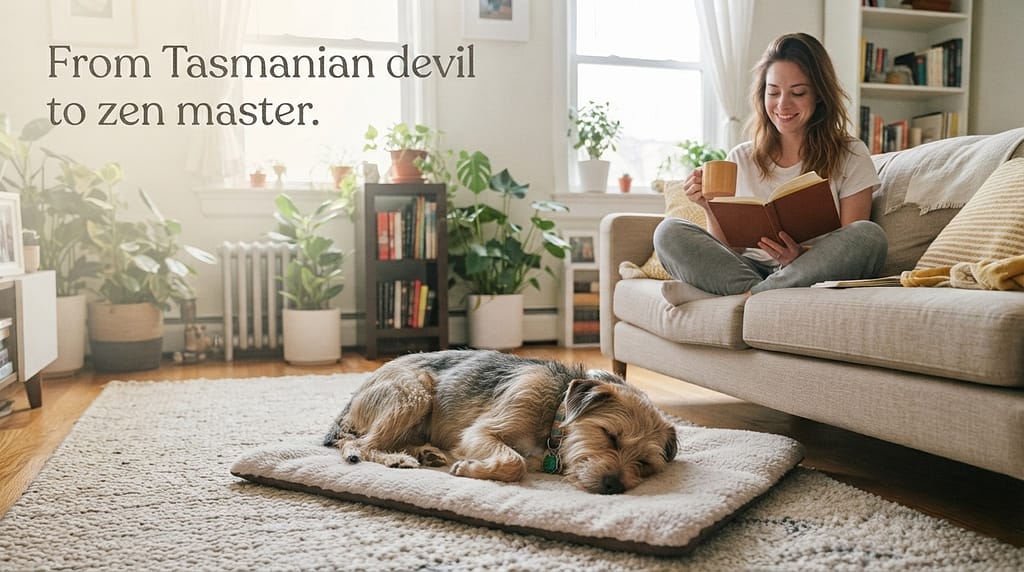
We’re going to break down the legendary “Karen Overall Relaxation Protocol” and adapt it specifically for the thin-walled, tight-space, neighbor-filled chaos of apartment living.
Grab your dog’s favorite treats, a yoga mat (yes, really), and let’s turn your Tasmanian devil into a zen master.
The Interactive Quiz: Is Your Dog a “Couch Potato” Wannabe?
Before we start the training, let’s diagnose your dog’s current “Chill Level.” Grab a pen and score them:
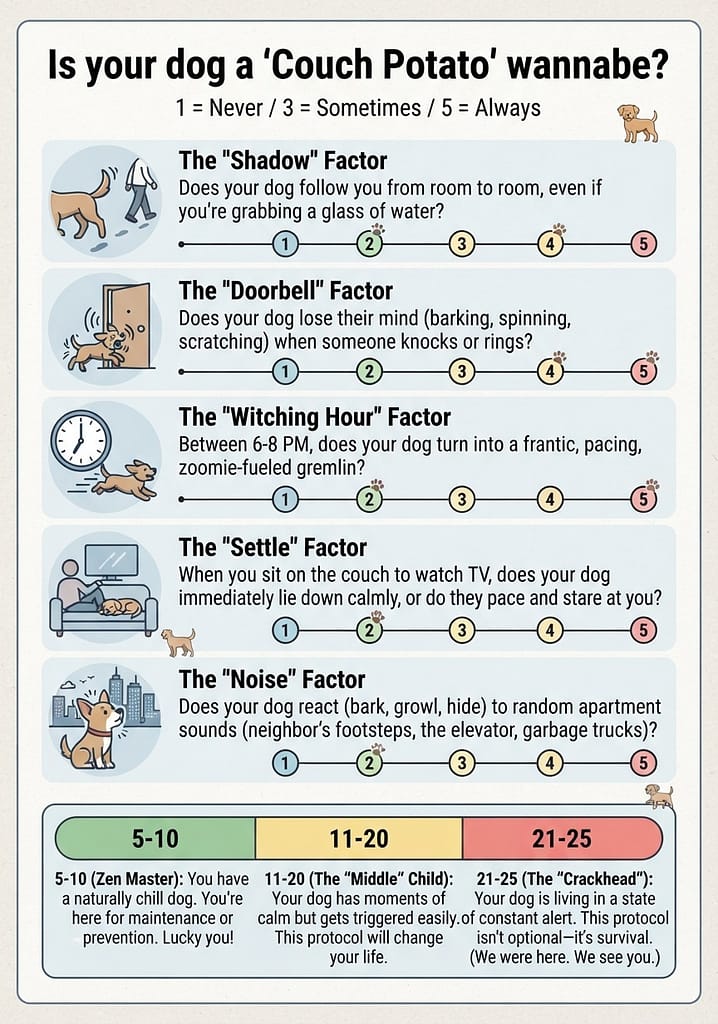
1 = Never / 3 = Sometimes / 5 = Always
- The “Shadow” Factor: Does your dog follow you from room to room, even if you’re grabbing a glass of water?
- The “Doorbell” Factor: Does your dog lose their mind (barking, spinning, scratching) when someone knocks or rings?
- The “Witching Hour” Factor: Between 6-8 PM, does your dog turn into a frantic, pacing, zoomie-fueled gremlin?
- The “Settle” Factor: When you sit on the couch to watch TV, does your dog immediately lie down calmly, or do they pace and stare at you?
- The “Noise” Factor: Does your dog react (bark, growl, hide) to random apartment sounds (neighbor’s footsteps, the elevator, garbage trucks)?
The Scoreboard:
- 5-10 (Zen Master): You have a naturally chill dog. You’re here for maintenance or prevention. Lucky you!
- 11-20 (The “Middle” Child): Your dog has moments of calm but gets triggered easily. This protocol will change your life.
- 21-25 (The “Crackhead”): Your dog is living in a state of constant alert. This protocol isn’t optional—it’s survival. (We were here. We see you.)
What the Heck is the “Relaxation Protocol” (And Why Does It Work in an Apartment)?
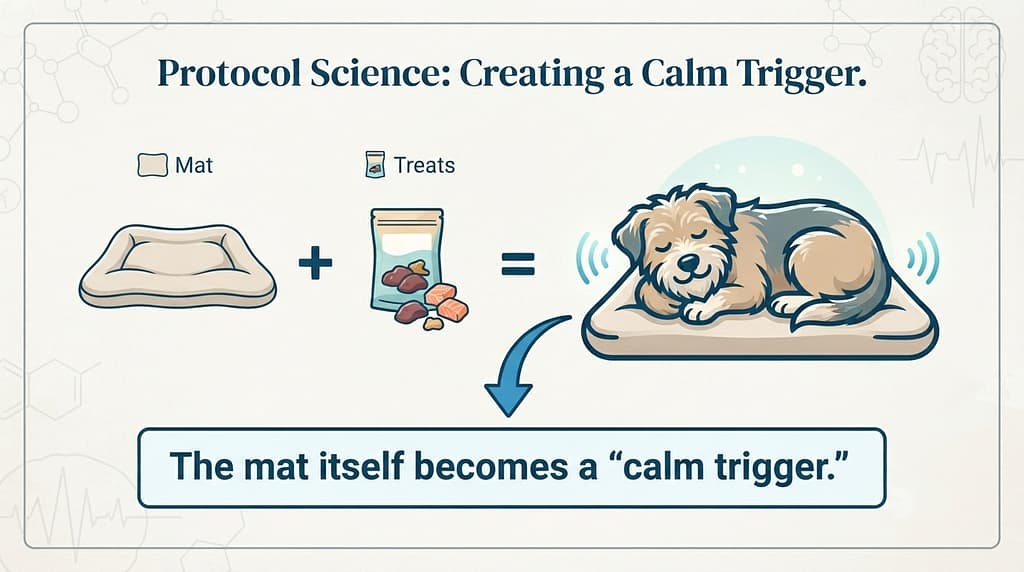
Developed by Dr. Karen Overall, the Relaxation Protocol is essentially a mat-training bootcamp.
But it’s not just “teaching a down-stay.” It’s about teaching your dog that staying in one place while boring stuff happens is the best game in the world.
The Science:
The protocol uses a concept called “Operant Conditioning with a side of Classical Conditioning.”
We are pairing a specific “place” (a mat) with a massive avalanche of treats.
Over time, the mat itself becomes a “calm trigger.” When they step on it, their brain automatically releases serotonin.
Why Apartments Need This:
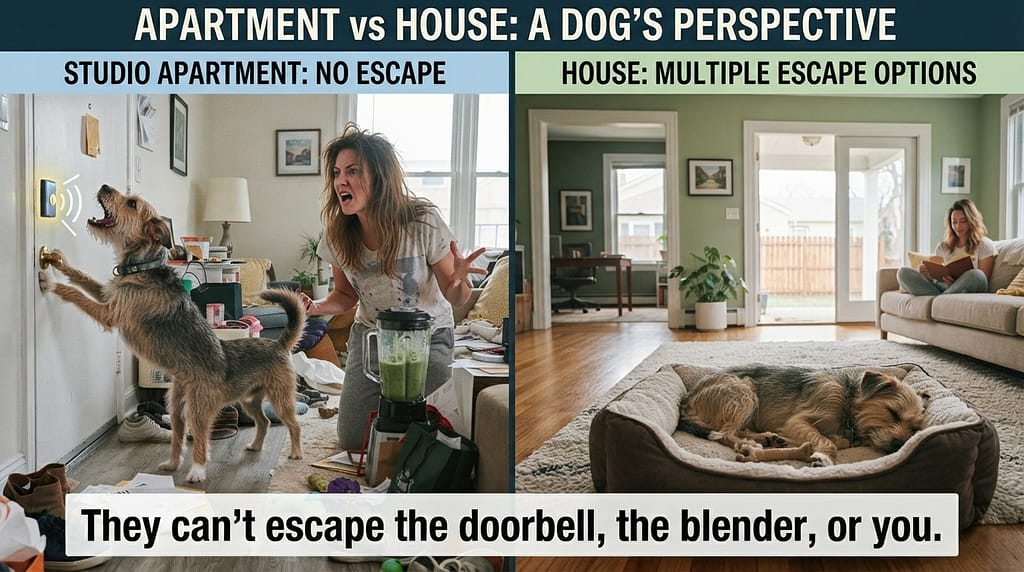
In a house, you can put a dog in a backyard or a quiet room. In a studio apartment, your dog is always in your face.
They can’t escape the doorbell. They can’t escape the blender. They can’t escape you.
The Protocol teaches them to ignore the doorbell. To ignore the blender.
To ignore you walking around. It teaches them that “this spot right here” is the safest, most boring, most rewarding place in the universe.
Step 0: The “Mat” Selection – Your Dog’s New Favorite Real Estate
You need a specific “go-to” spot. This is the holy grail of the protocol.
Our Rules for Apartment Mats:
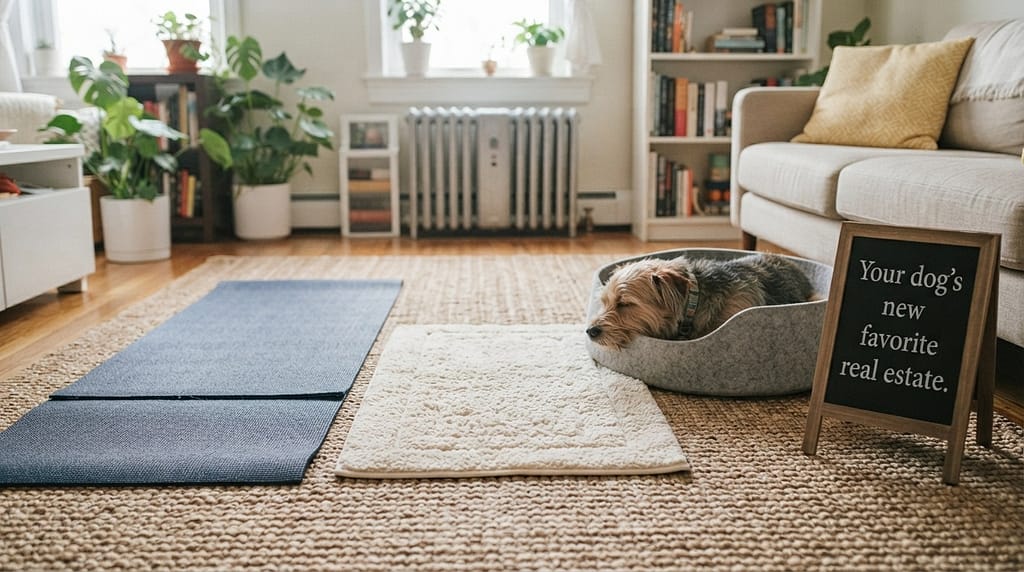
- Portable: It must be small enough to carry around. We use a cheap yoga mat cut in half. Others use a bathmat or a specific dog bed.
- Non-Slip: In a studio, if the mat slips on the hardwood, your dog will get scared and refuse to sit on it. Put a rug gripper under it.
- Distinct: It should look different from your rugs. Dogs are smart. They know the difference between “the lounge rug” and “the work mat.”
The “Double-Mat” Hack (Our Favorite):
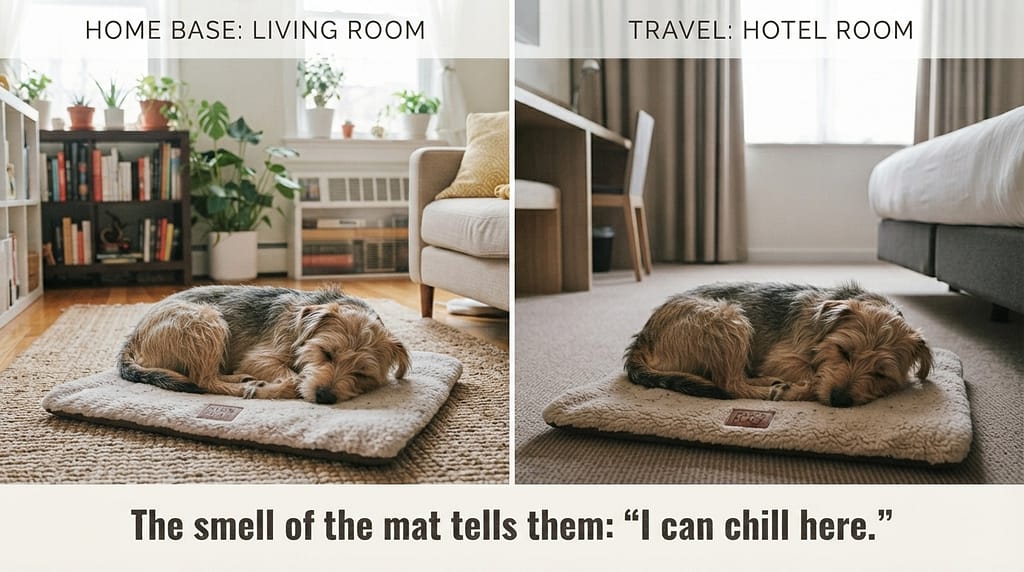
We bought TWO identical mats. One stays in the living room for training sessions.
The other travels. We take the travel mat to the vet, to cafes, to friends’ houses. The smell of the mat tells them, “Ah, I know this place. I can chill here.”
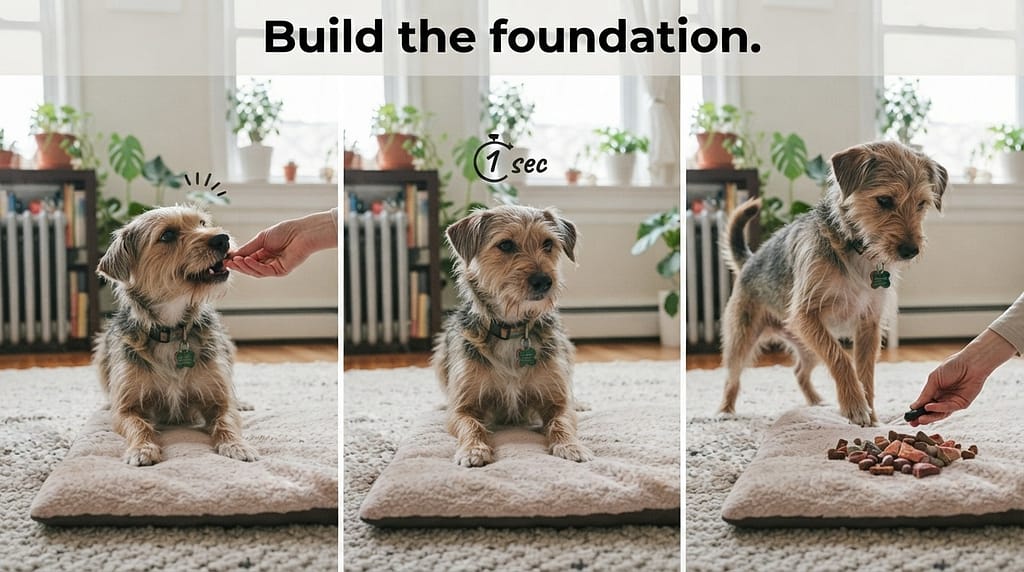
Phase 1: The “Bribe” Phase (The Foundation)
Note: We are NOT starting the crazy schedule yet. We are just introducing the mat.
The Goal: Make the mat the most exciting thing in the world.
The Method:
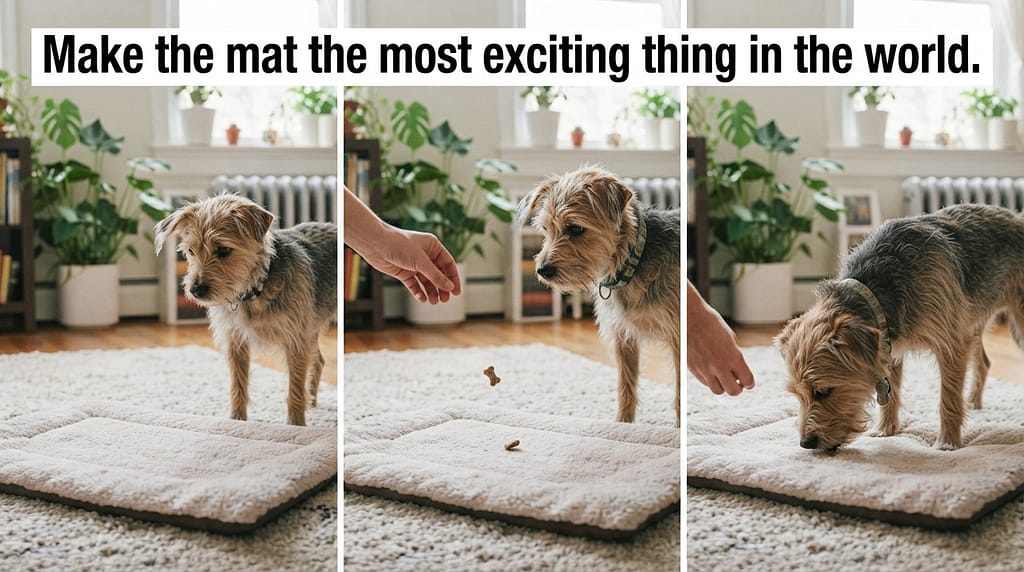
- Day 1-3: Place the mat on the floor. Every time your dog even looks at the mat, toss a treat on it. Do this randomly, 20 times a day.
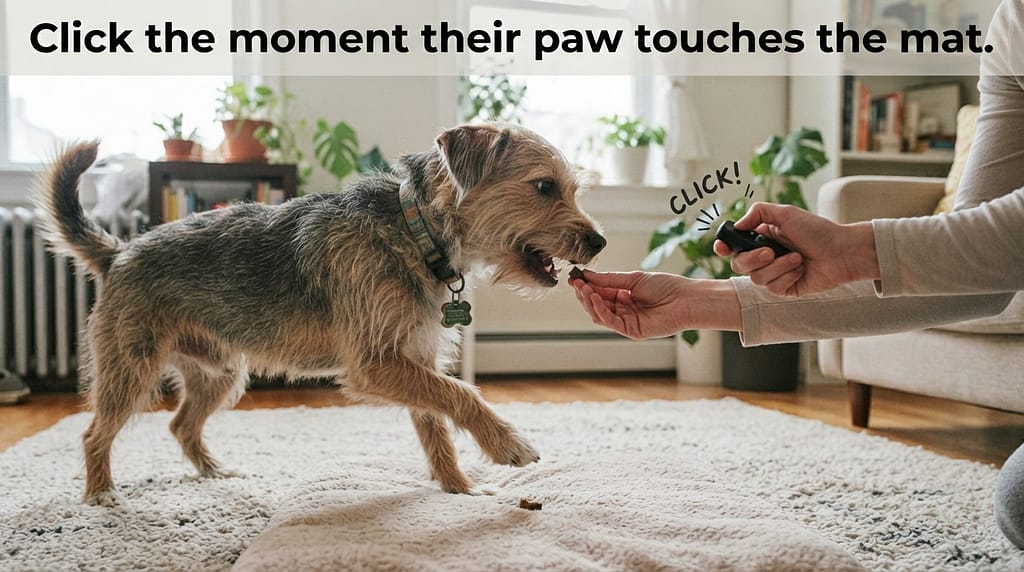
- The “Magic” Click: If you use a clicker, click the exact moment their paw touches the mat. Treat. Click. Treat.
- The “Stay” Ignition: Once they are sprinting to the mat, we add a “Down.” Say “Down” (only once), and lure them with a treat from their nose to the floor. The moment their elbows touch the mat, click and treat.
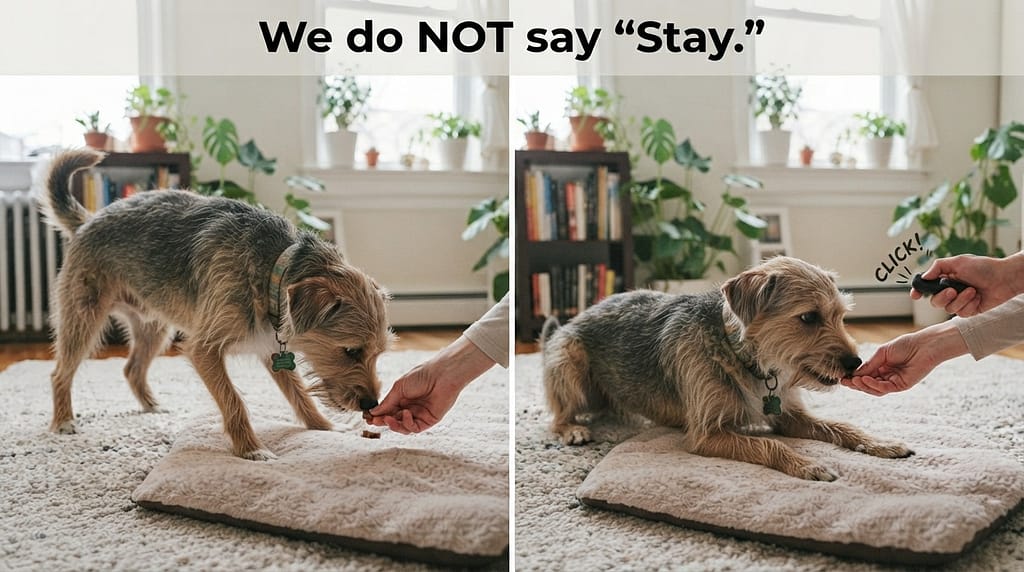
The Golden Rule: We do NOT say “Stay.” Stay implies they are locked in a prison. Instead, we say “Good settle” and keep treating.
We are building value, not restriction.
Phase 2: The “Durations” (The Patience Olympics)
Now we increase the time they are on the mat. We are going to treat them for staying, not for getting up.
The “Zen” Timer:
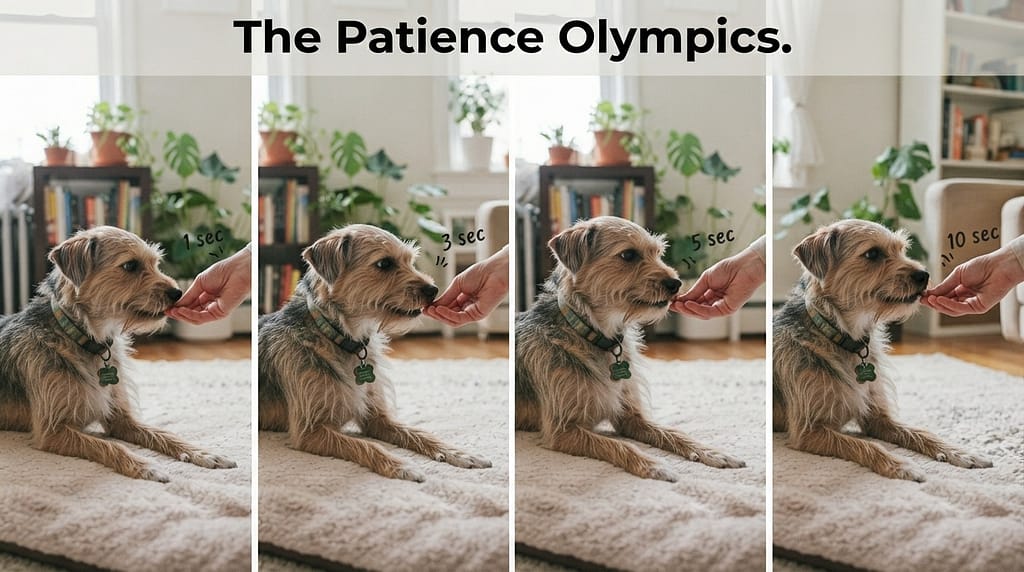
We put a treat on the floor in front of them. We wait. If they stay, we click and treat. We slowly increase the time between treats:
- Day 1: Treat every 1 second they are down.
- Day 2: Treat every 3 seconds.
- Day 3: Treat every 5 seconds.
- Day 4: Treat every 10 seconds.
The “Jackpot” Rule:
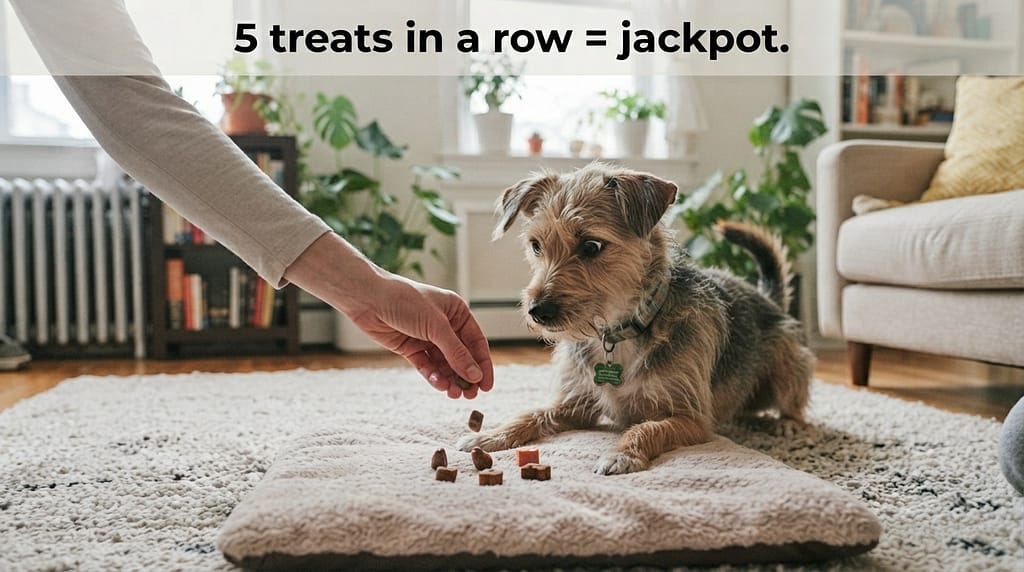
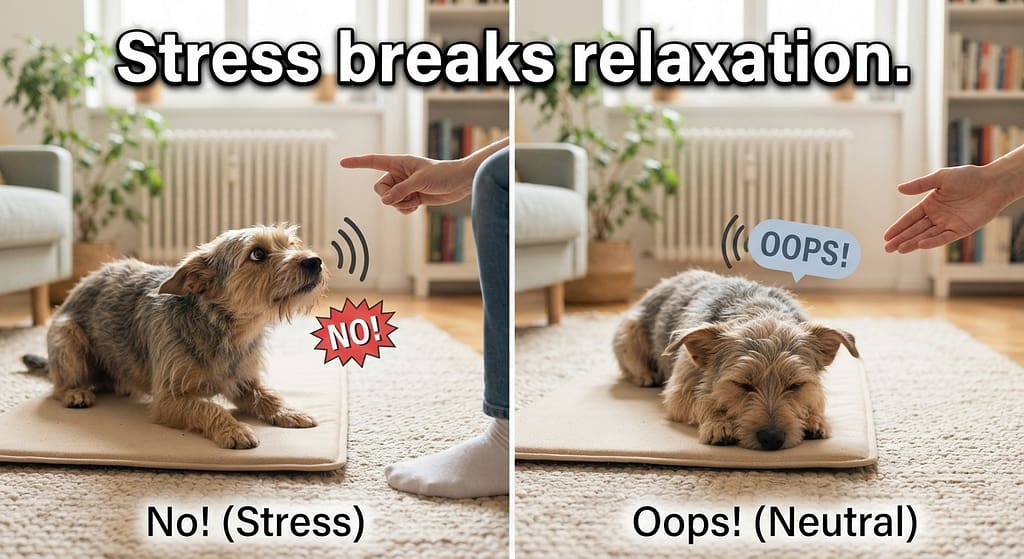
If they get up before the click, we just calmly say “Oops,” put them back on the mat, and try again. We never scold. This is a game. They are learning.
The Apartment Nightmare (Distractions):
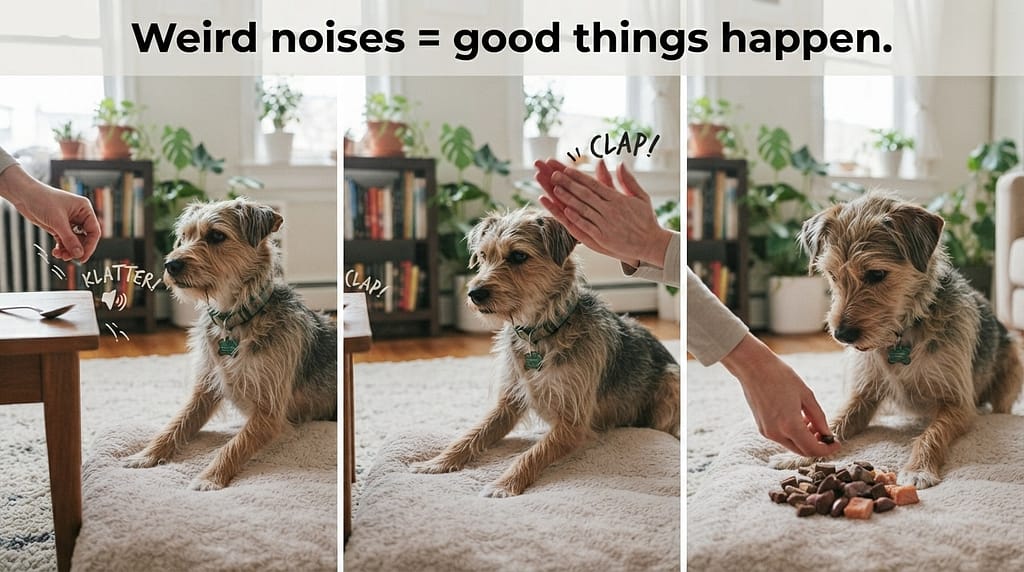
This is where it gets real. In a studio, you can’t “turn off” the noise. So we use the noise as our training tool.
We start the “Distraction” phase by doing silly things while they are on the mat:
- Drop a spoon on the floor.
- Clap our hands.
- Turn on the blender.
- Watch TV loudly.
The Rule: If they stay down during the distraction, we give them a super jackpot (5 treats in a row). If they get up, we just reset. This teaches them: “Weird noises = good things happen.”
Phase 3: The “Official” Relaxation Protocol (The Step-by-Step Schedule)
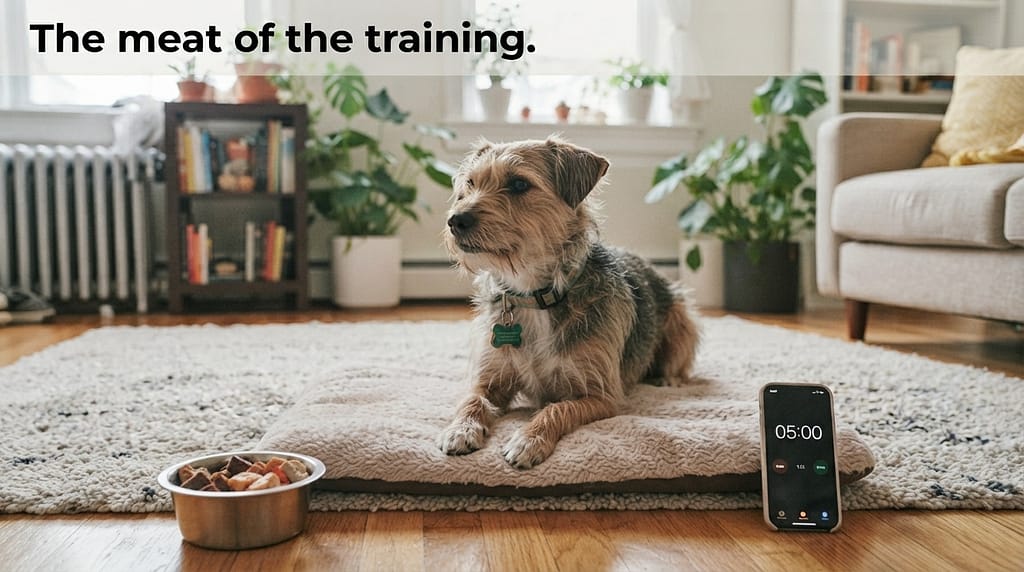
Okay, this is the meat of the training. We are going to give you the exact schedule we used, adapted from the Overall Protocol, but simplified for the apartment dweller.
The Setup:
- Have your dog on the mat.
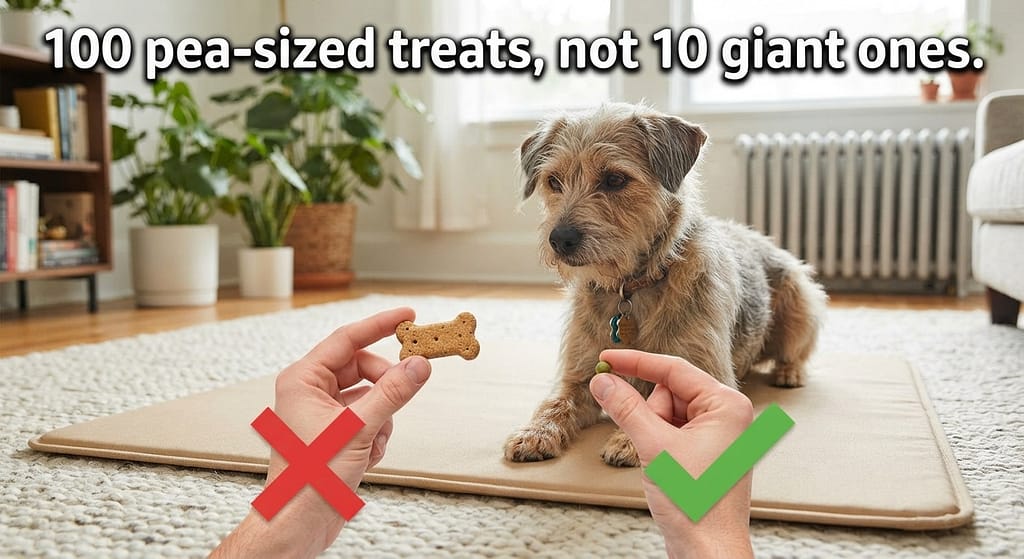
- Have a bowl of 100 small, high-value treats (cheese, boiled chicken, hot dog bits—the good stuff).
- Have a timer or your phone ready.
The Schedule (Do this once a day, 5 days a week):
- Day 1-2 (The Baseline):
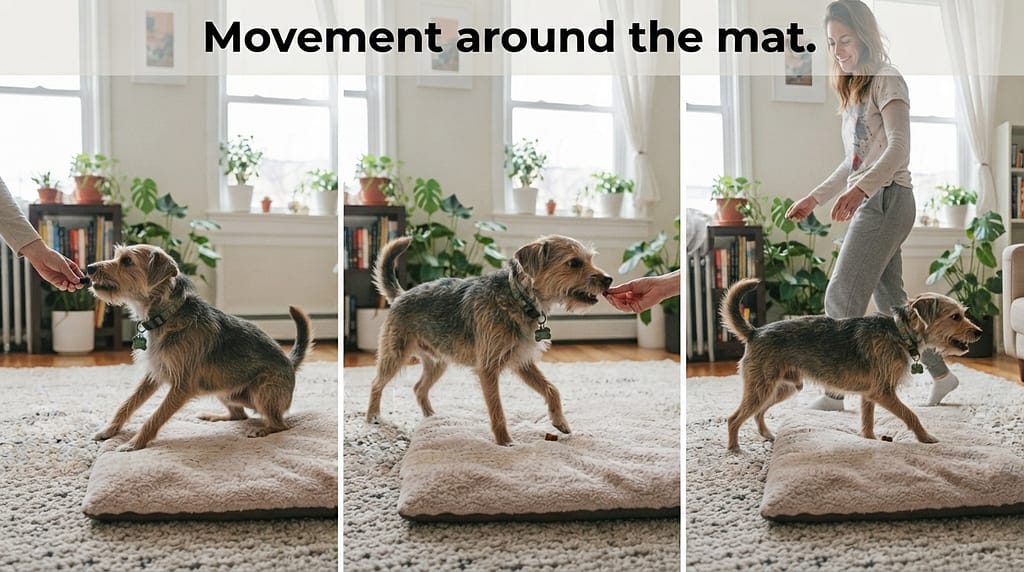
- Day 3-5 (The Movement):
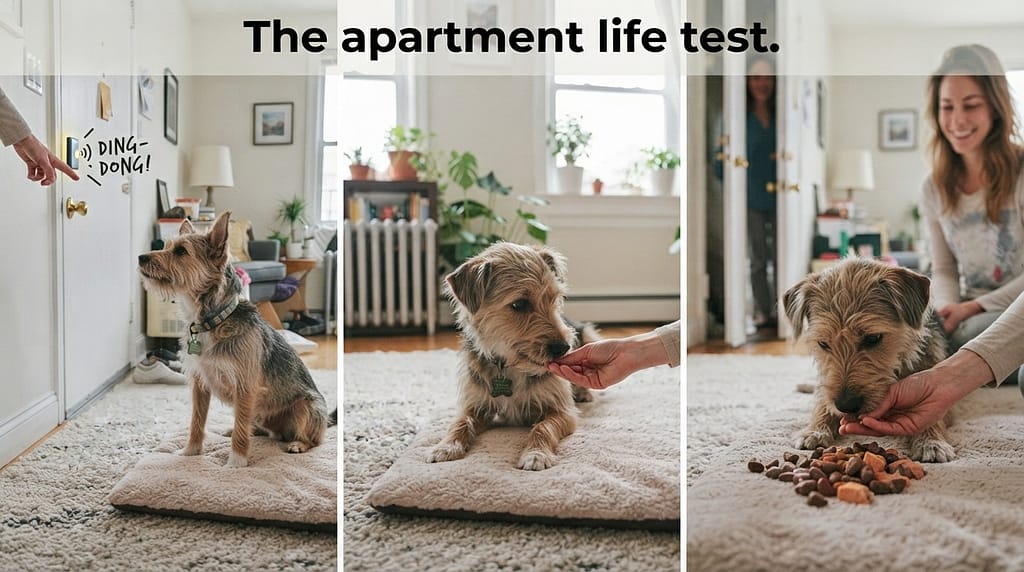
- Week 2 (The “Doorbell” Assault):
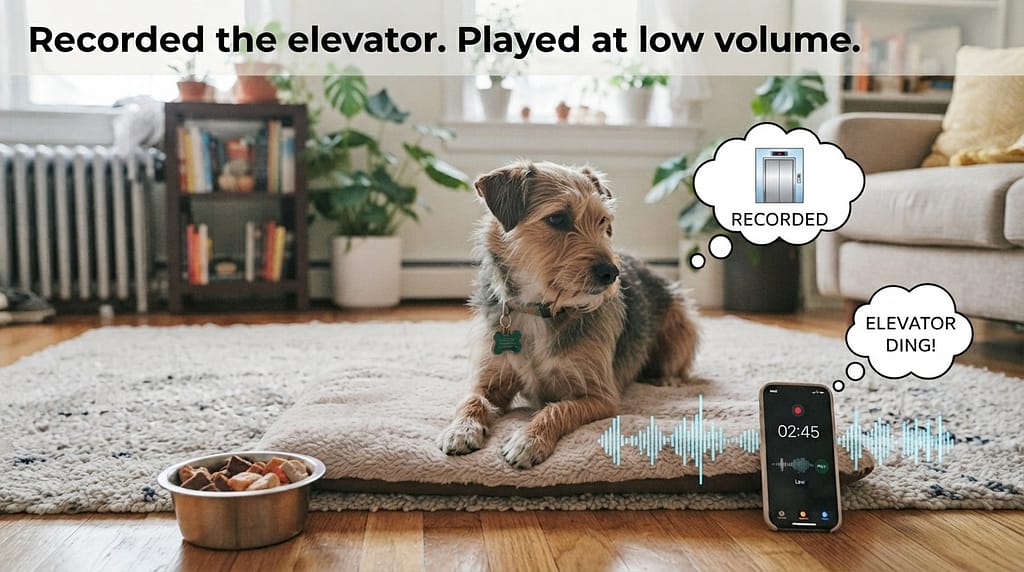
- The “Elevator” Hack: We recorded the sound of our building’s elevator dinging on our phone. We played it at a low volume while training. Over the week, we turned the volume up until it was real-life loud. By the end, the elevator was just “white noise.”
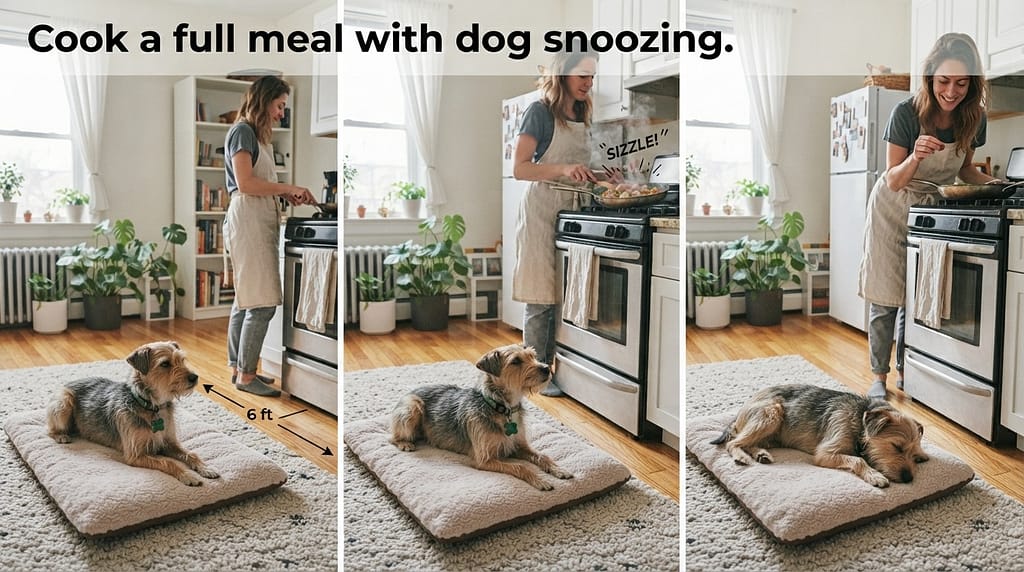
- Week 3 (The “Cook” Challenge):
- Week 4 (The “Out of Sight” Magic):
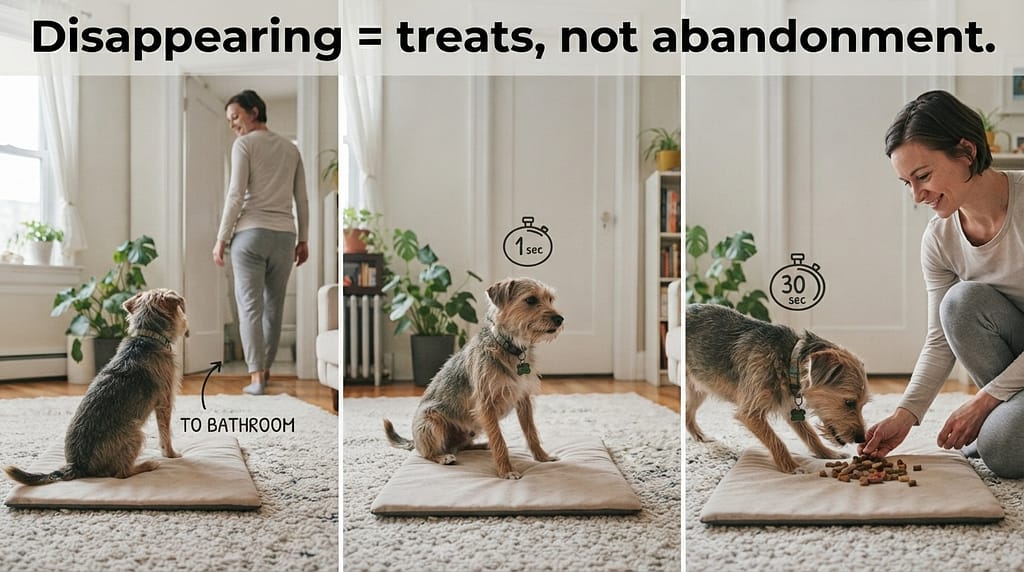
- This teaches them: “Mom disappearing behind the bathroom door = treats, not abandonment.”
The “Apartment” Troubleshooting Guide
Problem: “My dog keeps getting up the second I walk away!”
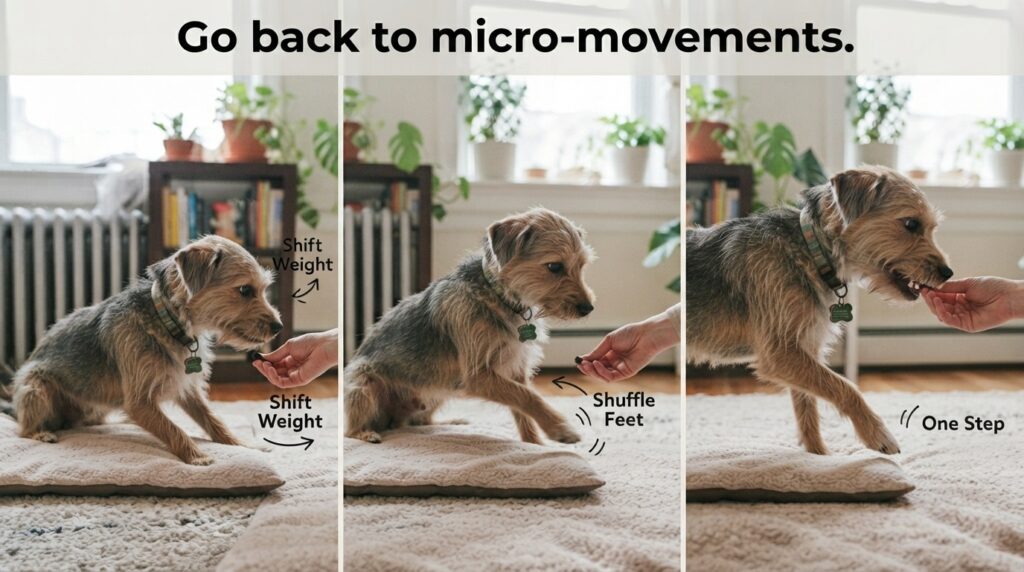
Solution: You moved too fast. Go back to the “Movement” phase. Start by just shifting your weight. Then shuffling your feet. Then taking one step. Break it down into micro-movements.
Problem: “I don’t have a ‘quiet’ time to train because my neighbors are always loud.”
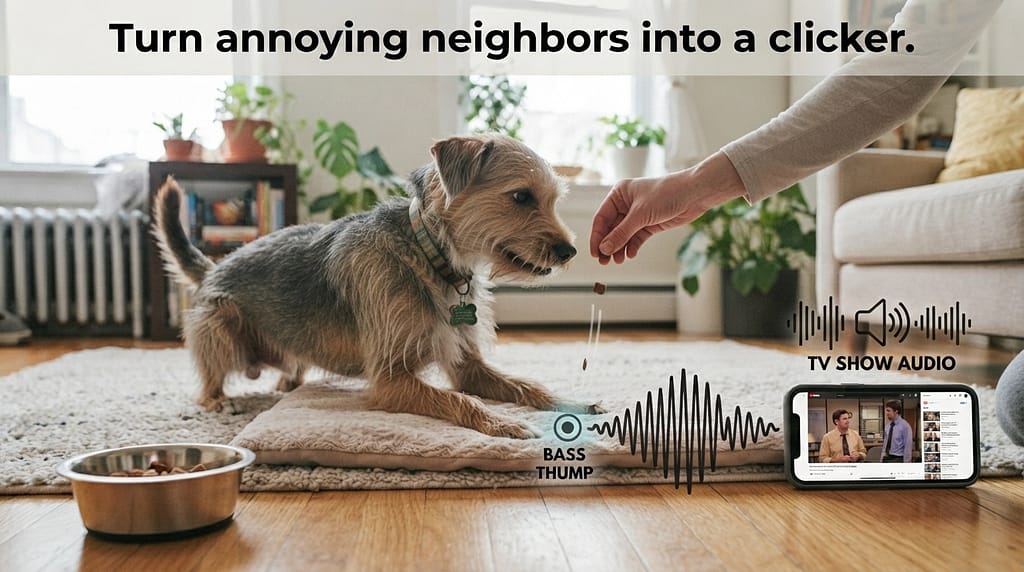
Solution: Use the neighbors! We trained during the neighbor’s TV show. The noise wasn’t an interruption; it was the training prompt. Every time the neighbor’s bass thumped, we treated. We turned an annoying neighbor into a clicker.
Problem: “My dog just falls asleep on the mat. Is that cheating?”
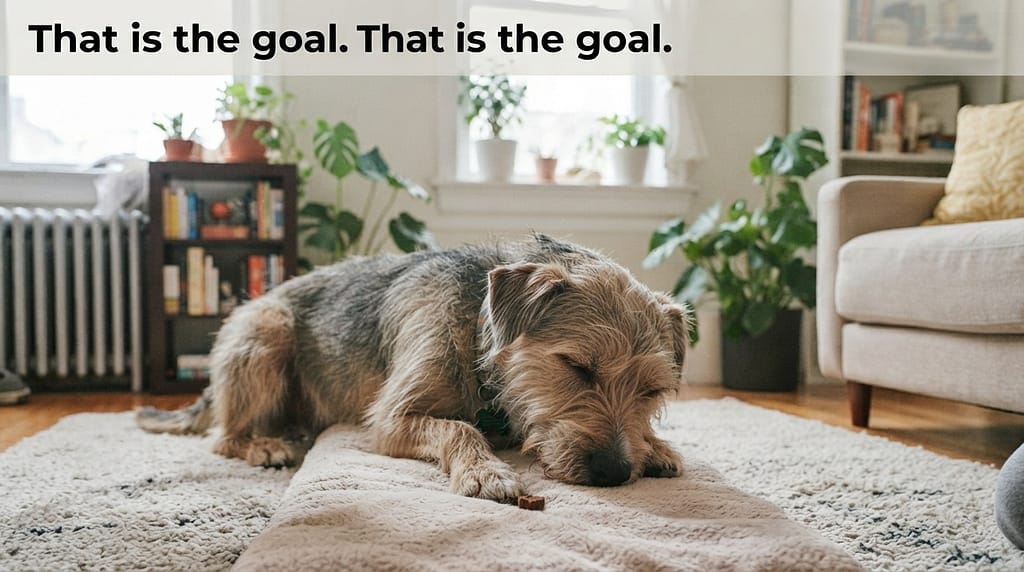
Solution: That is the goal. If they are sleeping, they are relaxed. We still drop a treat between their paws every minute to reinforce the “mat = good” connection. We let sleeping dogs lie—and eat cheese.
Problem: “What if the mat is right next to the front door, and my dog gets scared?”
Solution: Move the mat. If the trigger is too intense, you can’t train. Find a location where your dog is “calm but aware.” If that’s the bathroom, so be it.
The “Do Not” List (We’ve Made These Mistakes)
- Do Not Say “No”: If they get up, you say “Oops” (neutral) and guide them back. “No” creates stress. Stress breaks relaxation.
- Do Not Over-Treat: We know we said 100 treats, but make them pea-sized! We don’t want a chubby dog.
2. Do Not Train When They Are Tired: Train before dinner when they are hungry and eager. A full dog is a sleepy dog, but a hungry dog is a motivated learner.
3. Do Not Expect Overnight Success: The protocol takes about 2 weeks to see major changes. Don’t quit on Day 3.
The “Mat” as a Secret Weapon
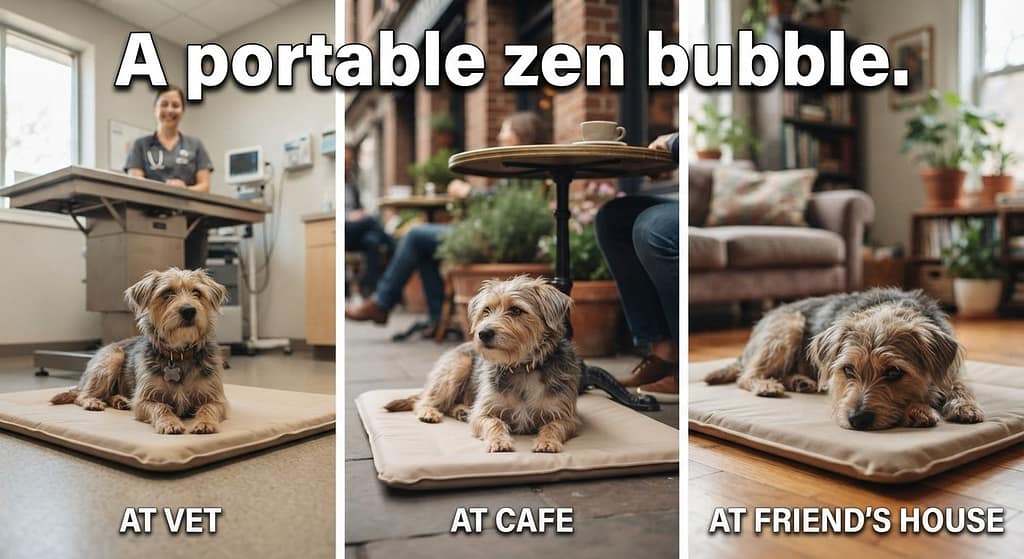
Once your dog has mastered the mat in the apartment, the fun begins. You take the mat everywhere.
- At the Vet: “Stay on the mat” while the vet does their thing.
- At a Cafe: “Stay on the mat” while you sip your latte (this blows other dog owners’ minds).
- At a Friend’s House: “Stay on the mat” instead of investigating the cat.
The mat becomes a “portable zen bubble.” When the world is too scary, they look for the mat. They trust the mat.
The Real-World Scenario: The “Doorbell” Test

Let’s fast forward six weeks.
The doorbell rings. It’s the delivery guy.
But instead of a furry torpedo launching across the studio, your dog lifts their head. They look at the door. They look at you. They look at the mat.
And then? They put their head back down and sigh.
You take the food. You close the door. You walk over and drop a single treat on the mat. They eat it without getting up.
You look at the dog. The dog looks at you. You both know you just won the lottery.
The Final Word: You Deserve Quiet

Look, we know the struggle. We’ve lived it. We’ve had the “barky” phase. We’ve had the “pacing” phase.
We’ve had the “my-neighbor-just-texted-me-again” phase.
But here’s the thing: Your dog isn’t trying to be difficult. They are trying to manage their environment. In a small space, they feel every vibration.
They hear every echo. It’s overwhelming.
The Relaxation Protocol isn’t about controlling your dog. It’s about giving them a safe harbor within the chaos.
It’s a skill—like learning to meditate. And just like humans, some dogs need to be taught how to chill.
You are the teacher. You are the architect of their calm.
Start small. Put down that mat. Toss a treat. Count to one second. Build from there.
Your neighbors will thank you. Your delivery drivers will thank you. And your dog?
Your dog will finally be able to rest.
And that, right there, is the greatest gift of all.
🐾 — Apartment Dog Guide (ADG)
Living large in small spaces, one paw at a time. That’s the apartment dog life—see you in the next guide!.


