
Is this a familiar scene?
You grab the leash, and your dog goes absolutely berserk.
Spinning in circles, barking with glee, a wriggling, whirling dervish of uncontrollable energy.
Then, the moment you step outside, the real work begins.
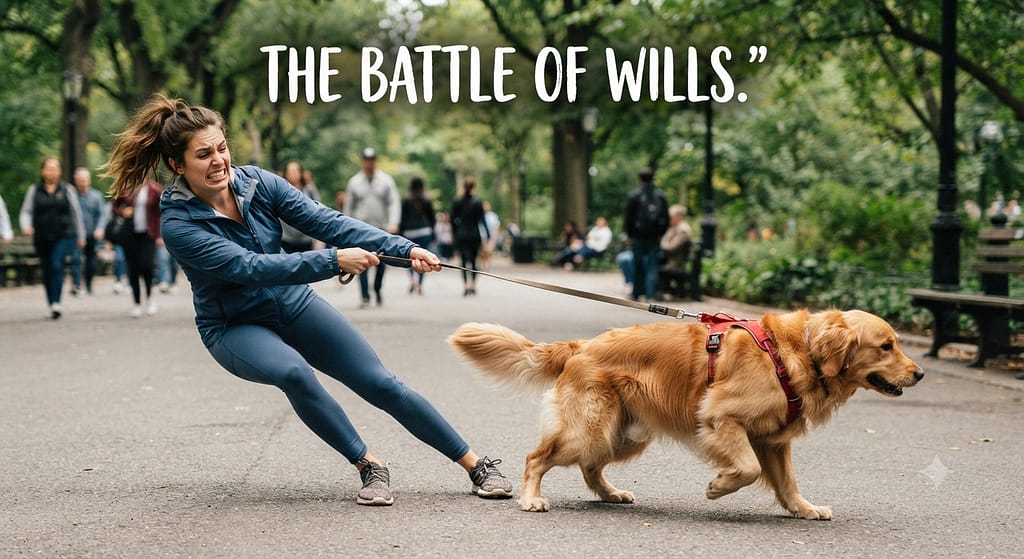
The pulling. The tugging. The sudden stops to sniff every single blade of grass.
Your arm feels like it’s being pulled from its socket, and what should be a pleasant stroll feels more like a grueling battle of wills.
You’re not alone.
And here’s a little secret…
Leash training isn’t about dominating your dog.
It’s about learning a new language together.
It’s about building a partnership where that simple piece of nylon or leather becomes a communication channel, not a restraint.
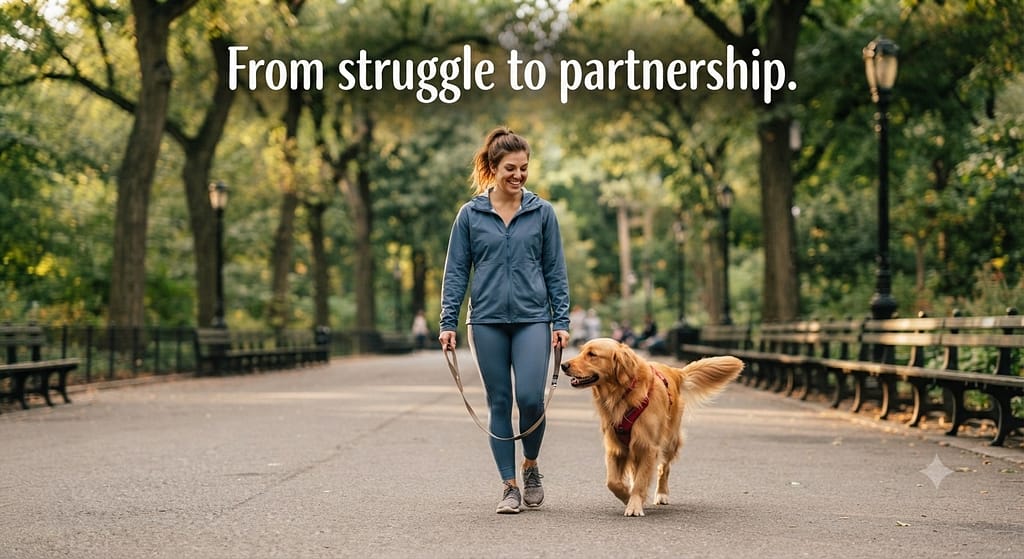
Ready to transform your walks from a stressful chore into the highlight of your day?
Buckle up (and clip that leash on!), because we’re diving into the 5 foolproof steps to master leash training.
This is more than a training guide; it’s a blueprint for a happier, more connected relationship with your furry best friend.
Step 1: Master the Pre-Walk Mindset & Gear Up for Success
Before we even think about stepping out the door, we need to set the stage for success.
This all begins long before the leash is clipped.
Think about it this way…
You wouldn’t run a marathon without a little stretching and the right shoes, would you?
The same logic applies to leash training. The “pre-walk” is where 50% of the battle is won.
The Calm Before the Walk: Taming the Pre-Walk Frenzy
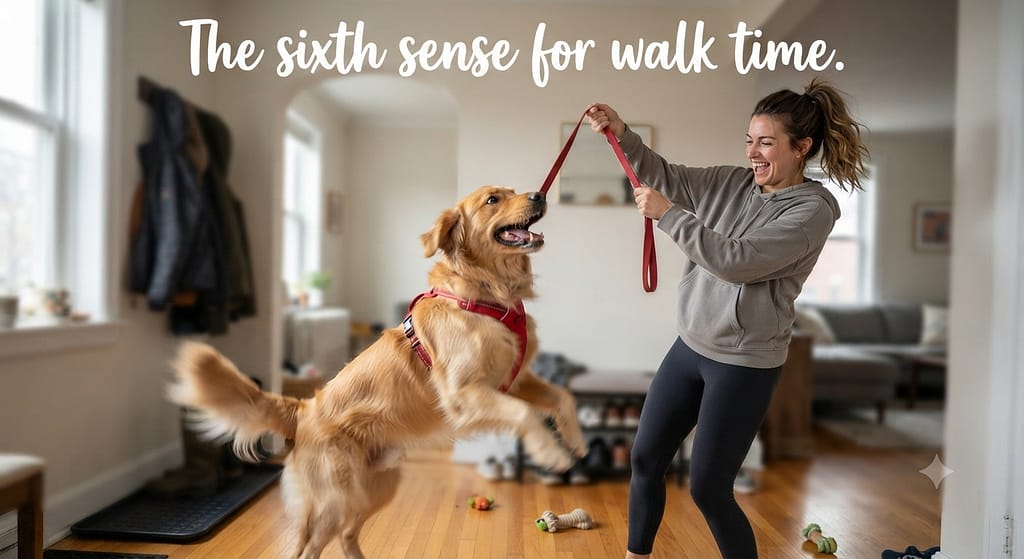
Your dog has a sixth sense for walk time.
The jingle of the leash keys sends them into a euphoric state. But here’s the problem…
If you clip the leash on while they’re in this hyper-aroused state, you’re essentially rewarding that crazed behavior.
You’re telling them, “Yes! This is exactly how you should act when it’s walk time!”
So, what do we do?
We become a bastion of calm.
- Ignore the Excitement: The moment your dog starts jumping and whining, become a tree. Cross your arms, look away, and do nothing. No talking, no touching, no eye contact.
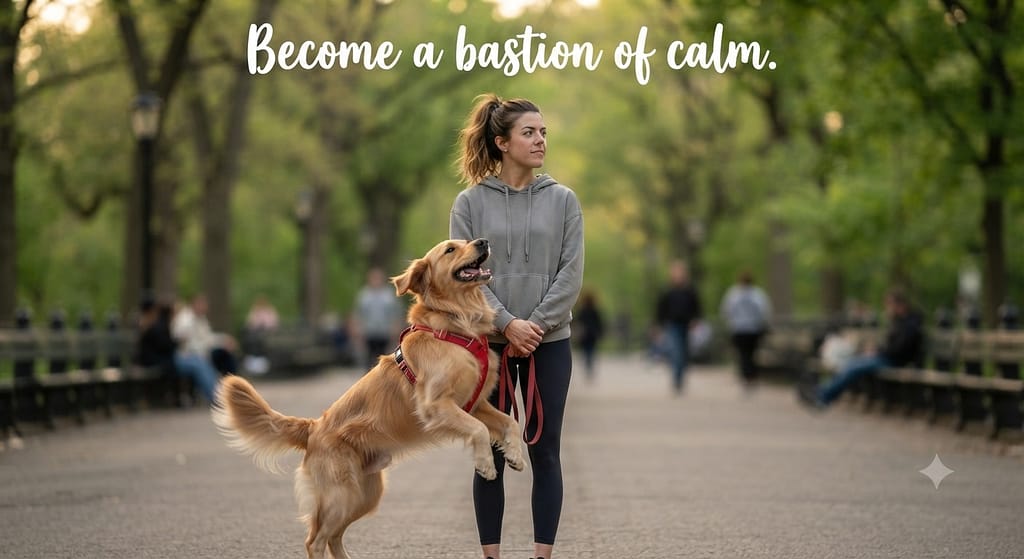
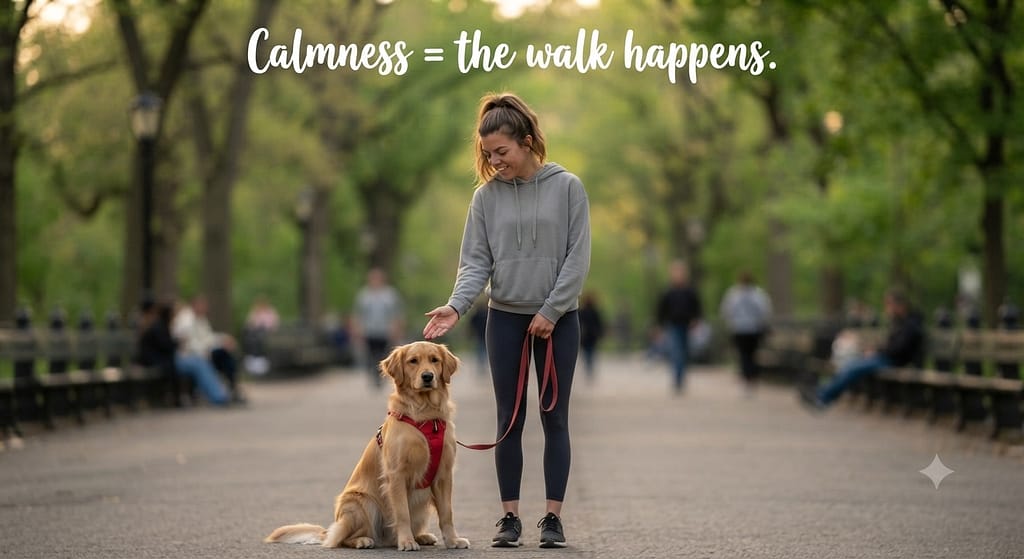
- The “Sit to Say Please” Rule: Ask your dog for a simple, calm behavior like a “sit” or a “down.” Only when they are calm and compliant do you reach for the leash and clip it on. You are teaching them that calmness, not chaos, is what makes the walk happen.
Which leads me to my next point…
Choosing Your Weapons: A Guide to Leashes and Harnesses
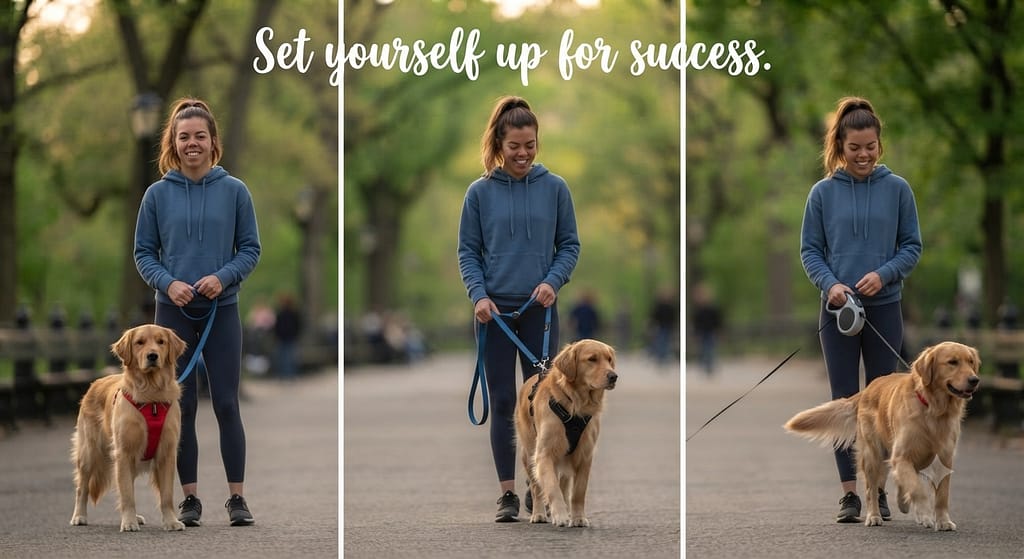
The gear you use makes a massive difference. Let’s break it down.
- The Standard Leash: A 4- to 6-foot nylon or leather leash is your best bet. Avoid retractable leashes for training. Why? They teach your dog that tension on the leash is normal and rewarding (they get to go further!). We want to teach the exact opposite.
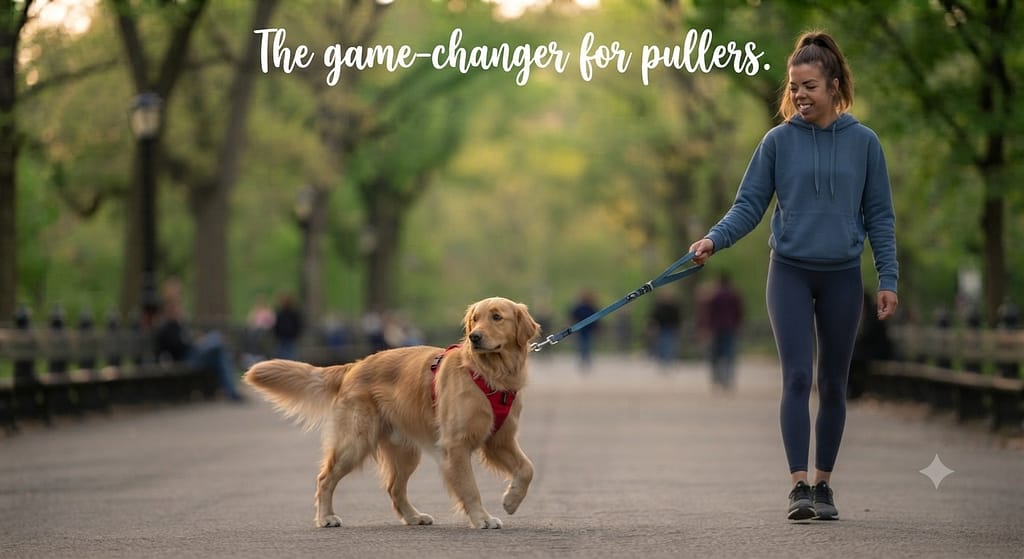
- The Collar vs. Harness Debate: For most dogs, especially pullers, a front-clip harness is a game-changer.
- Back-Clip Harness: Great for trained dogs, but can actually encourage pulling (think of a sled dog!).
- Front-Clip Harness: When your dog pulls, the front-clip gently turns their chest back towards you, naturally discouraging the forward momentum. It’s a subtle, humane, and highly effective tool.
- Head Halters: These are like a halter for a horse and offer a high level of control for extremely strong dogs, but they require a slow, positive introduction.
Your Interactive Task:
Take a look at your current walking gear. Is it setting you up for success?
If you’re using a retractable leash or a back-clip harness on a puller, consider making a small investment in a front-clip harness.
It might just be the single biggest change you make.
Now that we’ve cultivated calm and geared up correctly…
Are you ready to build the very foundation of your communication?
Let’s talk about the most important skill of all.
Step 2: Become the “Sun” – Teaching Loose Leash Walking
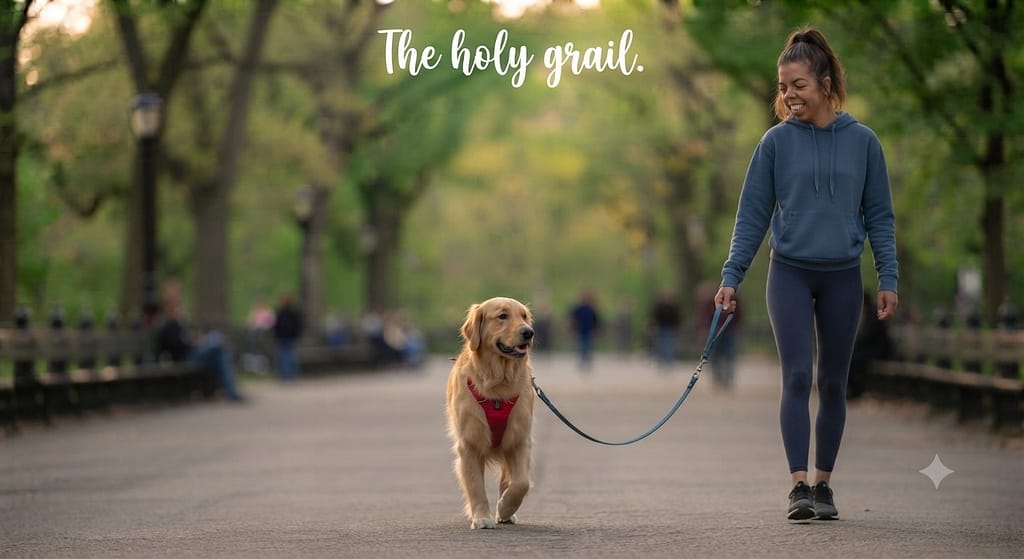
This is the core of it all. The holy grail. Loose Leash Walking.
The goal is simple: your dog walks with a nice, relaxed “J” shape on the leash, with neither of you applying any pressure.
But how do we communicate this complex idea?
We make ourselves the most interesting thing in their world.
The Magnet Game: Be More Fun Than a Fire Hydrant
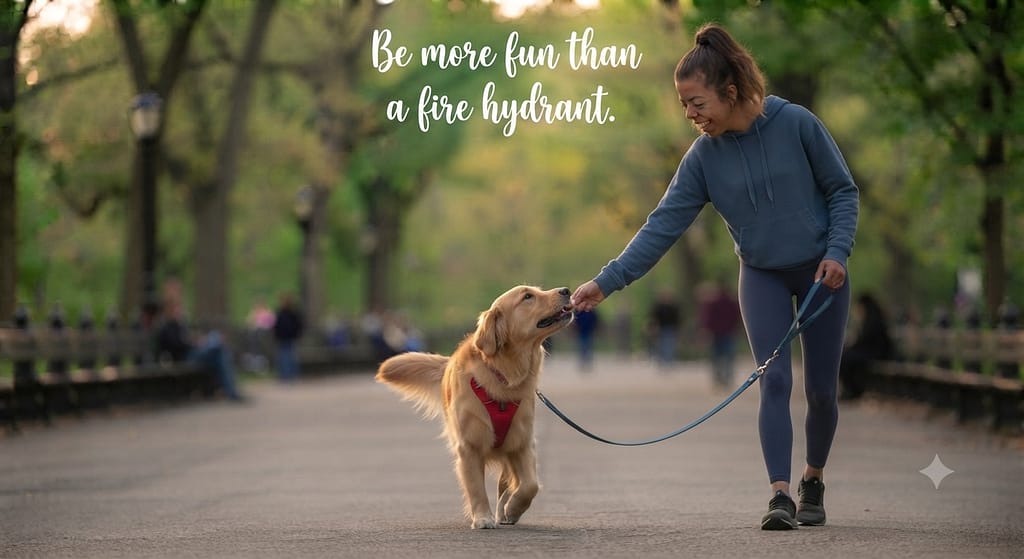
Dogs pull because they want to get to something fascinating—a smell, another dog, a tree.
Our job is to flip the script and make staying near us the most rewarding choice.
Here’s how you play:
- Start in a low-distraction environment like your living room or backyard. Have a pocket full of high-value treats (think small pieces of chicken, cheese, or hot dog—something they love).
- Take one step. If your dog stays with you without pulling, immediately mark the behavior with a “Yes!” or a clicker, and give them a treat.
- Become unpredictable. Change direction. Stop suddenly. Walk in a circle. The moment your dog chooses to follow you and re-engage, MARK and REWARD!
You are teaching them a vital lesson: Paying attention to you is a fun and profitable game.
But what about when they pull?
The “Tree” Method: Making a Pulling a Dead End
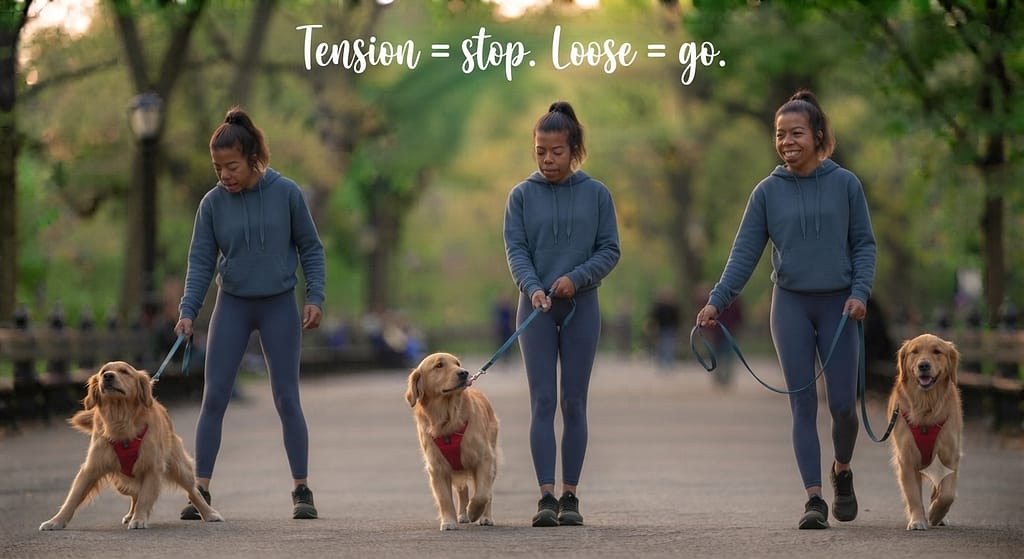
This is the single most powerful technique for eliminating pulling.
And it requires immense patience.
The rule is simple: Tension on the leash = we stop moving. A loose leash = we move forward.
- The moment your dog hits the end of the leash and creates tension, you become a TREE. Plant your feet. Stop moving. Do not pull back, just hold steady.
- You can make a gentle noise to get their attention, but do not yank, jerk, or plead.
- Wait. They will eventually stop straining, take a step back, or look back at you. The microsecond the leash goes slack, MARK that moment with a “Yes!” and take a step forward, rewarding them with the continuation of the walk.
It will feel tedious at first.
You might only make it ten feet in ten minutes.
But you are programming a fundamental law of physics into your dog’s brain: Pulling makes the world stop. A loose leash makes the world go.
Let me ask you a question…
What’s the one thing that’s even more powerful than a treat?
The answer might surprise you.
Step 3: Master the Art of the Reward (It’s Not Just About Treats!)
We’ve mentioned treats a lot, but reward-based training is a nuanced art.
If you rely on treats alone, you’ll end up with a dog who only listens when you have food in your hand.
We want a dog who listens because the partnership itself is rewarding.
Building a “Reward Bank”
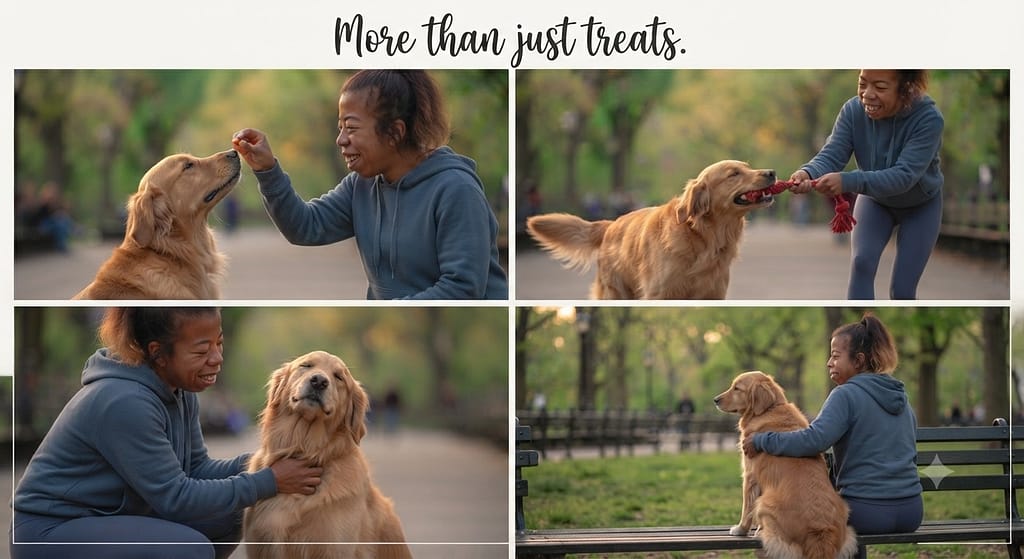
Think of your dog’s motivation like a bank account.
You need to make lots of deposits so you can make occasional withdrawals.
- Primary Reinforcers: These are the big ones—food, play, and affection. Use a mix!
- Food: High-value for high-distraction environments, lower-value for easy tasks.
- Play: A quick game of tug or a thrown ball can be an explosive reward for a high-energy dog.
- Affection: For some dogs, a “Good boy!” and a chest scratch are pure gold.
- Life Rewards (The Secret Sauce): This is the most powerful concept in modern dog training. The world itself is the reward.
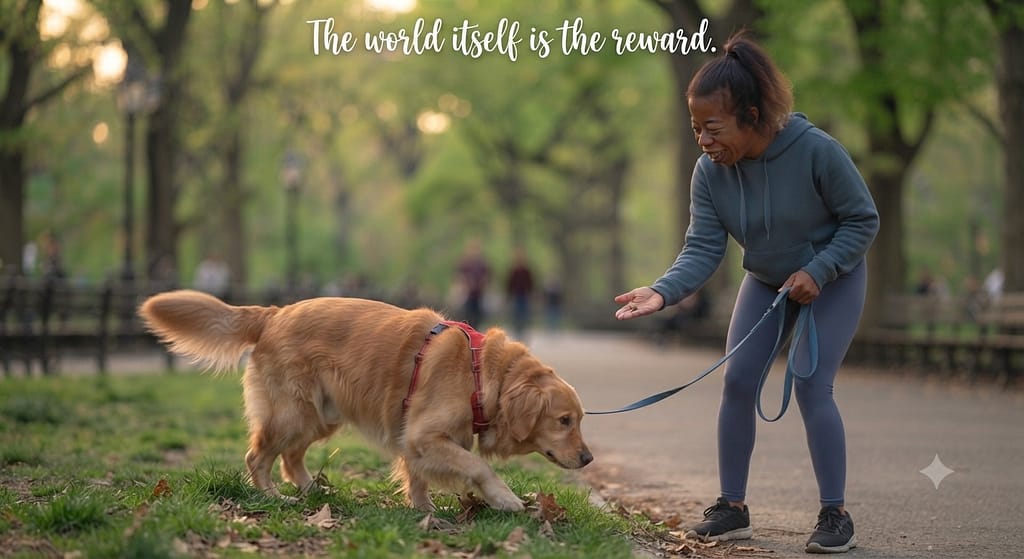
- You want to sniff that bush? Okay! But first, I need a “sit.” It happens. “Yes!” You release them to go sniff. The sniffing is the reward.
- Do you want to greet that friendly person? Okay! But first, a “look at me.” They look at you. “Yes!” You release them to go say hello. Social interaction is the reward.
By using “life rewards,” you are teaching your dog that cooperating with you is what gives them access to all the wonderful things the world has to offer.
But wait…
What about when the world gets a little too wonderful?
When are distractions high?
Let’s talk about that.
Step 4: Conquer the Great Outdoors – Proofing Against Distractions
Your dog might be a leash-walking prodigy in your quiet living room.
But the real world is a carnival of distractions.
We can’t expect perfection immediately. We need to build up slowly.
This is called proofing.
The Distraction Ladder: Climbing One Step at a Time
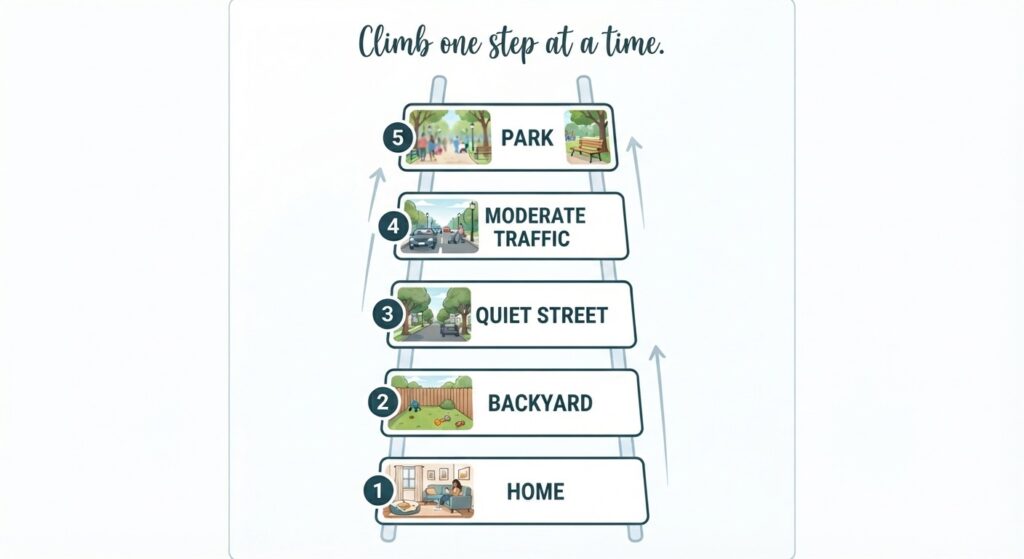
You wouldn’t try to bench press 300 pounds on your first day at the gym.
You start with the bar. The same goes for training.
- Start at the Bottom: Master the skill in your home (no distractions).
- Add a Mild Distraction: Practice in your backyard.
- Move to a Low-Traffic Area: A quiet street early in the morning.
- Graduate to a Moderate Distraction: A busier sidewalk, but at a less busy time.
- The Ultimate Test: A park with other dogs, squirrels, and people.
At each new level, you may need to go back to using higher-value treats and being more generous with your rewards.
If your dog fails at a new level, don’t get frustrated. It just means you moved too high, too fast.
Take a step back down the ladder to a level where they can succeed and rebuild their confidence.
The “Engage-Disengage” Game for Reactivity
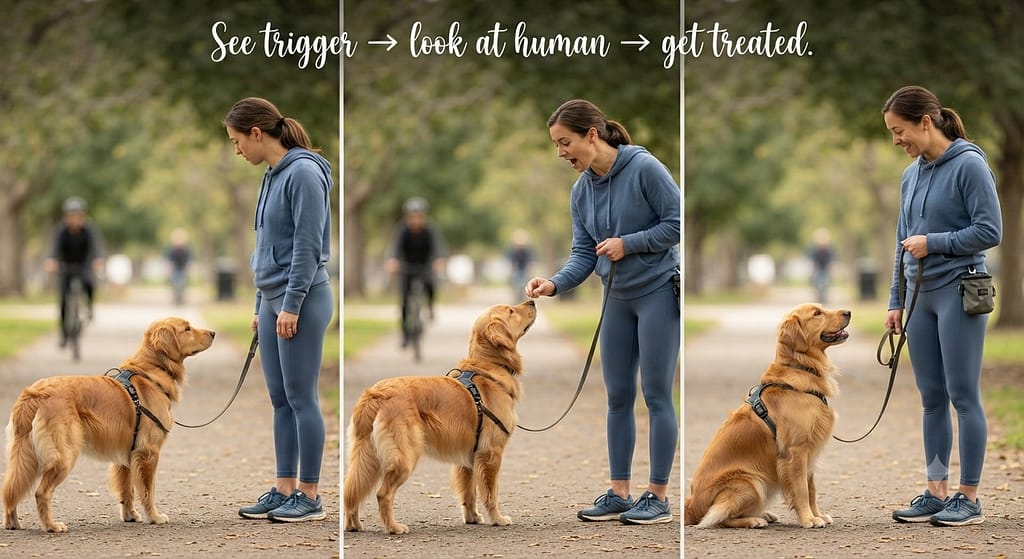
Does your dog bark, lunge, or freeze at other dogs, bikes, or people? This is a common challenge, and it often stems from fear or frustration.
The “Engage-Disengage” game is your best friend here.
- Find a distance from the trigger (e.g., another dog) where your dog notices it but does not react. This is called the “threshold” distance.
- The moment your dog looks at the trigger, mark it with a “Yes!” and give a treat. You are teaching them: “Seeing that scary/frustrating thing makes good things happen.” This is the “Engage” part.
- After several repetitions, you might notice your dog looking at the trigger and then immediately looking back at you, as if to say, “Hey, I saw the thing, where’s my treat?” THIS IS THE GOLDEN MOMENT.
- The moment they choose to disengage from the trigger and look at you, you mark and reward with a jackpot (several treats in a row)!
This game changes your dog’s emotional response from “Oh no, a dog!” to “Oh boy, a dog! That means chicken is coming!”
Now, let’s address the elephant in the room…
What do you do when it all falls apart?
Step 5: Troubleshooting & Maintaining Your Leash-Walking Zen
You’re going to have bad days. Your dog will have regressions.
This is normal. The key is not to aim for perfection, but for consistent progress.
Common Problems & Solutions

- “My dog is a sniffing machine!” Remember the “life rewards.” Let them sniff! Use it. Ask for a “heel” or a “let’s go” for 20 feet, then release them with a “Go sniff!” command. They learn that structured walking earns them free time.
- “He just doesn’t listen when we’re outside.” This means the environment is still too distracting. Go back to Step 4 and work at an easier level. You may also need to up your treat value—outside is where the real steak (or cheese) comes out!
- “The ‘Tree’ method doesn’t work—he just pulls harder!” Are you being consistent? Every single time? Also, try combining it with an 180-degree turn. The moment they pull, you cheerfully say “Let’s go!” and turn and walk the other way. This makes pulling a dead-end and removes them from what they wanted.
The Power of “Practice Walks” vs. “Potty Walks”
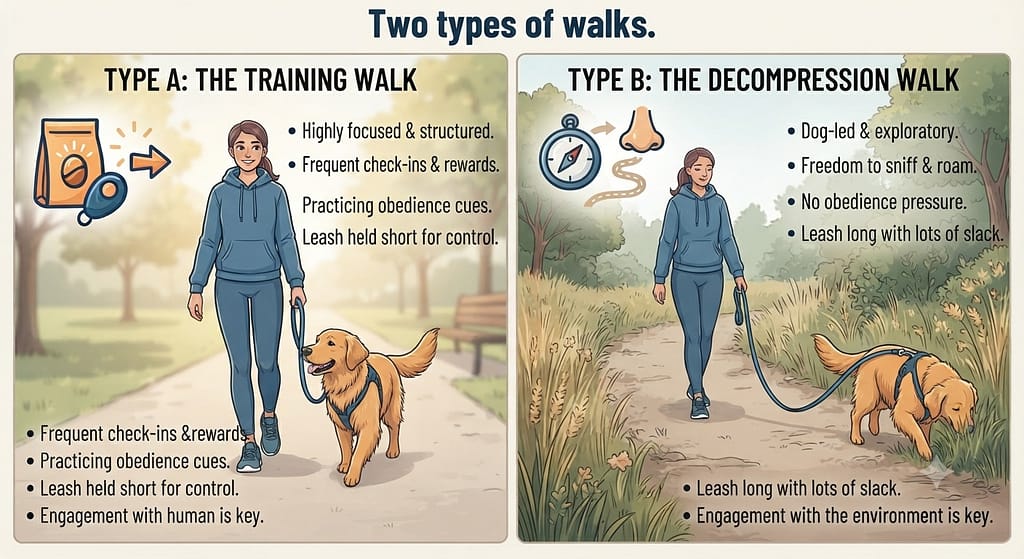
This is a mindset shift that will save your sanity.
Separate your walks into two types:
- Training Walks: Short (10-15 minutes), focused, and highly rewarding. You have your treat pouch, and you are actively practicing the skills. The goal is learning.
- Potty/Decompression Walks: Longer, more relaxed. Use a longer leash if possible in a safe area. Let your dog sniff and explore to their heart’s content. The goal is mental stimulation and exercise.
By making this distinction, you avoid the frustration of feeling like you have to be “on” every single time you leave the house.
Your Journey to Loose Leash Freedom Starts Now
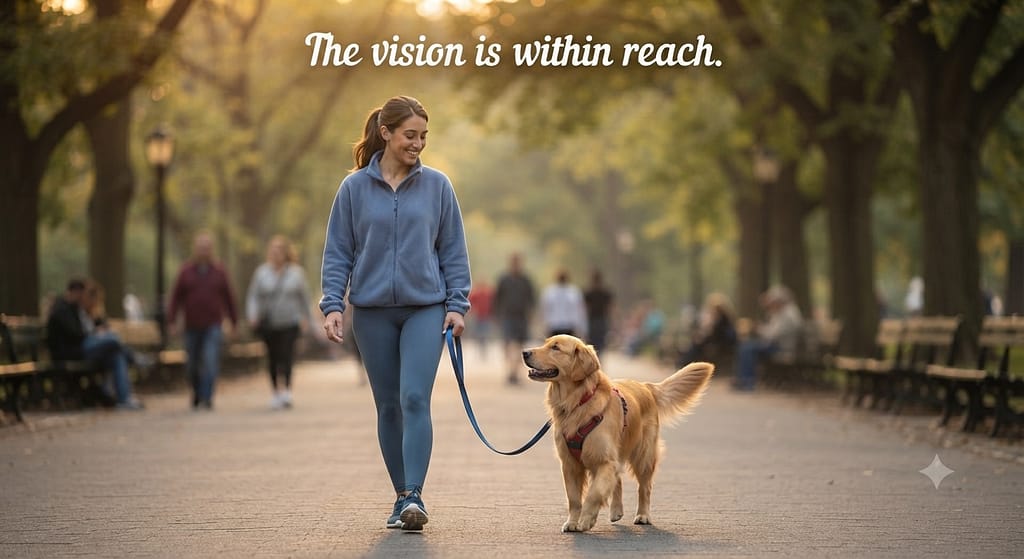
Look back at that frantic, pull-happy dog from the beginning of our journey.
See them now?
Walking calmly by your side, occasionally glancing up to check in with you.
The leash hangs in a soft curve, a mere symbol of your connection, not a tool of restraint.
That vision is absolutely within your reach.
Leash training is not a one-week fix. It’s a journey of building trust, communication, and mutual understanding.
There will be setbacks, but there will also be moments of brilliant, joyful success that make it all worthwhile.
Your Final Interactive Mission:
- Gear Check: Go assess your leash and harness. Make a change if needed.
- Mindset Shift: Before your next walk, take 30 seconds to breathe and embody calmness. Your dog will feel it.
- Start Small: Don’t try to do all five steps at once. Pick one thing—maybe the “Tree” method for the first five minutes of your walk—and master it.
You have the map. You have the tools.
The path to peaceful, joyful walks is right there, waiting for you to take the first step.
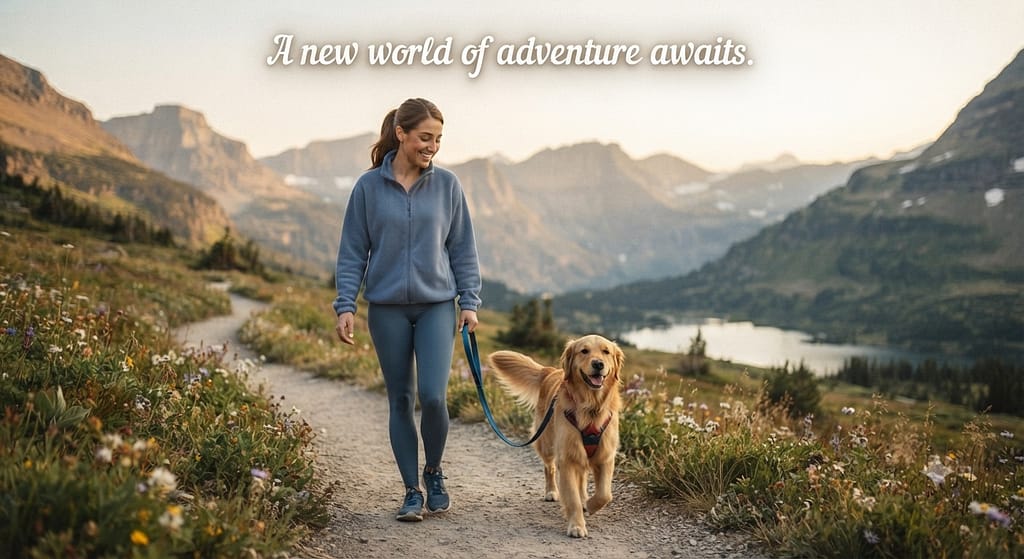
Now, go clip on that leash with confidence. A whole new world of adventure with your best friend is just outside your door.
🐾 — Apartment Dog Guide (ADG)
Living large in small spaces, one paw at a time. That’s the apartment dog life—see you in the next guide!.